

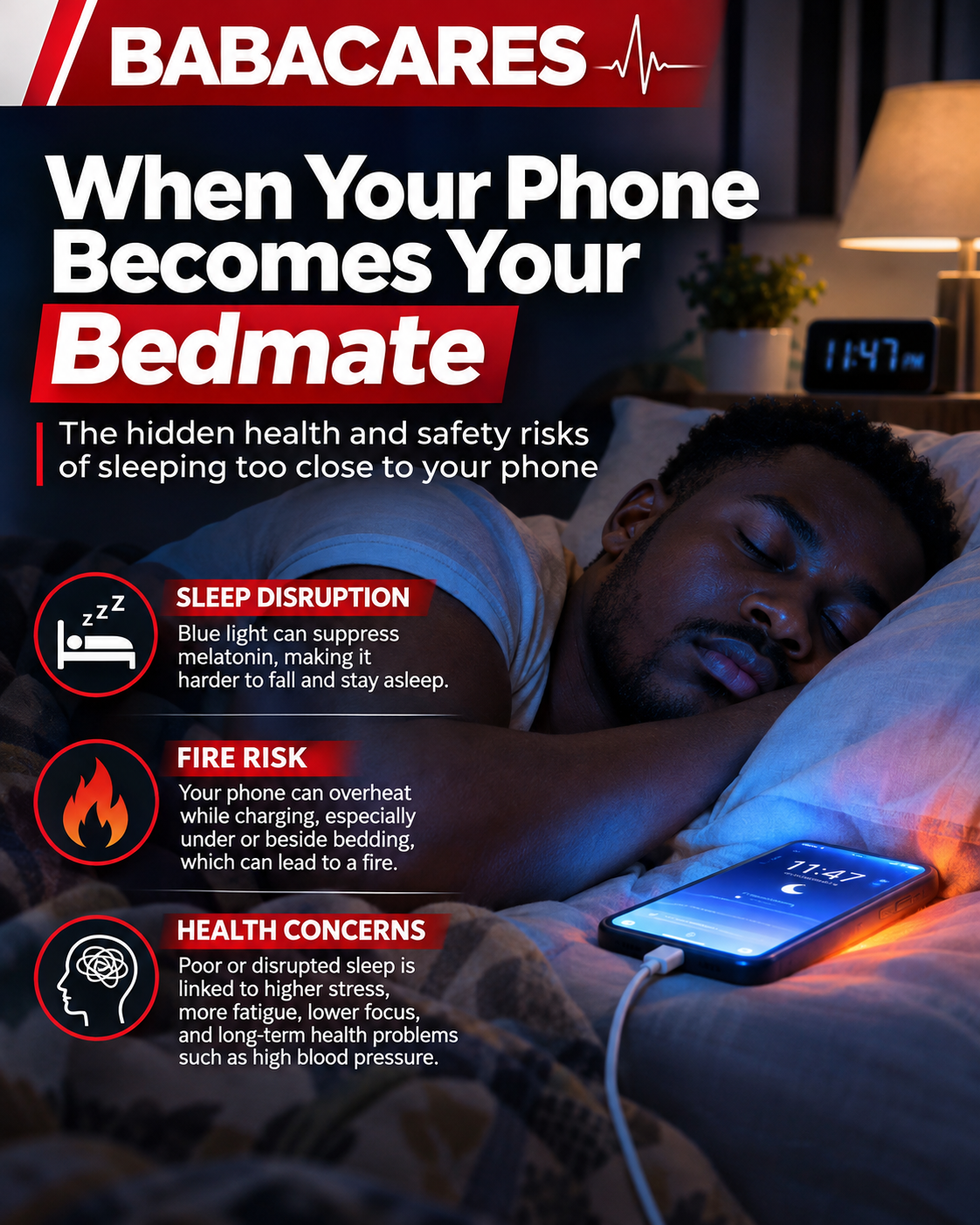
When Your Phone Becomes Your Bedmate: The Hidden Health and Safety Risks of a Digital Habit.
By Babajide Moronfolu | Babacares
It is almost midnight. You have finished scrolling through Facebook, responding to WhatsApp messages and watching videos on TikTok. You plug your phone into a charger, place it beside your pillow and drift off to sleep.
For millions of people around the world, this has become a nightly ritual. But could this seemingly harmless habit be putting our health and safety at risk?
From disrupted sleep and emotional stress to battery fires and interference with implanted medical devices, sharing our sleeping space with smartphones deserves greater attention.
When technology steals your sleep
The human body requires adequate sleep to repair tissues, regulate hormones, strengthen immunity and maintain healthy brain function.
Exposure to smartphone screens before bedtime can suppress melatonin, the hormone responsible for regulating our sleep-wake cycle. Notifications, incoming messages and the temptation to check social media can further interrupt quality sleep.
Over time, persistent sleep deprivation is associated with an increased risk of:
-
High blood pressure and cardiovascular disease.
-
Type 2 diabetes and obesity.
-
Anxiety and depression.
-
Poor memory and concentration.
-
Impaired immune function.
-
Fatigue and reduced productivity.
The US Centers for Disease Control and Prevention (CDC) recommends turning off electronic devices at least 30 minutes before bedtime.
These health risks are associated with inadequate sleep, rather than simply having a phone nearby.
A potential fire hazard beneath your pillow
Perhaps one of the most overlooked dangers is charging a mobile phone underneath a pillow, blanket or on a mattress.
Smartphones contain lithium-ion batteries that can overheat, particularly when damaged, defective or connected to unsuitable chargers.
Bedding can trap heat and prevent adequate ventilation, increasing the risk of overheating.
A battery fire occurring while someone is asleep could result in severe burns, smoke inhalation, property destruction and even death.
Fire safety authorities warn against charging electronic devices on beds, couches or other soft surfaces.
Your pillow was designed to support your head, not to serve as a charging station.
Mobile phone radiation: Separating fear from scientific evidence
Concerns about sleeping close to mobile phones frequently centre on radiation exposure.
Mobile phones emit radiofrequency electromagnetic energy, a form of non-ionising radiation that differs from the ionising radiation associated with X-rays.
According to Health Canada, current scientific evidence does not establish adverse health effects from radiofrequency exposure within approved safety limits.
Claims that sleeping beside a mobile phone causes brain cancer, infertility or permanent brain damage have not been conclusively established.
While unnecessary fear should be avoided, keeping your phone some distance away remains a reasonable personal precaution.
A special warning for people with heart conditions
Individuals with pacemakers and implanted cardiac defibrillators should pay particular attention to where they place their smartphones.
Some modern phones contain powerful magnets capable of interfering with implanted medical devices.
The US Food and Drug Administration (FDA) and Nigeria's National Agency for Food and Drug Administration and Control (NAFDAC) recommend maintaining a distance of at least 15 centimetres (six inches) between such electronic devices and implanted medical devices.
Sleeping with a phone on your chest is particularly inadvisable if you have one of these implants.
Is your phone robbing you of your peace of mind?
The dangers are not entirely physical.
Constant exposure to disturbing news, social media arguments, financial worries and work-related messages can make it difficult for the mind to relax before sleep.
For some individuals, the fear of missing messages or online developments creates an unhealthy dependence on their phones.
We have gradually transformed our bedrooms from places of relaxation into extensions of our offices, newsrooms and social networks.
How to protect yourself and your family
-
Never sleep with a charging phone under your pillow.
-
Avoid charging your phone on your mattress.
-
Use certified, manufacturer-approved chargers.
-
Replace damaged cables and swollen batteries.
-
Keep your phone on a hard, well-ventilated surface.
-
Switch off electronic screens at least 30 minutes before sleeping.
-
Activate the Do Not Disturb feature while allowing essential emergency calls.
-
Consider keeping your phone approximately one metre away from your bed to reduce distractions. This is a practical suggestion, not a medically established radiation safety requirement.
-
Teach children healthy digital bedtime habits.
-
Install functional smoke alarms in your home.
Babacares' Perspective
The smartphone has become our companion, office, entertainment centre, banking hall and window to the world. But should it also become our bedmate?
Technology should serve humanity, not undermine our well-being.
Although some fears surrounding mobile phone radiation remain scientifically unsubstantiated, the established risks of sleep disruption, battery fires and interference with implanted medical devices should not be ignored.
Tonight, before you retire to bed, consider giving your phone its own resting place.
Recharge your phone safely, but more importantly, allow your body and mind to recharge peacefully.
Your messages can wait until morning. Your health and safety cannot.
References and further reading
Read more on Babacares.com, subscribe and share.
#Babacares #DigitalWellness #MobilePhoneSafety #SleepHealth #PublicHealth #HealthyLiving #FireSafety #HealthAwareness
https://www.babacares.com/blog-details?details=1190&title=When+Your+Phone+Becomes+Your+Bedmate%3A+The+Hidden+Health+and+Safety+Risks+of+a+Digital+Habit










Comments