

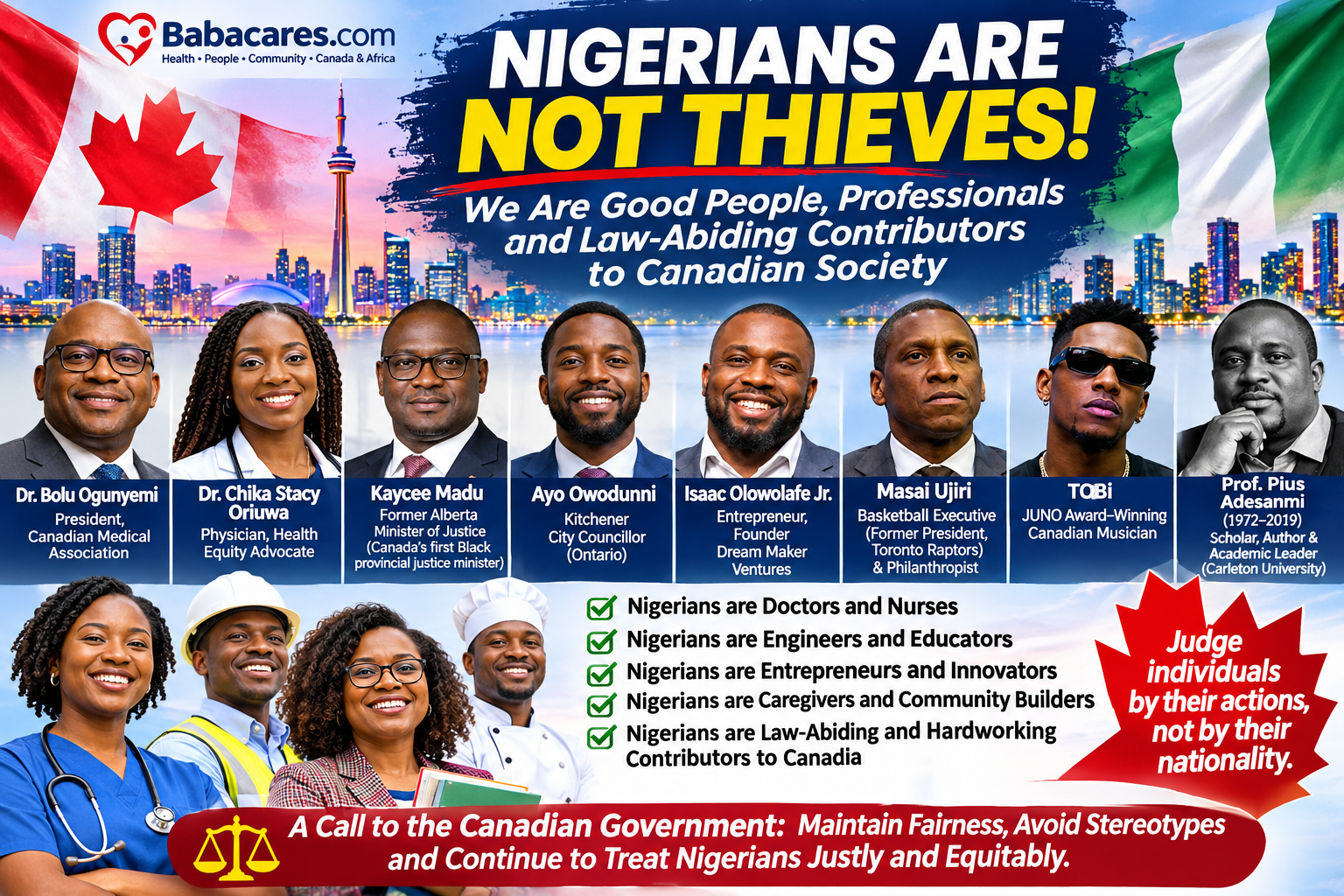
NIGERIANS ARE NOT THIEVES: We Are Professionals, Nation Builders and Law-Abiding Contributors to Canadian Society
An appeal to Canadian authorities: Judge individuals by their actions, not by their nationality.
By Babajide Moronfolu | Babacares.com
The arrest of several individuals reportedly identified as Nigerians in connection with a multimillion-dollar vehicle theft investigation in Ontario has once again brought an uncomfortable question to the forefront: Should an entire nationality be judged by the alleged criminal actions of a few individuals?
The answer must be an emphatic no.
Nigerians are not a nation of thieves. We are a people of diverse backgrounds, talents, professions, beliefs and achievements. Millions of Nigerians are committed to honesty, education, hard work, family values and respect for the laws of the countries where they live.
From hospitals and universities to businesses, government institutions and community organizations, Nigerians have contributed significantly to Canadian society.
These contributions deserve recognition, particularly at a time when negative headlines threaten to overshadow the achievements of hardworking, law-abiding Nigerian Canadians.
Criminal allegations must not become a national identity
On November 16, 2026, Peel Regional Police announced the results of Project Cadetta, an investigation into an alleged organized vehicle theft and export operation.
Twelve individuals were charged, with 96 vehicles valued at approximately $4.5 million recovered. Nigerian media outlets reported that eight of those charged were Nigerians.
These allegations are serious, and the victims deserve justice.
However, an arrest is not a conviction, and those accused are entitled to the presumption of innocence.
If any individuals are ultimately found guilty, they should face the consequences provided by Canadian law.
But justice must remain individual.
It would be unfair and damaging to extend suspicion to Nigerian students, healthcare professionals, entrepreneurs, families and other residents who have no connection whatsoever to the alleged crimes.
Nigerians living in Canada should not have to defend their integrity every time someone with a Nigerian name appears in a criminal investigation.
Nigerians who have made remarkable contributions to Canada
Canada has benefited from the knowledge, skills, creativity and leadership of many people of Nigerian origin and heritage.
Their stories demonstrate that Nigerian identity is also associated with excellence, innovation, public service and meaningful contributions to society.
1. Dr. Bolu Ogunyemi — President, Canadian Medical Association
Nigerian-born dermatologist and professor at Memorial University, Dr. Ogunyemi became president of the Canadian Medical Association in May 2026, making history as the organization's first Black physician president. His leadership represents a remarkable achievement within Canadian healthcare.
2. Dr. Chika Stacy Oriuwa — Physician and Health Equity Advocate
Born in Canada to Nigerian immigrant parents, Dr. Oriuwa became the first Black woman to serve as sole valedictorian of the University of Toronto's Faculty of Medicine. She has also been recognized for her advocacy concerning racial equity and mental health.
3. Kaycee Madu — Former Alberta Minister of Justice
Born in Nigeria, Madu became Canada's first Black provincial justice minister in 2020. His appointment was a historic milestone in political representation, although his later public and professional record also attracted controversy.
4. Ayo Owodunni — Municipal Leadership in Ontario
Nigerian-born Owodunni made history in 2022 by becoming the first Black person elected to Kitchener City Council. His journey illustrates how immigrants can contribute through democratic participation and community leadership.
5. Isaac Olowolafe Jr. — Entrepreneur and Philanthropist
Born in Ibadan, Nigeria, Olowolafe became a successful Canadian entrepreneur and founder of Dream Maker Ventures. His contributions include investments in businesses, support for underrepresented entrepreneurs and an educational endowment at the University of Toronto.
6. Masai Ujiri — Basketball Executive and Philanthropist
Raised in Nigeria, Ujiri helped build the Toronto Raptors team that won the 2019 NBA championship. Through Giants of Africa, he has also supported youth development and leadership opportunities. His success illustrates Nigerian influence in Canada's sporting history.
7. TOBi — Award-Winning Canadian Musician
Born in Lagos and raised in Brampton, TOBi, whose full name is Oluwatobi Feyisara Ajibolade, has won multiple JUNO Awards. He is among the Nigerian-born artists helping shape contemporary Canadian music and cultural expression.
8. Professor Pius Adesanmi (1972–2019) — Academic and Public Intellectual
The late Nigerian-born scholar served as a professor at Carleton University and directed its Institute of African Studies. His work strengthened scholarship, literary discourse and international understanding of African societies.
Institute of African Studies+1
These are just a few examples.
Beyond prominent personalities are thousands of other Nigerian Canadians whose contributions rarely make newspaper headlines: nurses caring for patients, Personal Support Workers assisting older adults, teachers educating children, engineers developing infrastructure, social workers supporting vulnerable families, and entrepreneurs creating employment opportunities.
Their contributions are no less important simply because their names are not famous.
An appeal to the Government of Canada: Do not punish a community for the actions of individuals
Canada has built an international reputation as a country that values multiculturalism, diversity, fairness and the rule of law.
These values must remain central to how criminal allegations involving members of immigrant communities are addressed.
Section 15 of the Canadian Charter of Rights and Freedoms guarantees equality before and under the law, including protection against discrimination based on national or ethnic origin, subject to the Charter's legal framework.
Canada
Babacares therefore appeals to Canadian authorities to ensure that investigations, security measures and immigration decisions are guided by evidence, individual circumstances and established legal procedures.
We are not suggesting that the Canadian government has announced new restrictions against Nigerians in response to Project Cadetta. No such announcement has been established in the evidence reviewed for this article.
Nevertheless, we must be proactive in discouraging prejudice and preventing criminal allegations from becoming a justification for discriminatory treatment.
No Nigerian student should face unfair suspicion because another Nigerian has been arrested.
No Nigerian professional should be denied an opportunity because someone who shares their nationality has been accused of wrongdoing.
No Nigerian family should be treated as a security threat merely because of its country of origin.
Canada must continue to protect its borders, investigate crime and enforce its laws. These responsibilities are entirely compatible with protecting the dignity and rights of law-abiding immigrants.
Nigeria must also protect its international reputation
The responsibility for protecting Nigeria's reputation does not rest with Canadian authorities alone.
The Nigerian government, its diplomatic missions and diaspora organizations also have important roles to play.
Nigeria should strengthen cooperation with Canadian authorities in tackling international criminal networks, particularly where stolen vehicles or illicit financial transactions have links to Nigeria.
Nigerian diplomatic representatives should also engage Canadian institutions to highlight the many positive contributions Nigerians make to the country.
Community associations, churches, mosques, cultural organizations and professional groups can support newcomers, encourage responsible citizenship and provide mentorship to young people.
Most importantly, Nigerians themselves must continue to demonstrate integrity in their daily conduct.
We cannot demand fair treatment abroad while ignoring the importance of accountability, ethical conduct and respect for the law.
The emotional burden of stereotypes
There is another dimension to this discussion that deserves attention: the emotional burden experienced by immigrants when their communities become the focus of negative publicity.
For many Nigerian immigrants, building a life in Canada involves considerable sacrifices.
Some have left established careers, families and familiar surroundings to seek safety, education or better opportunities.
They work long hours, pay taxes, raise children and contribute to their communities.
When criminal stories are repeatedly associated with their nationality, some may worry about being unfairly judged by employers, neighbours, colleagues or other members of society.
Such concerns deserve compassion and responsible public discussion.
From a community well-being perspective, belonging, dignity and social acceptance are important aspects of mental and emotional health.
People should be evaluated by their character, conduct and contributions—not by stereotypes attached to their country of birth.
Let the achievements of Nigerians tell the fuller story
The accomplishments of Dr. Bolu Ogunyemi, Dr. Chika Stacy Oriuwa, Isaac Olowolafe Jr., Masai Ujiri, Ayo Owodunni, TOBi, the late Professor Pius Adesanmi and many others demonstrate the diversity of Nigerian contributions to Canada.
But we should not need an internationally recognized achievement to deserve fair treatment.
A Nigerian cleaner who works diligently, a caregiver who treats patients with dignity, a student who obeys the law and a parent who raises responsible children are equally entitled to respect.
Their contributions form part of the foundation of Canadian society.
Our message should therefore extend beyond celebrating famous Nigerians.
It should affirm the dignity of every law-abiding person of Nigerian origin.
A final message to Canadians and Nigerians
To the Canadian public, our appeal is simple:
Please do not judge millions of Nigerians by the alleged actions of a few.
To Canadian authorities, we respectfully ask that crime prevention, investigations and immigration decisions remain fair, evidence-based and free from nationality-based prejudice.
To Nigerians living in Canada, we encourage continued commitment to professionalism, honesty, community service and respect for Canadian laws.
And to those who choose to participate in criminal activity, remember that your decisions may harm victims, destroy families, and create serious consequences for yourselves and others.
Nigeria is a nation of more than 200 million people with an extraordinary diversity of cultures, professions and individual experiences.
It cannot be defined by a criminal allegation, an arrest photograph or a sensational social media headline.
Nigerians are doctors. Nigerians are nurses. Nigerians are engineers. Nigerians are educators. Nigerians are entrepreneurs. Nigerians are caregivers. Nigerians are community builders.
Above all, Nigerians are individuals who deserve to be judged by their own actions.
We stand with victims of crime. We support lawful investigations and accountability. And we reject the unfair stereotyping of innocent people.
Nigerians are not thieves by nationality. Criminality is an individual choice, not a national identity.
By Babajide Moronfolu | Babacares.com
Read more on Babacares.com, subscribe and share.
Sources for publication
The following sources document the achievements and legal principles discussed in this article:









Comments