

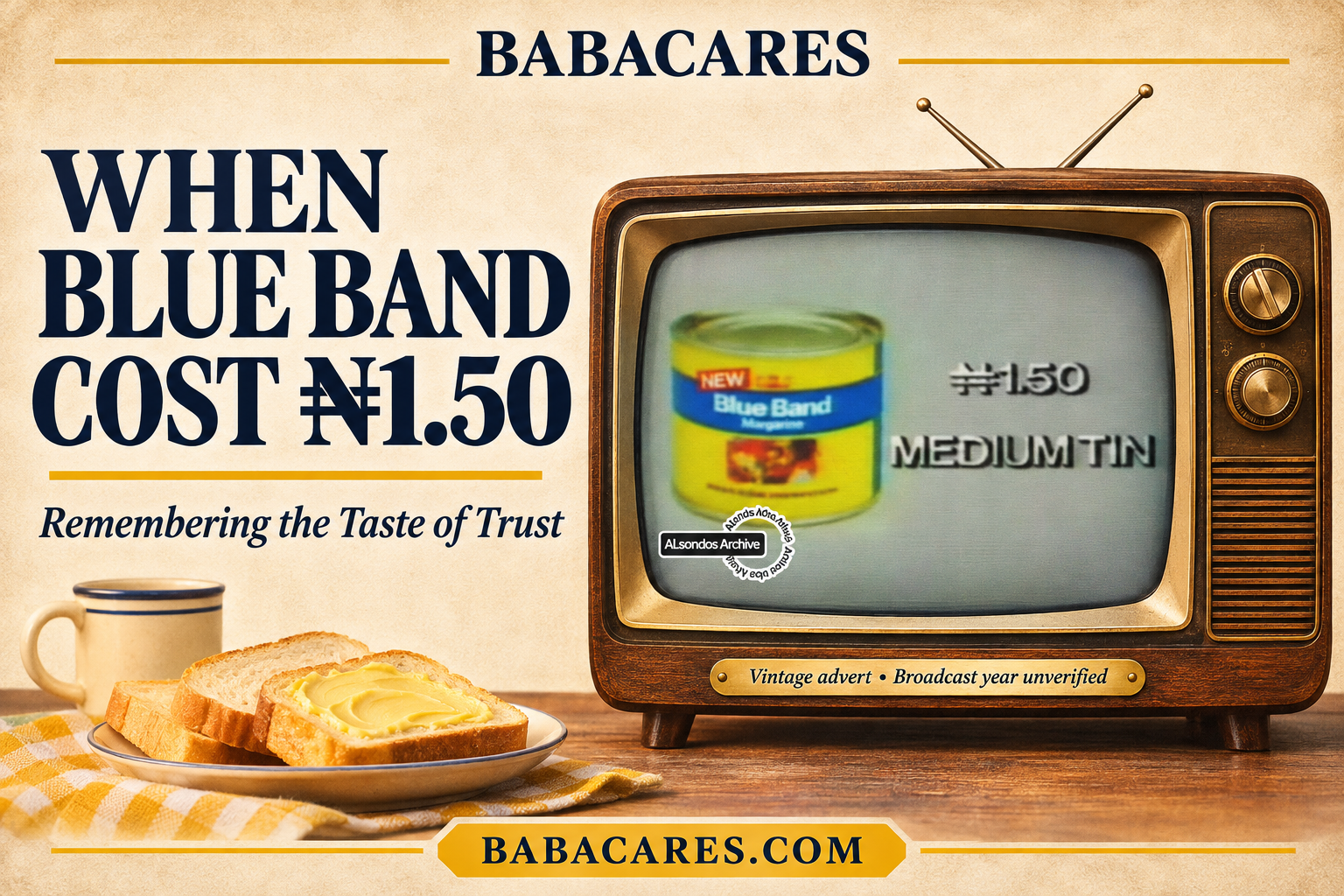
WHEN BLUE BAND COST ₦1.50: REMEMBERING THE TASTE OF TRUST
By Babajide Moronfolu | Babacares
Personal reflection and consumer-health commentary
An old television advertisement can bring back an entire childhood.
A familiar tin. A recognizable colour. A price that makes you look twice.
In a screenshot from an old Blue Band television commercial, a medium tin is advertised for ₦1.50—one naira, fifty kobo.
For me, that image brings back memories of Nigerian television, family breakfasts and a time when familiar household products inspired confidence. We bought them, took them home and enjoyed them without the anxiety that now surrounds so many conversations about what we eat.
What we miss goes beyond the price. We miss the feeling of trust.
A small tin carrying big memories
Many Nigerian households called it “Blue Band butter,” although Blue Band is a margarine or vegetable-fat spread rather than dairy butter. The brand itself describes its products as margarine and spreads. www.blueband.com
For those who grew up with it, however, the memory is more personal than technical: bread at breakfast, a familiar tin on the table, and the pleasure of spreading something tasty across a slice.
The commercial’s exact broadcast year has not been independently established. Although I associate it with television memories from the 1970s, the screenshot cannot confirm that date. Nigeria introduced naira and kobo in January 1973, so an advert displaying a naira price would belong to that period or later. www.cbn.gov.ng
Still, the image captures something powerful: how a simple household purchase can become a symbol of the life we remember.
What does Blue Band cost today?
Online listings checked on November 10, 2026, show how different the price tag looks today. Shoprite Nigeria lists a 450g Blue Band tub at ₦2,299.99, while Supermart lists Blue Band Spread for Bread, 450g, at ₦3,000. Prices vary by retailer, location and product variant, and online listings may differ from prices at checkout. shoprite.ng
The old advertisement’s ₦1.50 medium tin now stands beside modern packs costing thousands of naira. However, the old tin’s weight and the advert’s exact year remain unconfirmed, so this is a nostalgic comparison rather than a precise measure of inflation.
An old price alone also cannot tell us how affordable something was. That requires knowing what families earned and what other necessities cost at the time.
Nevertheless, for those who remember that familiar tin on the breakfast table, the difference prompts a deeper question: how comfortably can a family afford the everyday foods it once took for granted?
Was everything safer then?
It is tempting to say that there were no adulterated products in those days.
But our memories cannot establish that every product was genuine or every meal safe. Nor can an old advertisement prove the quality of everything sold during that era.
What we can honestly describe is our experience of confidence—the feeling that a familiar product would be what its label promised.
That is a reasonable expectation in any generation.
A parent buying food should be able to trust its contents. A worker spending hard-earned money should receive a genuine product. An older adult should not have to wonder whether an everyday purchase could endanger their health.
Food safety is a health issue
Adulteration and contamination are not interchangeable. Adulteration can involve deliberately diluting or substituting ingredients, while contamination can arise from unsafe water, poor handling, storage failures or other hazards.
Both deserve serious attention.
The World Health Organization explains that contaminated food can transmit harmful bacteria, viruses, parasites and chemicals. Young children, older people and people who are already ill can be particularly vulnerable to its effects. www.who.int
For families, unsafe food can mean illness, treatment costs, missed work and additional caregiving responsibilities. A purchase intended to nourish a household can instead create hardship.
The concern here extends across the food supply; the old Blue Band advert is a starting point for reflection, not evidence of a safety problem with the brand.
Trust must be supported by accountability
Nigeria’s consumer-protection authorities have identified present-day problems that deserve attention. In an August 19, 2026 notice, the Federal Competition and Consumer Protection Commission warned about goods carrying misleading information or missing essential labelling, including dates, batch numbers, ingredients and manufacturer details. It directed businesses to withdraw non-compliant products from sale. fccpc.gov.ng
Clear labels matter, but consumers also need honest manufacturers, responsible retailers, effective inspections and consequences for deliberate deception.
Consumers can help by examining labels and packaging, choosing traceable sellers and reporting suspicious products. However, a shopper cannot detect every hazard by sight. Protecting the food supply requires action throughout production, distribution and sale.
The confidence we deserve again
Watching that old Blue Band advert, I understand why someone would sigh and say: “Gone are those days.”
We are remembering our homes, our parents and the ordinary pleasures that shaped us. We are also expressing a wish for a country where everyday purchases come with greater confidence.
We cannot bring back yesterday’s prices simply by wishing. We can demand honest products, reliable information and stronger protection for the money families spend.
Food should nourish us. Buying it should not fill us with fear.
Do you remember this Blue Band tin or the television advert? What household product takes you straight back to your childhood?
READ MORE ON BABACARES.COM, SUBSCRIBE AND SHARE.
https://www.babacares.com/blog-details?details=1161&title=WHEN+BLUE+BAND+COST+%E2%82%A61.50%3A+REMEMBERING+THE+TASTE+OF+TRUST










Comments