

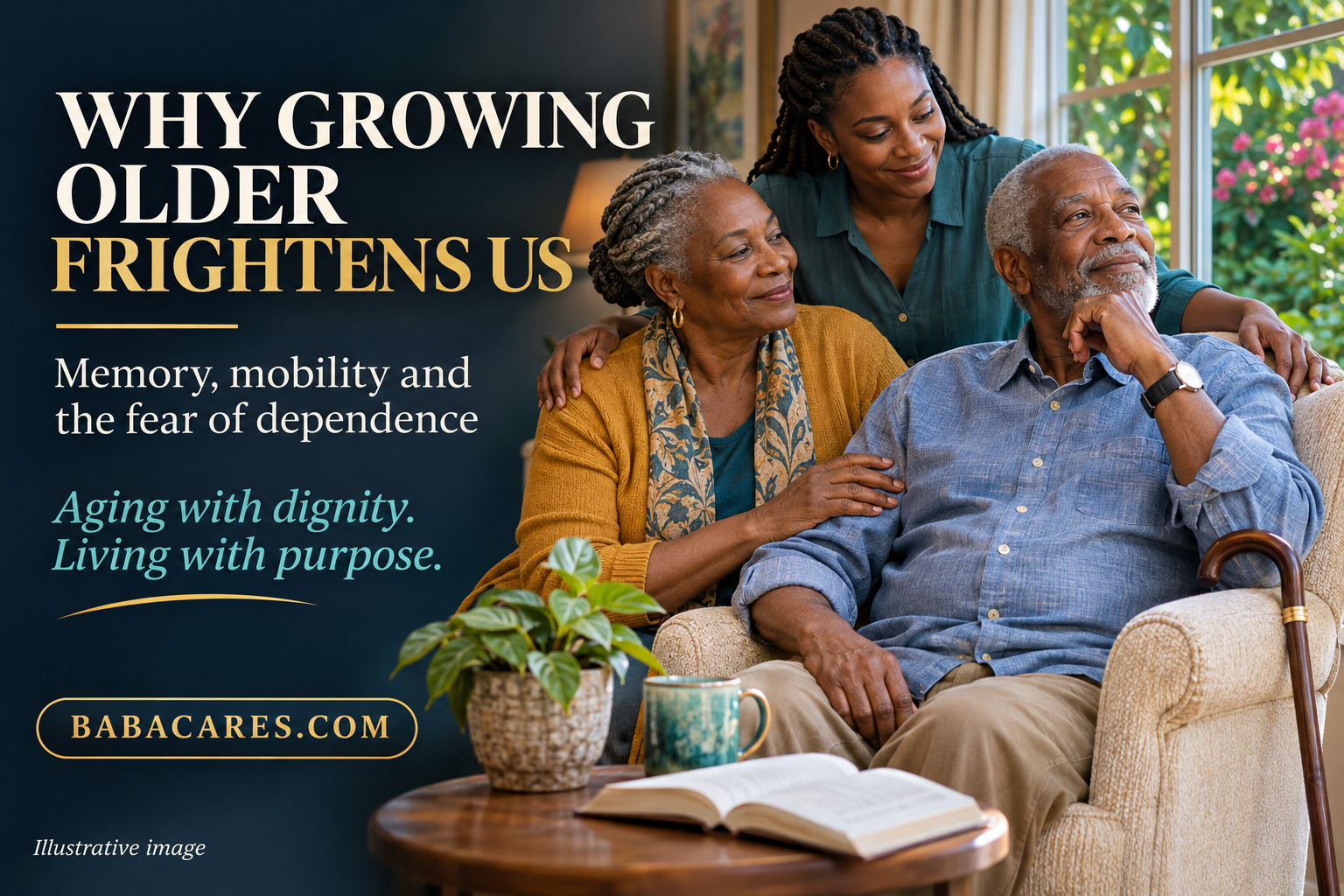
WHY GROWING OLDER FRIGHTENS MANY PEOPLE: MEMORY, MOBILITY AND THE FEAR OF DEPENDENCE
By Babajide Moronfolu | Babacares
For many people, the fear of old age has little to do with grey hair or wrinkles. It is the fear of forgetting familiar faces, struggling to walk, or needing someone to help with bathing, dressing and eating.
Behind that worry is a deeply personal question: “Will I still be able to live life on my own terms?”
Watching a parent struggle with dementia, seeing a neighbour become housebound, or caring for someone who needs daily assistance can make the future feel frightening. People may begin to imagine those experiences as their own inevitable destination.
But one person’s experience does not tell the whole story of aging. Growing older takes different forms, and needing support does not erase a person’s identity, value or right to make decisions.
The fear of losing mental sharpness
Few possibilities feel more unsettling than losing trust in your own memory.
Misplacing keys may prompt a worrying thought: “Is this how it starts?” Forgetting a name can suddenly feel like evidence of something serious.
The emotional weight comes from what memory represents. It connects us to our relationships, achievements, culture and personal history. The prospect of losing that connection can feel like losing part of ourselves.
Yet fear can also make people interpret every ordinary lapse as a warning. Persistent changes that interfere with daily life deserve professional assessment; anxiety alone cannot tell someone what a memory problem means.
When movement becomes a symbol of freedom
Walking to the shops, climbing stairs, driving to church or getting out of a chair may seem like small activities. Together, they give people freedom.
That is why the possibility of weaker mobility can feel so threatening. Someone who has always worked, travelled and cared for others may struggle to imagine asking for help to leave the house.
A walking stick, walker or wheelchair can also carry an unfair social stigma. People may resist using one because they fear appearing frail.
But mobility aids can support participation and independence. Being able to attend a family celebration safely matters more than whether someone arrives with assistance.
“I do not want to become a burden”
This is one of the most painful statements people make about their future.
It often comes from love. Parents do not want to interrupt their children’s careers or place pressure on their families. Spouses worry about exhausting each other. People living alone may wonder who would notice if they needed help.
These concerns deserve practical conversations about care, housing, finances and available support.
They also deserve a compassionate response: needing care does not make someone a burden. Support needs can be demanding, and caregivers need help too, but those demands should never be confused with the worth of the person receiving care.
The fear of being overlooked
Some people fear that others will stop listening to them as they age.
They worry that relatives will make decisions without asking, healthcare workers will speak over them, or society will treat them as people whose useful years are over.
Respectful care must protect more than physical safety. It should preserve privacy, preferences, relationships and meaningful choices.
An older adult may need help preparing meals while remaining fully capable of deciding what to eat, whom to see and how to spend the day.
Preparation can make the future feel less frightening
We cannot control every illness or change that may come with age. Healthy habits are not a guarantee against disability, and becoming unwell is not a personal failure.
Still, preparation can replace some uncertainty with practical action:
-
Make movement and enjoyable learning part of everyday life.
-
Maintain friendships and connections beyond work.
-
Attend appropriate health appointments and discuss changes early.
-
Consider whether the home could accommodate changing mobility.
-
Talk openly about care preferences, finances and trusted decision-makers.
-
Accept useful support before a difficulty becomes a crisis.
These steps are about creating options and preserving participation.
Aging should leave room for purpose
People often describe later life only through what may be lost. Less attention is given to what can continue or develop: friendships, creativity, faith, mentoring, storytelling and learning.
Purpose does not disappear when paid work ends. Nor does it depend on physical strength or perfect memory.
A person can need assistance and still offer humour, affection, knowledge and companionship. Families and communities have a responsibility to make room for those contributions.
The Babacares perspective
Fear of aging deserves understanding, not dismissal. Memory changes, mobility difficulties and care needs can bring real challenges.
But we should be careful about allowing the most difficult examples of old age to define everyone’s future.
A better conversation asks: What support would help this person keep doing what matters to them? How can we protect their choices? How can we support the people providing care?
Growing older should not mean becoming invisible. Receiving help should not mean surrendering dignity.
For anyone anxious about the years ahead, there is value in preparing thoughtfully while continuing to live fully today.
READ MORE ON BABACARES.COM, SUBSCRIBE AND SHARE.
https://www.babacares.com/blog-details?details=1155&title=WHY+GROWING+OLDER+FRIGHTENS+MANY+PEOPLE%3A+MEMORY%2C+MOBILITY+AND+THE+FEAR+OF+DEPENDENCE







Comments