

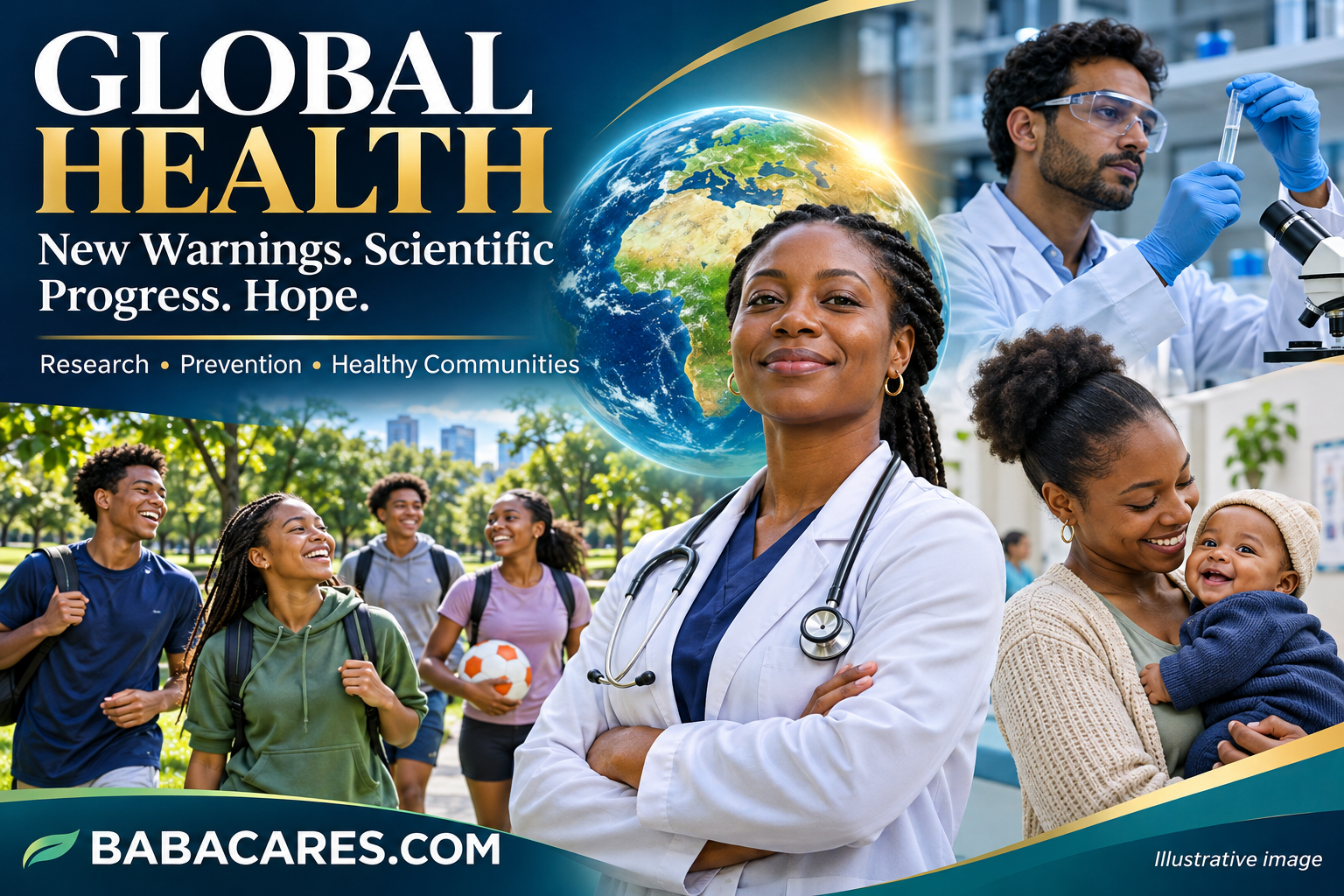
GLOBAL HEALTH: NEW WARNINGS, SCIENTIFIC PROGRESS AND LESSONS FOR EVERY FAMILY
By Babajide Moronfolu | Babacares
November 6, 2026
Recent global health developments reveal both urgent challenges and reasons for hope. Scientists are advancing research against Ebola, new findings highlight inactivity among teenagers, and Barbados has achieved an important milestone in preventing HIV transmission to babies.
Together, these developments show why health protection depends on scientific research, prevention and accessible everyday care.
Ebola research advances, but candidate vaccines remain under evaluation
On November 4, the World Health Organization announced that expert groups had recommended adding two vaccine candidates to the ongoing Tumaini trial in the Democratic Republic of the Congo.
The candidates—Oxford’s ChAdOx1, developed with the Serum Institute of India, and Moderna’s mRNA-1469—are designed to protect against the Bundibugyo virus responsible for the current outbreak. Their entry into the trial requires national approvals.
This is encouraging scientific progress, but it does not mean the vaccines have already been proven effective or approved for general use against Bundibugyo virus. Clinical trials must establish how well they work and assess their safety. WHO says vaccine-trial results are expected in early 2027.
For readers following outbreak news, the distinction matters: a promising research announcement is a step towards better protection, rather than confirmation that an outbreak has been brought under control.
Teenage inactivity raises concerns about future health
New WHO estimates released on November 4 found that approximately one in four adolescents aged 11–17 reported no day in the previous week with at least 60 minutes of moderate-to-vigorous physical activity.
That does not mean these teenagers never moved. It means they did not report reaching that activity threshold on any day during the week assessed.
The research drew on 389 population-based surveys involving more than 3.2 million adolescents across 140 countries and territories. Girls reported lower activity levels than boys, and overall progress has remained largely unchanged over 15 years.
WHO is calling for safer walking and cycling routes, more opportunities for activity at school, and accessible places to play and exercise.
The lesson for families and communities extends beyond telling young people to exercise. Children need environments where movement is safe, affordable and part of normal daily life.
Climate action could prevent substantial loss of life
A WHO report published on November 4 estimates that scaling up six climate and health measures could prevent 1.6 million deaths annually.
The measures include heat-health warning systems, climate-resilient drinking-water services, basic sanitation, handwashing facilities, cleaner household energy and more efficient fossil-fuel pricing policies.
These figures are modelled projections, rather than deaths already prevented. Their achievement would depend on implementation, investment and local conditions.
For Babacares readers, the report connects environmental policy with familiar household concerns: safe water, clean cooking, reliable sanitation and protection during extreme heat. These are practical health needs that deserve attention alongside hospital treatment.
Barbados demonstrates progress in protecting babies from HIV
On October 30, WHO announced that Barbados had eliminated mother-to-child transmission of HIV as a public health problem.
The assessment found that no new infections from mother-to-child transmission were reported among infants born in Barbados between 2022 and 2024. During that period, 98% of pregnant women received antenatal care, 98% were tested for HIV, and 98% of pregnant women living with HIV received antiretroviral treatment.
The achievement reflects sustained access to testing, treatment and follow-up. It does not mean HIV has disappeared from Barbados or that prevention services can stop. Continued investment is necessary to maintain the milestone.
The Babacares perspective
These stories point towards a shared priority: make prevention and timely care available before illness becomes a crisis.
Research needs sustained support. Young people need opportunities to be active. Communities need safe water and healthier environments. Pregnant women need confidential, respectful care without unnecessary barriers.
Global health progress becomes meaningful when it reaches the people who need it—in their homes, schools, communities and healthcare facilities.
READ MORE ON BABACARES.COM, SUBSCRIBE AND SHARE.
https://www.babacares.com/blog-details?details=1154&title=GLOBAL+HEALTH%3A+NEW+WARNINGS%2C+SCIENTIFIC+PROGRESS+AND+LESSONS+FOR+EVERY+FAMILY




Comments