

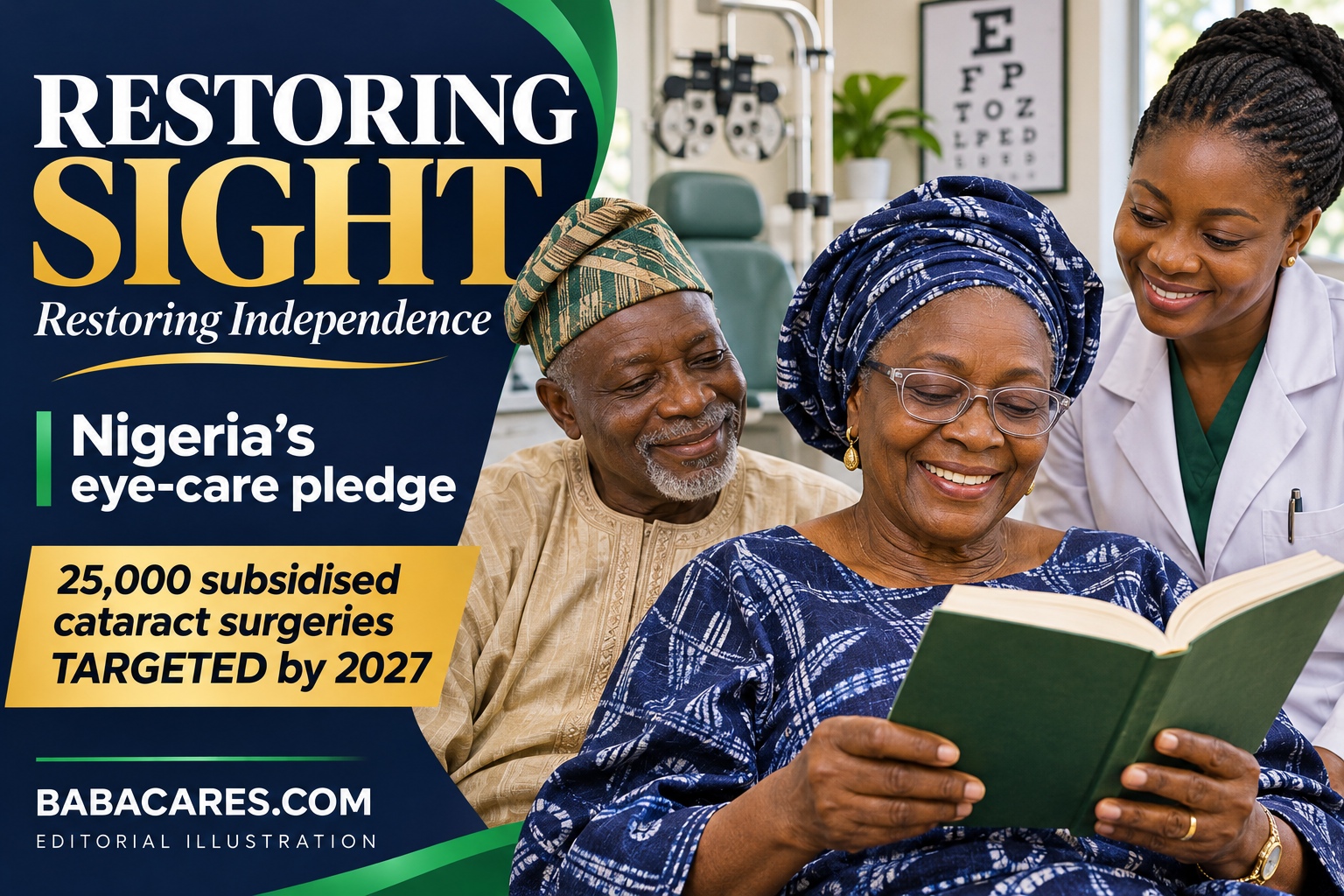
Restoring Sight, Restoring Independence: What Nigeria’s Eye-Care Promise Could Mean for Families
By Babacares
Reading a message, recognising a familiar face or moving confidently around the home can become difficult when vision deteriorates. For an older person, poor eyesight can gradually reduce independence—and increase the support needed from family members.
Nigeria’s latest eye-care commitments could help address some of those challenges, provided they translate into accessible, quality services.
The Federal Government has pledged 25,000 fully subsidised cataract surgeries and five million pairs of reading spectacles by 2027, alongside plans to train 15,000 primary healthcare workers.
Minister of State for Health and Social Welfare, Dr. Iziaq Salako, outlined the commitments at the Global Summit for Eye Health in St John’s, Antigua and Barbuda, on November 2, 2026. The announcement was reported by Premium Times the following day. These figures are programme targets, not confirmation that all the services have already been delivered.
Why This Matters for Healthy Aging
The World Health Organization identifies cataracts and refractive errors among the leading causes of vision impairment and blindness. Although sight problems affect all ages, most people living with vision impairment or blindness are over 50.
Timely access to appropriate eye care can help reduce the consequences for everyday life, work and participation in the community.
For Babacares readers, the importance extends beyond seeing more clearly. Better vision can mean greater confidence when reading, shopping, working or spending time with loved ones.
It can also help families support an older relative’s independence.
Surgery and Reading Glasses Meet Different Needs
The two main parts of the pledge address different problems.
Cataract surgery treats clouding of the eye’s natural lens. Reading spectacles can help with presbyopia—the age-related difficulty focusing on nearby objects that commonly develops after 40.
Reading glasses do not remove cataracts, and they are not a treatment for every cause of reduced vision. An appropriate eye assessment helps establish what support or treatment a person needs.
Building on Existing Programmes
The cataract target was previously reaffirmed in an October 8, 2026 government statement, which linked the planned surgeries to the Renewed Hope Health Connect initiative.
That statement also reported earlier progress under Nigeria’s eye-care programmes, including the training of more than 3,000 healthcare workers and distribution of over 1.5 million pairs of reading spectacles across 16 states.
Those are government-reported achievements and should be distinguished from the larger targets now being discussed.
Why Training Health Workers Matters
The latest announcement includes plans to integrate primary eye care into the Basic Health Care Provision Fund. Its stated focus includes vulnerable populations, particularly women, older people and underserved rural communities.
From a service-delivery perspective, the potential benefit is a clearer route from identifying a vision problem to receiving specialist assessment and treatment.
However, training must be supported by functioning referral systems, equipment and access to qualified eye-care professionals.
What Families Need to Know About Access
The announcement reviewed for this article does not provide a complete national list of participating hospitals, eligibility rules or a verified public registration process.
Families should therefore seek information from their state health ministry, local primary healthcare centre or recognised public eye clinic about any participating services and referral arrangements.
Before enrolling, ask:
-
Who qualifies for the programme?
-
Which facilities are authorised to provide treatment?
-
What does the subsidy cover?
-
Are tests, medicines and follow-up appointments included?
People with worsening vision should seek assessment rather than wait for a future outreach programme.
The Test Is Safe Care and Better Vision
A surgery target is important, but numbers alone do not establish success. WHO’s cataract-care recommendations cover assessment before surgery, the operation itself and postoperative care—highlighting the importance of quality throughout the process.
For Babacares, the questions to watch are whether the programme reaches people who cannot afford care, publishes clear access information and reports meaningful outcomes.
Nigeria’s pledge offers an opportunity to reduce avoidable vision loss. Its lasting value will be measured in people who can see better, participate more fully and regain confidence in daily life.
Restoring sight can help restore independence—and that is a promise worth following through.
READ MORE ON BABACARES.COM, SUBSCRIBE AND SHARE.
https://www.babacares.com/blog-details?details=1150&title=Restoring+Sight%2C+Restoring+Independence%3A+What+Nigeria%E2%80%99s+Eye-Care+Promise+Could+Mean+for+Families








Comments