

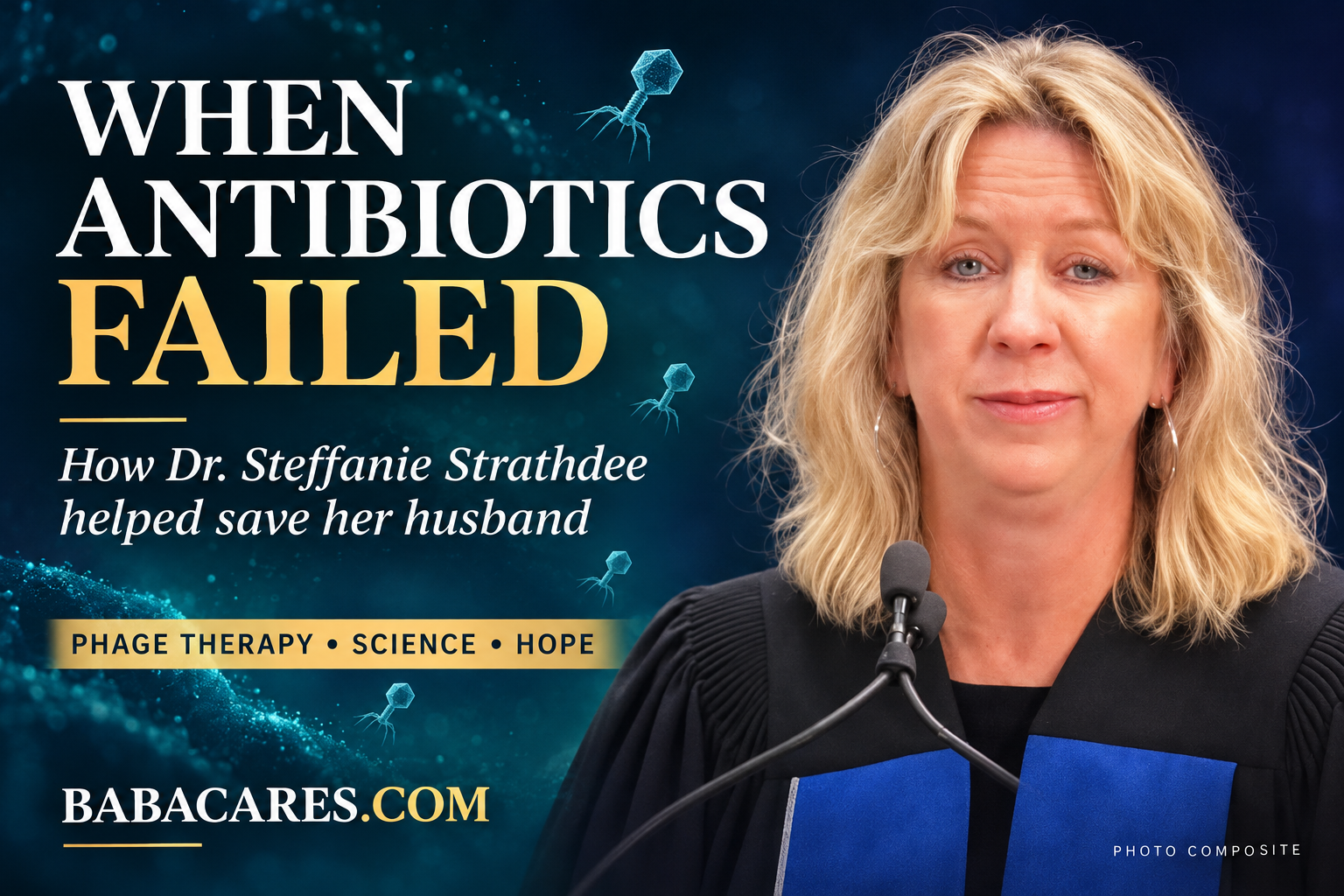
When Antibiotics Failed: How Dr. Steffanie Strathdee Helped Save Her Husband
By Babacares
What happens when a scientist who studies infectious diseases finds herself watching a loved one deteriorate from an infection that available antibiotics cannot control?
For Dr. Steffanie Strathdee, that question became painfully personal. When her husband, Professor Tom Patterson, became critically ill, she helped bring together researchers and doctors to pursue an experimental treatment using viruses that attack bacteria.
His recovery became an important chapter in renewed interest in phage therapy, a century-old approach offering potential help against some drug-resistant infections.
A Holiday Became a Medical Emergency
Patterson fell ill during a trip to Egypt in November 2015. Initially diagnosed with pancreatitis, he subsequently developed a serious infection involving Acinetobacter baumannii, a bacterium that can resist multiple antibiotics.
Despite intensive treatment, his condition worsened. He eventually fell into a coma and required life support. His medical team was running out of treatment options.
For Strathdee, an infectious-disease epidemiologist and University of Toronto alumna, the crisis transformed her role. She was now a caregiver and advocate searching for another possibility.
An Old Scientific Idea Offered New Hope
Strathdee revisited something she had learned during her undergraduate education: bacteriophages, usually shortened to phages.
These are viruses that infect bacteria. Carefully selected phages can target particular bacterial strains, making them potential tools against infections that are difficult to treat.
She contacted researchers and helped connect an international network willing to identify suitable phages for Patterson’s infection. His treatment required specialist preparation, medical supervision and emergency regulatory permission.
A Recovery Built on Teamwork
In March 2016, Patterson began receiving phage treatment. He subsequently regained consciousness, but recovery was neither immediate nor straightforward.
Doctors adjusted the treatment as the bacteria developed resistance, using additional phages and antibiotics. Patterson eventually recovered sufficiently to return home in August 2016. His case demonstrated what a coordinated scientific and clinical effort could achieve in a desperate situation.
Does This Mean There Is a Cure for Superbugs?
His infection was successfully treated, but phage therapy is not a guaranteed cure for every resistant infection.
Phages must be matched to the bacteria causing illness. Treatment also raises questions about preparation, dosing, resistance and how best to combine phages with antibiotics.
Clinical trials are helping researchers establish when this approach is safe and effective. Patterson’s recovery helped lay the groundwork for further research; it did not settle every scientific question.
A Message for Patients, Families and Caregivers
For Babacares readers, this story brings together scientific knowledge, caregiver advocacy and collaboration.
Strathdee’s contribution was not a miracle remedy she created alone. It was her determination to connect knowledge, specialists and an urgently ill patient.
Her experience reminds us that families can ask questions and advocate for specialist advice while recognising that experimental treatments require careful assessment.
Hope becomes most powerful when it is supported by evidence, teamwork and compassionate care.
READ MORE ON BABACARES.COM, SUBSCRIBE AND SHARE.
https://www.babacares.com/blog-details?details=1148&title=When+Antibiotics+Failed%3A+How+Dr.+Steffanie+Strathdee+Helped+Save+Her+Husband











Comments