

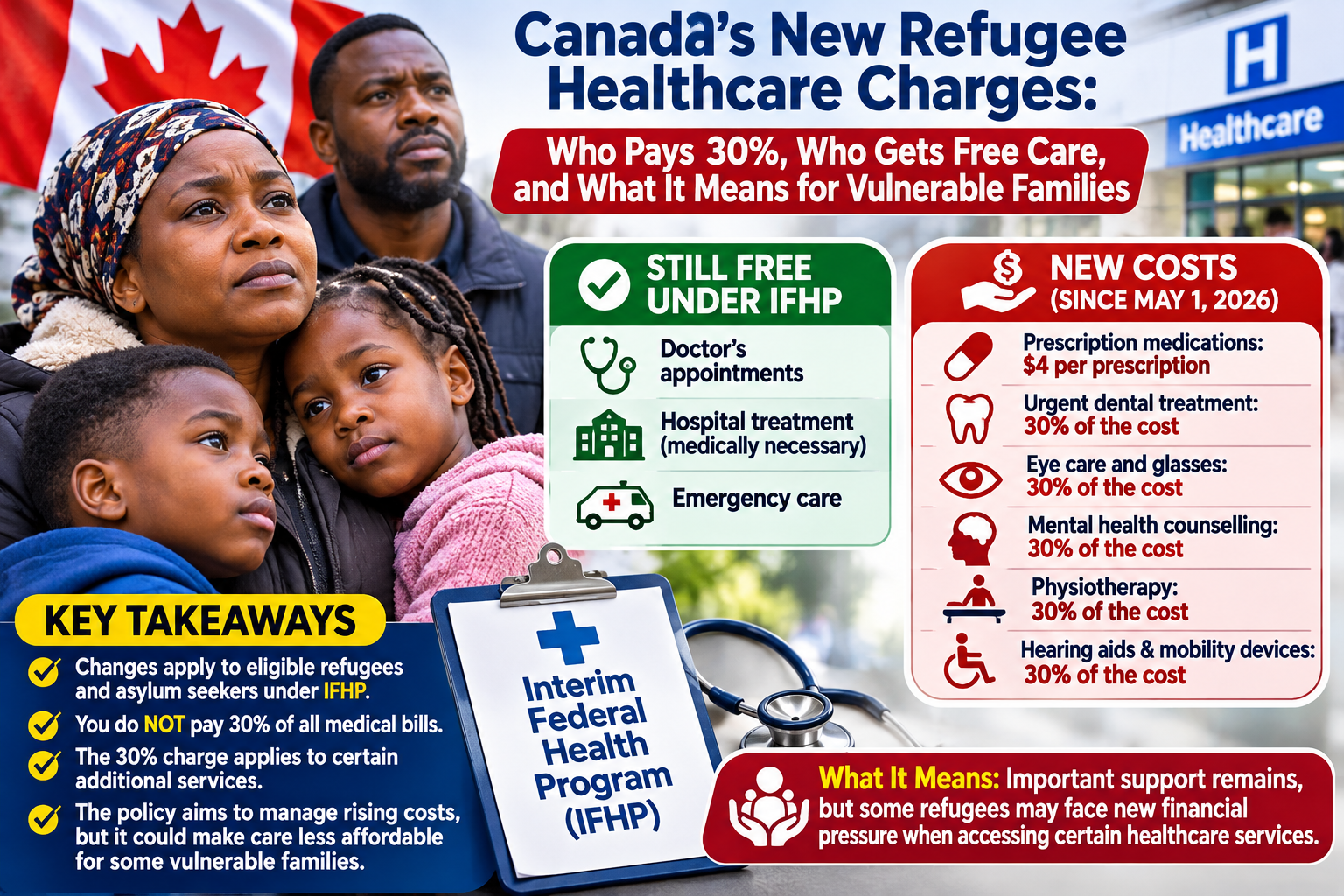
Canada's New Refugee Healthcare Charges: Who Pays 30%, Who Gets Free Treatment, and What It Means for Vulnerable Families
For thousands of refugees and asylum seekers in Canada, accessing healthcare now comes with an additional financial responsibility. But contrary to alarming claims circulating online, refugees are not required to pay 30% of every medical bill.
Since May 1, 2026, Immigration, Refugees and Citizenship Canada (IRCC) has introduced new charges under the Interim Federal Health Program (IFHP), which provides temporary healthcare coverage to eligible refugees, asylum seekers and certain other vulnerable groups.
The changes have raised important questions about healthcare affordability, particularly for families struggling with housing costs, unemployment and the challenges of settling in a new country.
What Has Changed?
Under the new policy, eligible IFHP beneficiaries must pay:
-
$4 for each eligible prescription filled or refilled.
-
30% of the covered cost of certain additional healthcare services, including urgent dental treatment, eye care, mental health counselling, physiotherapy, hearing aids and mobility equipment.
However, doctor's appointments, medically necessary hospital treatment, emergency care and other eligible basic healthcare services remain fully covered under IFHP, without the new co-payments.
For example, if an eligible dental procedure costs $500, the patient pays $150 while IFHP covers the remaining $350.
The 30% charge applies to eligible supplemental benefits, not every healthcare service. Costs outside the program's coverage limits may still be the patient's responsibility.
Who Is Affected?
The changes mainly affect people receiving eligible benefits under IFHP, including refugee claimants, certain protected persons and resettled refugees.
Refugees who have transitioned to provincial or territorial healthcare insurance generally receive medically necessary hospital and physician services through those programs. Their eligibility for other benefits depends on their circumstances and available coverage.
Importantly, the policy does not mean all refugees or permanent residents must pay 30% of their medical expenses.
Why Did Canada Introduce the Charges?
The federal government says the changes are intended to manage rising program costs and maintain the long-term sustainability of refugee healthcare.
According to the Parliamentary Budget Officer, the co-payment policy is projected to reduce federal spending by approximately $217 million annually by 2029–2030.
However, reducing government expenditure also means transferring some costs to individuals who may already face financial difficulties.
The Public Health Concern: Could Some Refugees Delay Treatment?
Healthcare professionals and refugee advocacy organizations have expressed concerns that the charges could discourage vulnerable individuals from obtaining necessary care.
Consider a newly arrived refugee family struggling to pay rent and buy groceries.
An additional $150 dental bill, repeated prescription charges or payments for mental health counselling could become a difficult financial burden.
Some patients may postpone treatment, skip medications or delay rehabilitation because of costs.
This could be particularly concerning for older refugees, people living with disabilities, individuals managing chronic illnesses and survivors of trauma.
Delayed treatment can also allow manageable health problems to become more serious and expensive.
These are potential consequences identified by healthcare advocates, rather than proof that every affected refugee will experience reduced access to care.
What Should Refugees Do?
Anyone covered under IFHP should:
-
Confirm their eligibility and available benefits.
-
Use healthcare providers registered with the IFHP.
-
Ask about co-payments before receiving treatment.
-
Keep receipts for payments made.
-
Seek guidance from settlement agencies or healthcare providers if they are unable to afford treatment.
Patients should not assume that essential hospital treatment now attracts a 30% charge.
The Babacares Perspective
Canada faces a genuine challenge in balancing healthcare expenditure with access to essential services.
However, refugee healthcare is not simply a financial issue. It is also a matter of public health, human dignity and successful integration.
Many refugees arrive after experiencing displacement, hardship and uncertainty. Access to timely healthcare plays an important role in helping them rebuild their lives.
The central question is whether the new charges will help sustain the healthcare system without placing necessary treatment beyond the reach of vulnerable families.
As the policy continues, its impact on healthcare access, treatment delays and refugee well-being deserves careful monitoring.
Healthcare information should educate, not create unnecessary fear.
References
-
Immigration, Refugees and Citizenship Canada – IFHP Co-payments
-
Parliamentary Budget Officer – Reviewing the Interim Federal Health Program
-
Canadian Council for Refugees – Concerns About Healthcare Co-payments
READ MORE ON BABACARES.COM, SUBSCRIBE AND SHARE.










Comments