

Clocks Go Back on November 1—but Not Everywhere: What Families and Workers Need to Know
By Babacares | October 31, 2026
An hour’s difference can mean a missed shift, a confused medication schedule or an international meeting attended at the wrong time.
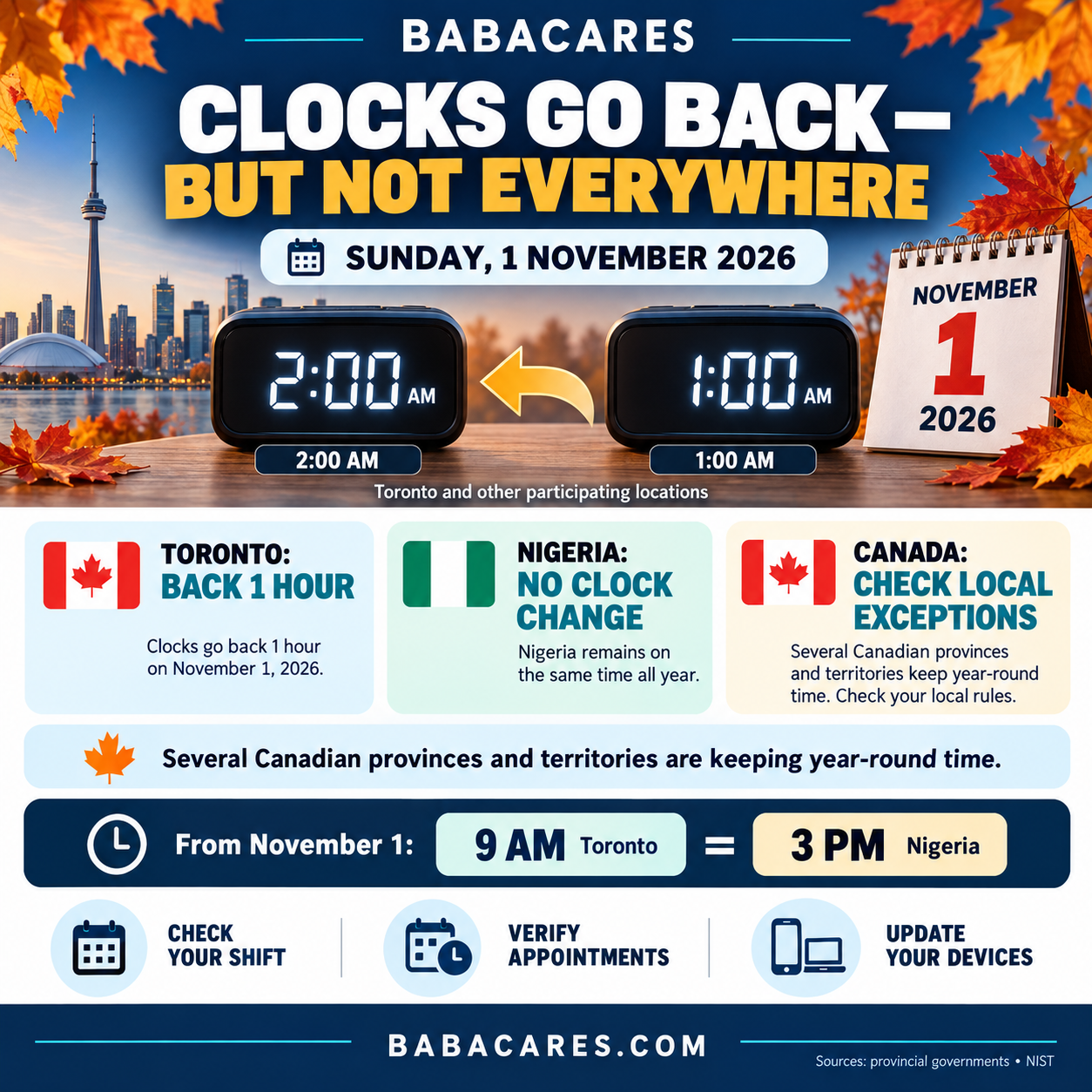
On Sunday, November 1, 2026, places still following the North American seasonal clock-change schedule will turn clocks back one hour at 2 a.m., returning to 1 a.m. Toronto, Ottawa, Montreal and much of the United States are among the locations affected. NIST
But “everyone in Canada changes their clocks” is no longer reliable advice. Several provinces and territories have adopted year-round time, making location-specific checks particularly important this year.
Where will clocks change?
| Country or region | What readers should know |
|---|---|
| Canada | Toronto and much of Ontario, most of Quebec, Atlantic provinces and other participating communities turn clocks back November 1. Important exceptions apply. |
| United States | Most locations turn clocks back November 1. Hawaii and most of Arizona do not; the Navajo Nation observes seasonal changes. |
| Mexico | Only certain northern border areas retain seasonal changes; most of the country does not change clocks. |
| The Bahamas and Bermuda | Scheduled to turn clocks back November 1. |
| United Kingdom and much of Europe | Their autumn change already occurred on October 25. |
| Nigeria | No clock change. Nigeria remains on West Africa Time throughout the year. |
| Cuba | Has cancelled this November’s rollback and is keeping daylight saving time until November 2027 under its current plan. |
Local exceptions and recent policy changes mean travellers should verify the destination city rather than rely on a country-wide assumption. NIST
Canada’s important exceptions
Most of British Columbia, along with Alberta, Manitoba and the Northwest Territories, will not turn clocks back this November. Yukon and most of Saskatchewan already follow year-round time arrangements. Parts of northwestern Ontario, including Kenora, are also ending seasonal clock changes. Local exceptions remain, including within British Columbia. archive.news.gov.bc.ca
For example, Toronto and Winnipeg will show the same clock time after Toronto’s rollback, while Toronto will be two hours ahead of Vancouver rather than three. These differences follow from the jurisdictions’ respective time rules. timeanddate.com
Why do countries change their clocks?
Daylight saving time shifts clock time to provide more daylight during summer evenings. Returning to standard time shifts daylight earlier on the clock, bringing brighter mornings and earlier evening darkness.
It does not create additional daylight. Historically, energy conservation was an important justification, although governments now also debate convenience, business coordination, health and road safety. NIST
Ending seasonal changes and choosing permanent daylight saving time are separate decisions. Sleep specialists generally favour permanent standard time, while some governments prefer year-round daylight saving for its lighter evenings. American Medical Association
The public-health implications
Turning clocks back offers an extra hour on the clock, but it does not guarantee an extra hour of sleep. Changes to bedtime, waking, meals and light exposure can temporarily disturb routines.
The autumn transition is generally easier than the spring change, but some people still experience disrupted sleep and reduced alertness. Children’s routines can also be unsettled. Findings about increased risks after the spring transition should not automatically be applied to November’s rollback. AAMC
For families and caregivers, sensible preparations include keeping sleep routines steady, making small adjustments when needed and planning for darker evening journeys.
People taking medicines at precise intervals should ask their pharmacist how to handle the change. Caregivers should confirm the plan rather than improvise a new dosing schedule.
Jobs, overnight shifts and likely confusion
Where clocks go back, the hour between 1 a.m. and 2 a.m. occurs twice. An overnight shift can therefore include an additional hour of actual work.
Employers should confirm staffing, breaks, handovers and how actual hours will be recorded and paid under applicable employment rules and agreements. Hospitals, care homes, security services, transport operators and other round-the-clock workplaces should clarify which occurrence of a repeated time an instruction refers to.
Other practical risks include:
- Missed home-care visits or appointments when workers and clients use different clocks.
- Incorrect alarms on devices with outdated time-zone information.
- Recurring online meetings shifting by an hour, particularly across jurisdictions changing their rules.
- Travel mistakes caused by assuming familiar time differences still apply.
Manitoba and Alberta specifically advise checking software updates, devices and appointments during their transition to year-round time. No More Falling back
What Nigerians connecting with Canada should know
Nigeria will not change its clocks. After Toronto’s rollback, Nigeria will be six hours ahead of Toronto, compared with five hours beforehand.
A meeting at 9 a.m. in Toronto will therefore be 3 p.m. in Nigeria from November 1. This follows from Toronto’s return to UTC−5 and Nigeria’s year-round UTC+1. timeanddate.com
What to do before Sunday
- Confirm your city’s rule. Do not assume every province or neighbouring community follows the same schedule.
- Update phones, computers and calendar applications. Enable automatic time settings, then verify the displayed time after the transition.
- Check manual clocks and alarms. Avoid adjusting a device twice.
- Reconfirm shifts, care visits, flights and appointments.
- Write international invitations clearly: include the date, city and time zone.
- Protect rest and safe travel. Avoid driving or operating machinery when drowsy.
The most useful reminder this year is simple: check your location, your device and your schedule.
References
- NIST: Daylight Saving Time Rules.
- British Columbia: Adopting permanent daylight saving time.
- Alberta: New time system.
- Manitoba: Year-round time and practical guidance.
- Northwest Territories: Ending seasonal time changes.
- UK Government: Clock-change dates.
- CDC/NIOSH: Time changes, sleep and workplace safety.
READ MORE ON BABACARES.COM, SUBSCRIBE AND SHARE.
https://www.babacares.com/blog-details?details=1131&title=Clocks+Go+Back+on+November+1%E2%80%94but+Not+Everywhere%3A+What+Families+and+Workers+Need+to+Know











Comments