

Nigeria Ebola Surveillance Review: 62 Contacts Monitored, No Additional Confirmed Cases in Latest Update
By Babacares | October 30, 2026
Based on the latest NCDC situation report located, dated October 29.
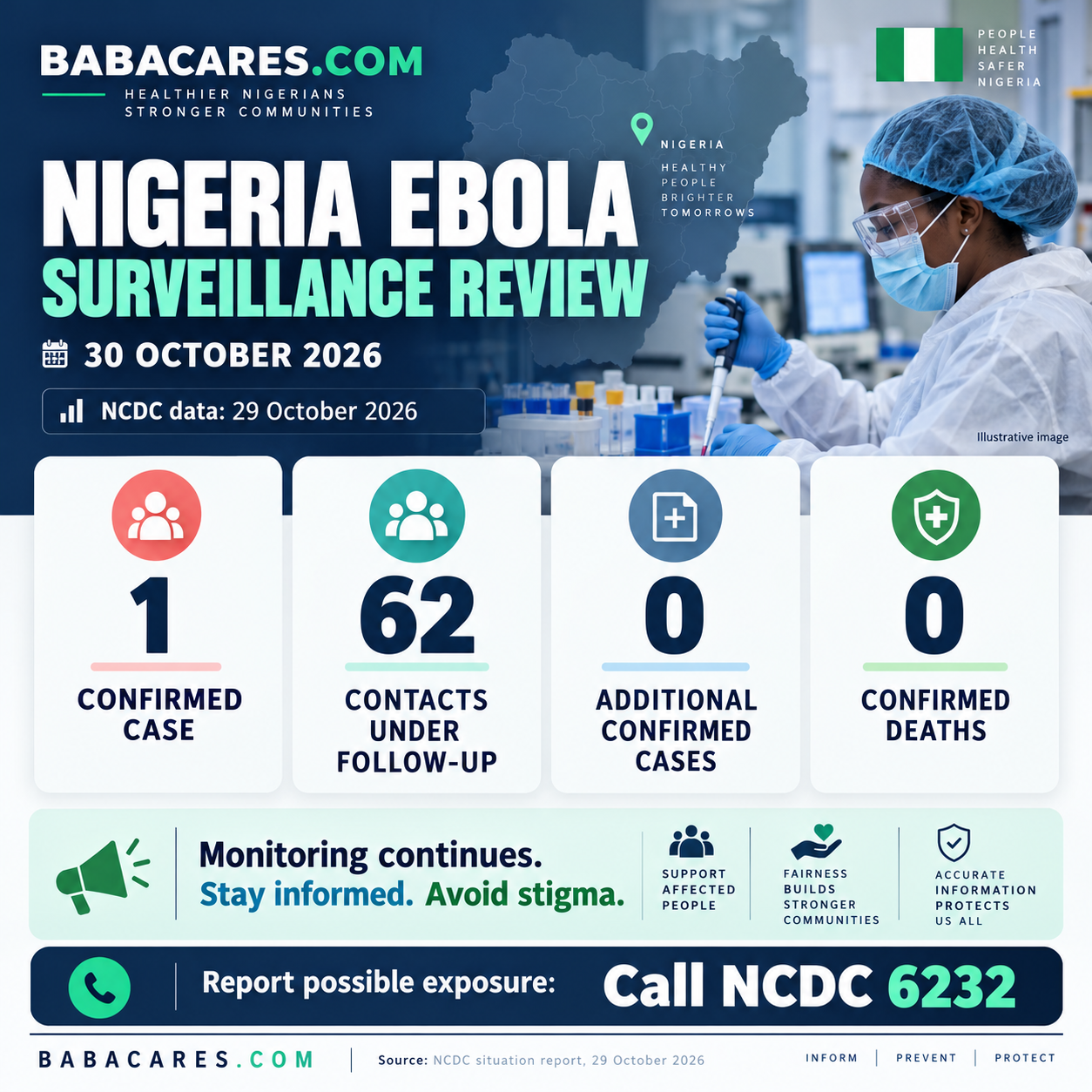
Nigeria’s latest Ebola surveillance update offers encouraging findings, but continued monitoring remains essential. NCDC reports one confirmed case, 62 contacts under follow-up and no confirmed deaths. No monitored contact had tested positive in the October 29 report. ncdc.gov.ng
What the latest surveillance shows
| Indicator | NCDC findings as of October 29 |
|---|---|
| Confirmed cases | 1, recorded in the Federal Capital Territory |
| Identified contacts | 62 |
| Contacts who tested positive | 0 |
| Symptomatic contacts in the preceding 24 hours | 0 |
| Confirmed-case deaths | 0 |
| Suspected case in Enugu | Tested negative |
NCDC also reported 18 samples tested: one positive and 17 negative. These are sample results and should not be interpreted as 18 separate patients. The report describes exposure as confined to a single epidemiological cluster linked to the index case. ncdc.gov.ng
What happened to the confirmed patient?
The confirmed patient was a woman who travelled from Uganda to Nigeria and tested positive for Bundibugyo virus on October 20. WHO said investigations were continuing to establish the likely source of infection and reconstruct her exposure history. Regional Office for Africa
She was medically evacuated to Switzerland on October 26. Her evacuation does not remove the need to monitor people who may have been exposed in Nigeria. ECDC’s October 29 assessment confirms that contact follow-up and epidemiological investigations remain ongoing. ecdc.europa.eu
Why surveillance must continue
Being identified as a contact does not mean a person has Ebola. It means health teams have identified a possible exposure requiring assessment and monitoring.
Contacts are generally monitored for 21 days after their last possible exposure, because symptoms can develop within that period. Cooperation helps teams identify illness promptly and prevent further transmission. ncdc.gov.ng
The absence of additional confirmed cases in this update is reassuring, but it is not an announcement that the outbreak response has ended.
What Nigerians should do
Ebola spreads through direct contact with infected blood or other body fluids and contaminated materials. NCDC advises people to:
- Report possible exposure promptly, even when feeling well.
- Cooperate with contact tracers and provide accurate information.
- Avoid unprotected contact with a suspected patient’s body fluids.
- Call public-health authorities before visiting a facility if symptoms develop after possible exposure.
- Reject rumours and avoid stigmatising patients, contacts or healthcare workers. ncdc.gov.ng
Do not wait for bleeding before seeking advice. Fever, severe weakness, headache, vomiting and diarrhoea can occur; bleeding is less frequent and may develop later. who.int
Report concerns through NCDC’s toll-free number, 6232, or your local public-health authorities. ncdc.gov.ng
References
- NCDC Ebola Disease Situation Report — October 29, 2026.
- NCDC: Update on Nigeria’s Ebola Disease Response — October 25, 2026.
- WHO Africa: Nigeria confirms imported Ebola Bundibugyo case.
- ECDC: Multi-country Ebola outbreak update — October 29, 2026.
- WHO: Ebola disease fact sheet.
READ MORE ON BABACARES.COM, SUBSCRIBE AND SHARE.











Comments