

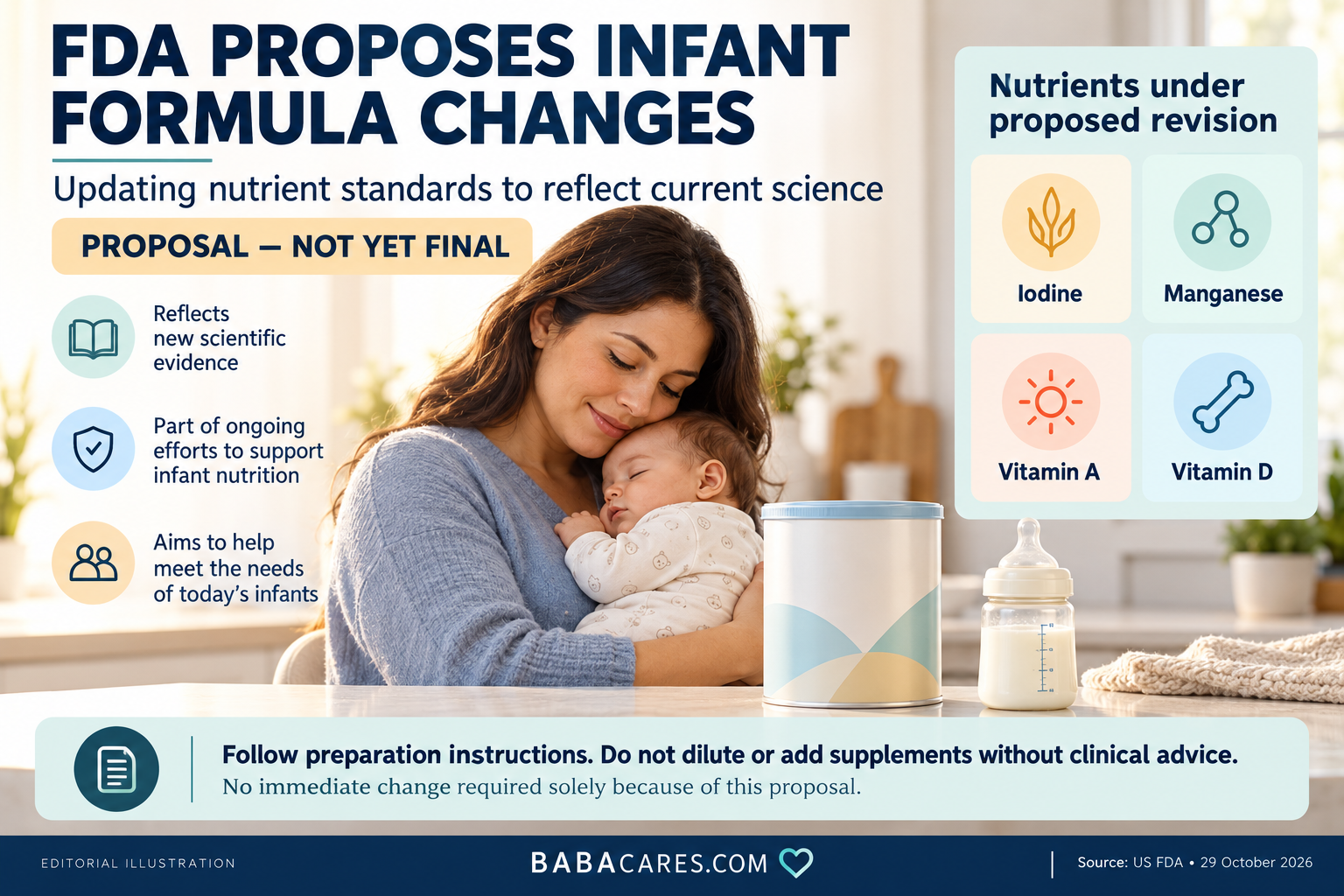
FDA Proposes Infant Formula Changes: What Parents Need to Know
October 29, 2026 | Babacares
The United States Food and Drug Administration has proposed changes to infant formula nutrient standards, opening a review that could eventually alter how manufacturers formulate and label their products.
The proposal is not yet a final rule, and it does not mean parents should stop using their baby’s formula. The FDA says the nutrient changes are intended to reflect current science, rather than respond to a newly identified safety concern.
What would change?
Announced on October 29, the proposal covers eight of the 30 nutrients currently required in US infant formula.
It would revise requirements for iodine, manganese, vitamin A and vitamin D, while retaining existing limits for chloride, potassium, selenium and sodium. Labels would also change to reflect updated requirements and measurement units.
The proposed adjustments include:
| Nutrient | Proposed change |
|---|---|
| Iodine | Raise the minimum and lower the maximum |
| Manganese | Lower the minimum and introduce a maximum |
| Vitamin A | Lower the permitted range and change measurement units |
| Vitamin D | Raise the minimum and maximum and change measurement units |
These are manufacturing specifications—not instructions for parents to add nutrients to bottles.
A broader review is underway
This is the first of three planned proposals in the FDA’s most comprehensive nutrient review since 1998.
Later phases will examine other nutrients and carbohydrate sources. The agency is also seeking views on ingredients such as DHA, ARA and L-carnitine, which manufacturers commonly add but which are not currently mandatory. The present proposal does not introduce new required nutrients.
When could changes reach families?
The FDA intends to combine the review’s eventual changes into one comprehensive final rule. Its proposed timetable would give manufacturers three years after that rule’s effective date to comply.
Public comments and further scientific assessment could influence the final requirements. Families should therefore expect a regulatory process, rather than an immediate change to products on shelves.
What parents should do now
Continue following reliable feeding advice and the instructions on your baby’s formula:
-
Use the exact amount of water and powder specified.
-
Do not dilute formula to make it last longer.
-
Do not make homemade infant formula.
-
Do not add vitamins, minerals or other ingredients unless your baby’s healthcare professional directs you to.
-
Follow preparation, storage and use-by instructions, and check official recall notices.
For families outside the United States, the proposal does not itself change local regulations. Follow guidance from your country’s health authorities and your child’s clinician.
Updating nutrition standards is an important responsibility. Parents also need clear communication so that a proposal to improve future standards does not create unnecessary fear about feeding their babies today.
READ MORE ON BABACARES.COM, SUBSCRIBE AND SHARE.
https://www.babacares.com/blog-details?details=1122&title=FDA+Proposes+Infant+Formula+Changes%3A+What+Parents+Need+to+Know











Comments