

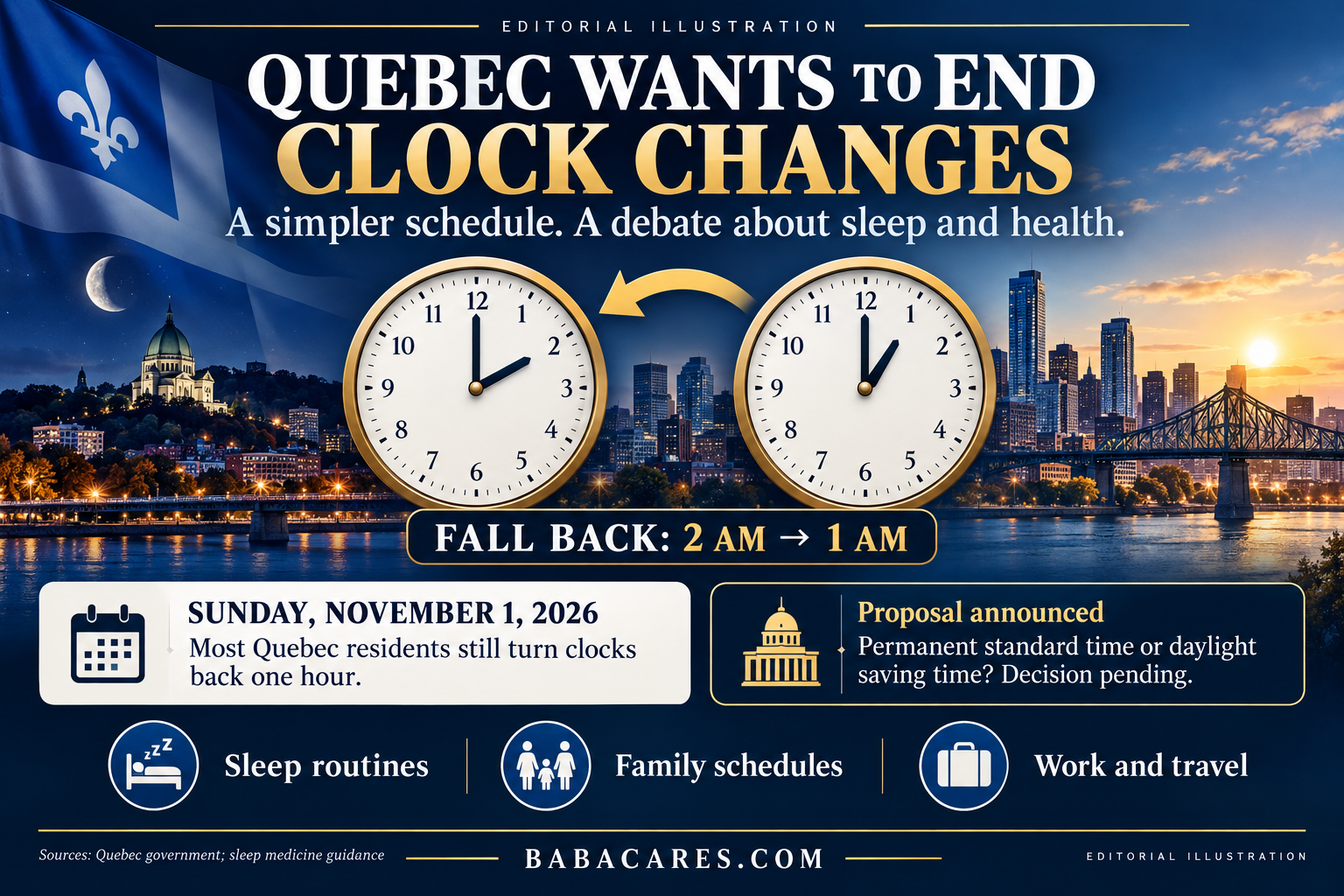
Quebec Moves to End Clock Changes: Why the Debate Is About More Than Confusion
October 29, 2026 | Babacares
Do we move the clocks forward or backwards? Will children wake earlier? And what happens to work schedules and appointments?
These familiar questions are receiving renewed attention after Quebec’s government announced plans to end the twice-yearly switch between standard time and daylight saving time.
In an October 28 announcement, Justice Minister Marie-Claude Sarrazin said the government intends to introduce legislation, following consultations with experts and the public. The province has not yet decided which time to keep permanently.
For now, the clocks still go back
Most Quebec residents should turn their clocks back one hour on Sunday, November 1, 2026, at 2 a.m., when it becomes 1 a.m.
The government hopes this will be the final adjustment, but that remains an intention requiring further action—not an already completed change to the rules.
Why changing the clock can unsettle the body
The inconvenience goes beyond remembering which direction to turn the hands.
Our internal body clock helps regulate sleep and wakefulness. Changing social schedules abruptly can disrupt that rhythm, particularly for people already short of sleep, early-morning workers and shift workers.
The spring transition is generally more disruptive because it removes an hour of sleep opportunity. Research has linked that transition with increased health and safety risks, including cardiovascular events and road crashes. The autumn adjustment is usually easier, but can still disturb routines.
For families and care providers, consistent routines matter. Children’s bedtimes, home-care visits and overnight staffing all require clear communication around the change.
Stopping the changes raises another question
There are two main options:
-
Permanent standard time: More morning daylight compared with permanent daylight saving time.
-
Permanent daylight saving time: Later evening daylight, but later winter sunrises.
Neither option creates additional daylight; it changes where daylight falls on the clock.
The American Academy of Sleep Medicine supports permanent standard time, arguing that it aligns better with human circadian biology. Ending seasonal changes and choosing the healthiest permanent time are therefore related—but separate—decisions.
Quebec must also consider coordination with neighbouring jurisdictions so that transport, business and cross-border schedules remain manageable.
How to ease the upcoming adjustment
Sleep specialists recommend protecting sleep before the transition, adjusting bedtime gradually if needed, getting morning daylight and avoiding excessive alcohol or late-day caffeine. Take extra care when driving as commuting conditions become darker.
People taking medicines on strict schedules should ask their pharmacist how to handle the time change rather than altering doses themselves.
Quebec’s proposal opens an important public-health discussion. A simpler clock system could reduce repeated disruption, but the final choice should consider sleep science, winter morning light and the practical needs of communities.
READ MORE ON BABACARES.COM, SUBSCRIBE AND SHARE.
https://www.babacares.com/blog-details?details=1120&title=Quebec+Moves+to+End+Clock+Changes%3A+Why+the+Debate+Is+About+More+Than+Confusion








Comments