

New Climate Report Warns of Rising Health Harm as Heat-Related Deaths Increase
October 29, 2026 | Babacares
Climate change is increasingly threatening people’s health, with a new international report warning that the damage is growing faster than the world’s response.
The 2026 Lancet Countdown on Health and Climate Change, released this week, tracks 54 indicators connecting climate conditions, public health and climate action. Its authors are calling for climate change to be formally recognised and addressed as a global health emergency. That call should not be confused with an announcement that WHO has formally declared such an emergency.
What does the report reveal?
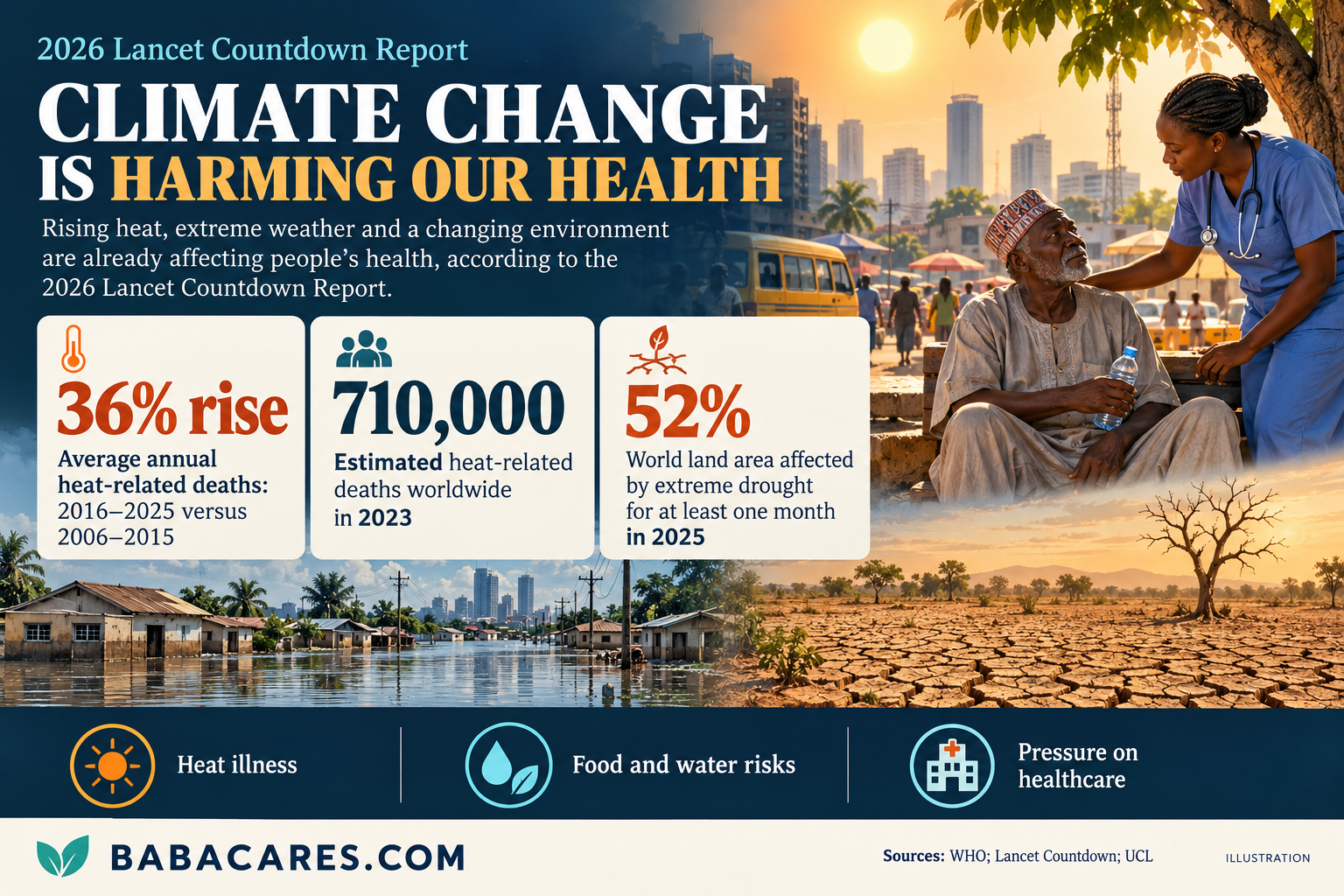
According to WHO’s summary, average annual heat-related deaths increased by nearly 36% in the decade following the Paris Agreement compared with the previous decade.
The report estimates that heat was linked to 710,000 deaths worldwide in 2023, with more than 70% attributable to human-caused climate change. These are estimates for 2023—not a count of deaths in 2026.
Researchers also report that extreme drought affected nearly 52% of the world’s land area for at least one month in 2025, highlighting growing pressures on water supplies and food security.
Why this is a health story
Climate change affects more than outdoor temperatures. WHO identifies risks from extreme weather, disrupted food supplies, water- and mosquito-borne diseases, and mental-health pressures.
Floods can damage homes and interrupt healthcare. Drought can undermine food production and access to safe water. These pressures can deepen existing inequalities, particularly where families already struggle to obtain basic services.
Older adults, children, outdoor workers and people with existing health conditions need particular protection from extreme heat.
What it means for Nigeria and Canada
For Nigerian communities, these findings underline the importance of reliable water supplies, flood preparedness, heat protection and healthcare facilities that can continue operating during emergencies. These are practical implications of the global findings, rather than new Nigeria-specific casualty estimates.
In Canada, a companion policy report highlighted by the Canadian Medical Association found that infants and adults aged 65 and older experienced about 10 heatwave days annually during 2021–2025—roughly 90% more than the 1986–2005 average.
How families can reduce heat risks
During hot weather, drink water regularly, reduce strenuous activity and spend time somewhere cool. Check on older relatives, neighbours living alone and people with chronic illnesses.
Confusion or unconsciousness alongside a high body temperature is a medical emergency. Call local emergency services and begin cooling the person while waiting for help.
There is room for progress
The report also identifies benefits from cleaner energy, reduced air pollution and better health preparedness. WHO says global clean-energy investment reached US$2.1 trillion in 2025, while early-warning systems and health adaptation planning are advancing.
Governments should build on that progress through stronger emergency planning, resilient healthcare, safer housing and protection for exposed workers.
The report’s message is clear: climate policy decisions have direct consequences for people’s health—and effective action can save lives.
READ MORE ON BABACARES.COM, SUBSCRIBE AND SHARE.
https://www.babacares.com/blog-details?details=1117&title=New+Climate+Report+Warns+of+Rising+Health+Harm+as+Heat-Related+Deaths+Increase










Comments