

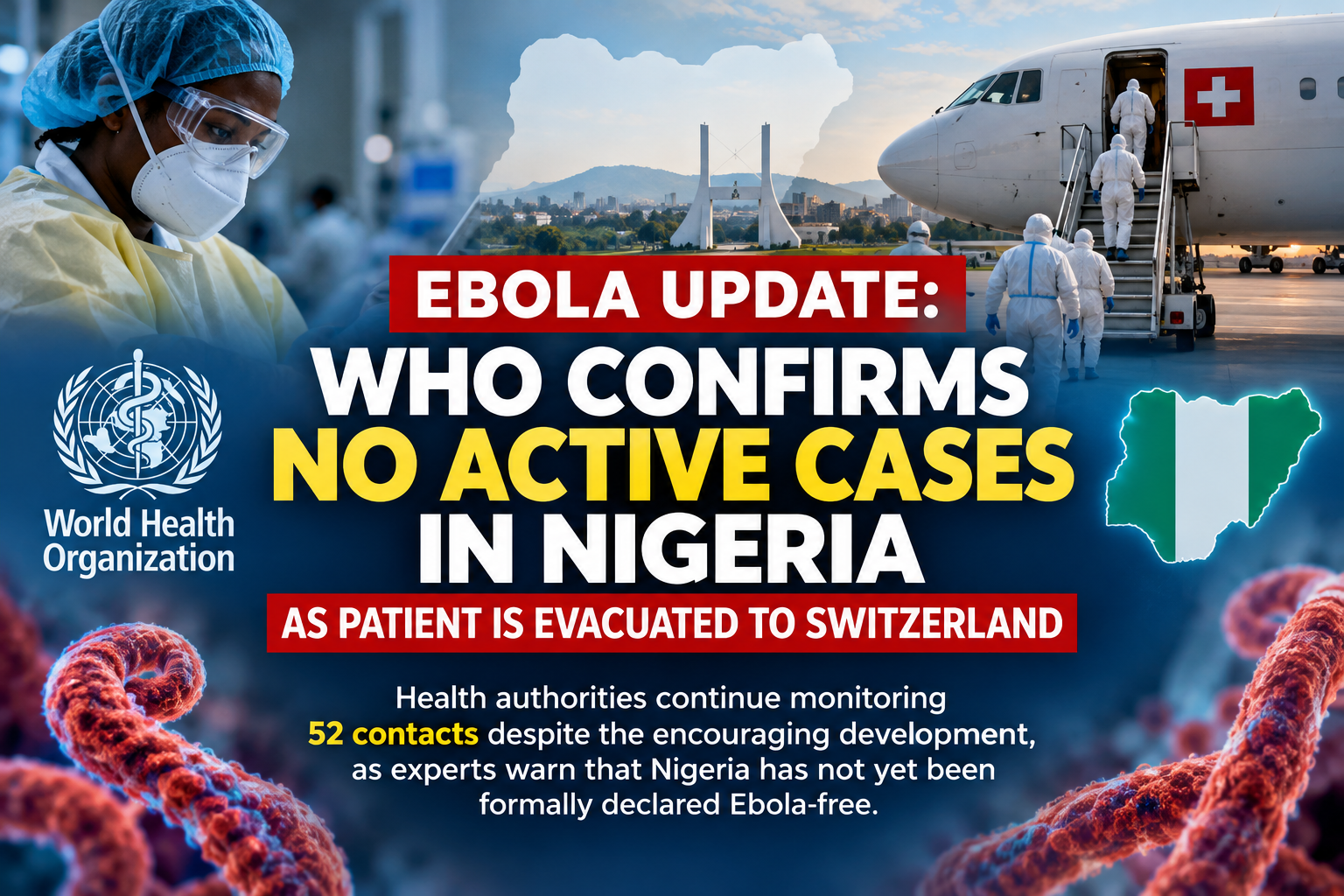
EBOLA UPDATE: WHO: Nigeria Has No Active Ebola Cases After Evacuation of Patient, but 52 Contacts Remain Under Surveillance.
Health authorities continue monitoring 52 contacts despite the encouraging development, as experts warn that Nigeria has not yet been formally declared Ebola-free.
By Babacares Health and Public Affairs Desk | October 26, 2026
Nigeria currently has no active Ebola patients within its borders following the evacuation of its only confirmed patient to Switzerland, the World Health Organization (WHO) has announced.
The development comes just six days after Nigeria confirmed its first imported Ebola infection in more than a decade.
WHO Regional Director for Africa, Professor Mohamed Janabi, announced on Monday, October 26, that the infected woman and her husband had been medically evacuated from Abuja to Switzerland.
The patient, a Swiss national, had been receiving treatment in Nigeria after laboratory testing confirmed infection with the Bundibugyo Ebola virus on October 20.
According to WHO, her condition had improved sufficiently for medical evacuation under strict infection-control arrangements.
However, the absence of an active Ebola patient in Nigeria does not mean the country has been formally declared free of the disease.
Nigerian Health Workers Praised for Their Response
Nigeria's Coordinating Minister of Health and Social Welfare, Professor Muhammad Ali Pate, confirmed that the patient had shown significant clinical improvement.
She was reportedly conscious, communicating and clinically stable before her evacuation.
Nevertheless, the minister cautioned that she could still be infectious, explaining why strict medical precautions were maintained throughout the transfer.
Professor Janabi commended Nigerian healthcare professionals, emergency responders and public-health institutions for successfully stabilizing the patient during the acute phase of her illness.
The development highlights the importance of coordinated emergency care, infection prevention and rapid public-health response.
What Happens to the 53 Identified Contacts?
Before the evacuation, the Nigeria Centre for Disease Control and Prevention (NCDC) had identified 53 contacts associated with the confirmed patient.
Following the evacuation:
-
52 contacts remain under surveillance in Nigeria.
-
One contact, the patient's husband, will be monitored in Switzerland.
-
Swiss medical authorities will manage the patient's continued treatment.
The husband reportedly remained without symptoms at the time of evacuation.
Contact monitoring is essential because Ebola symptoms can develop between two and 21 days after exposure.
Public-health authorities must therefore continue observing identified contacts for the appropriate period.
Why Nigeria Is Not Yet Officially Ebola-Free
Although there are no active patients currently receiving treatment in Nigeria, the risk of further infection cannot be completely dismissed until surveillance requirements have been satisfied.
Under WHO guidance, an Ebola outbreak may be declared over after 42 days without new confirmed cases, calculated from the relevant last infectious event.
This observation period is designed to provide greater confidence that transmission has stopped.
Consequently, the evacuation of Nigeria's only confirmed patient represents progress, but not the formal conclusion of the country's Ebola response.
How Nigeria's Ebola Case Developed
Nigeria confirmed the infection on October 20 after a woman who had recently travelled from Uganda tested positive for the Bundibugyo Ebola virus.
She reportedly arrived in Abuja on October 3 and developed symptoms several days later.
The case prompted contact tracing, disease surveillance and enhanced screening measures.
Nigeria subsequently expanded health declaration requirements for international arrivals as part of its preventive response.
The source of the woman's infection remains under investigation.
Genomic analysis has indicated similarities between the virus detected in Nigeria and one identified in Kenya, but a direct transmission connection has not been established.
The Public-Health Lesson for Nigeria
The latest development offers an opportunity to evaluate Nigeria's healthcare preparedness.
The successful stabilization of the patient demonstrates the value of trained healthcare workers and coordinated medical intervention.
However, the incident also raises questions about the speed of diagnosis, infection-control readiness, border surveillance and the availability of specialized treatment facilities.
Nigeria must ensure that both public and private hospitals can recognize suspected infectious diseases promptly.
Healthcare workers also require appropriate protective equipment, training and access to reliable laboratory services.
A strong healthcare system should not merely respond when an outbreak is confirmed. It should be prepared to identify potential threats before they spread.
Babacares Perspective: An Encouraging Development, Not the End of Vigilance
At Babacares, we welcome the news that Nigeria currently has no active Ebola patients.
The efforts of healthcare professionals, emergency responders and public-health authorities deserve recognition.
Nevertheless, removing the only infected patient from the country does not automatically eliminate the possibility of further transmission.
The remaining contacts must complete surveillance, while health authorities continue monitoring for suspected cases.
Nigerians should rely on information from NCDC, WHO and other credible public-health institutions.
There is no justification for unnecessary panic, but complacency must also be avoided.
Conclusion: Nigeria Must Consolidate Its Progress
Nigeria's experience with Ebola in 2014 demonstrated that effective surveillance, contact tracing and coordinated medical response can prevent a wider public-health emergency.
The latest development provides another opportunity to strengthen those systems.
With the confirmed patient receiving further treatment in Switzerland and 52 contacts still under surveillance in Nigeria, the country's immediate responsibility is to ensure that no additional transmission occurs.
Nigeria may currently have no active Ebola patients, but the real public-health achievement will be preventing further infections and completing the required surveillance successfully.
THE BABACARES QUESTION
Has Nigeria developed a stronger and more responsive healthcare system since the 2014 Ebola outbreak, or does the latest incident reveal areas requiring further improvement?
Nigerians deserve transparent communication, strong disease surveillance and a healthcare system capable of responding rapidly to emerging infectious threats.
READ MORE ON BABACARES.COM, SUBSCRIBE AND SHARE.
References
-
Punch — Nigeria Has No Active Ebola Cases After Patient's Evacuation, WHO, October 26, 2026
-
TheCable — WHO Clarifies Nigeria Has Not Been Declared Ebola-Free, October 26, 2026
Editorial note: This report reflects the information available on October 26, 2026. The absence of active Ebola patients in Nigeria should not be confused with formal certification that the outbreak has ended.









Comments