

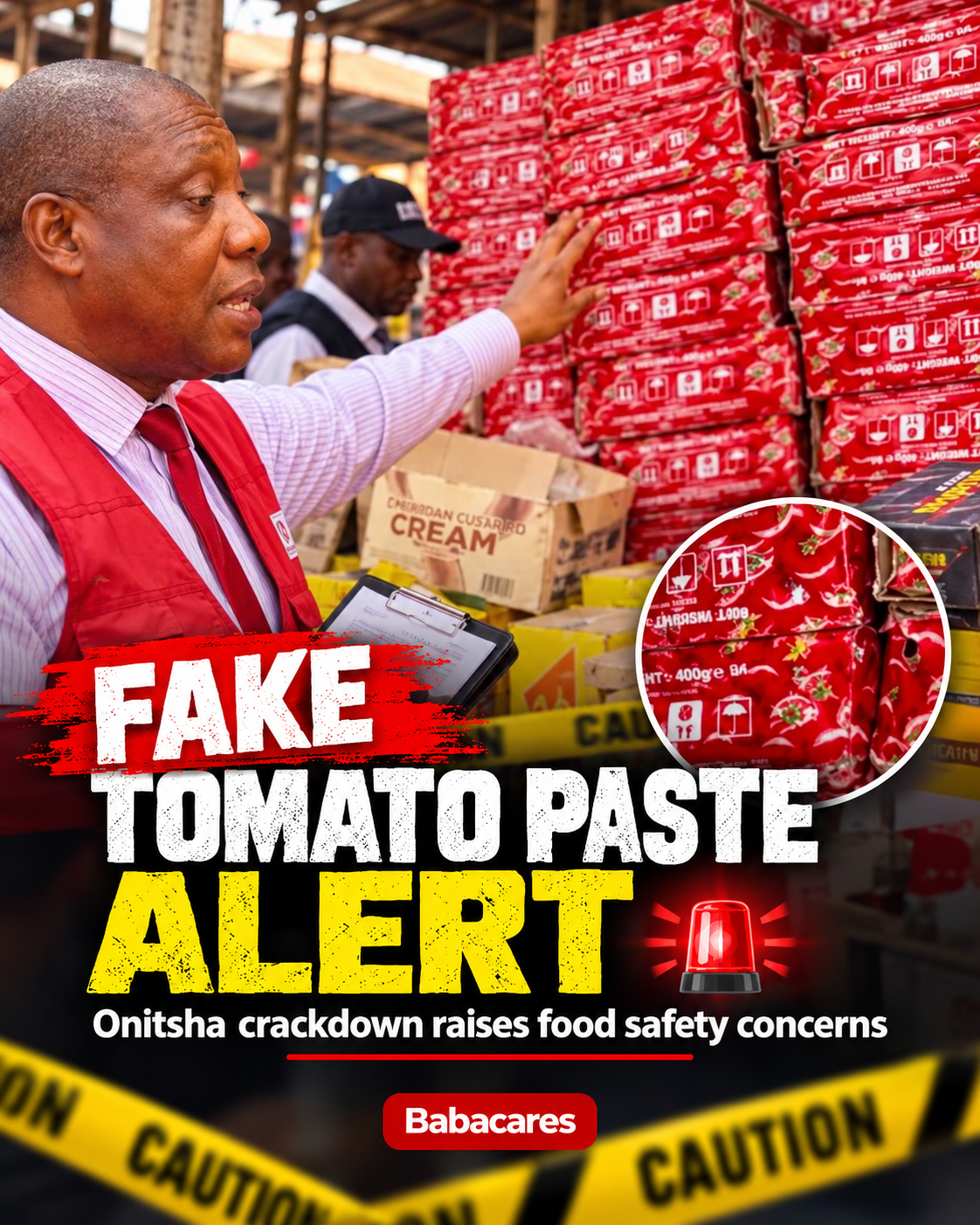
FAKE TOMATO PASTE IN NIGERIA: NAFDAC UNCOVERS ALLEGED COUNTERFEIT PRODUCTS IN ONITSHA, RAISING FOOD SAFETY CONCERNS
Babacares Health and Consumer Safety Report | October 23, 2026
Imagine buying tomato paste to prepare a family meal, only to discover that the NAFDAC registration number printed on the package actually belongs to a sachet-water product.
That is the troubling deception reportedly uncovered during a recent enforcement operation by Nigeria's National Agency for Food and Drug Administration and Control (NAFDAC) at Bowa Market, Onitsha, Anambra State.
According to reports published on October 22, 2026, NAFDAC identified imported tomato paste marketed under the name "Pur" bearing an improperly used registration number. The number reportedly belonged to a different product category altogether — sachet water.
GISTSMATE
+1
For millions of Nigerian families who rely on tomato paste for everyday cooking, the discovery raises an important question: How can consumers be sure that the packaged foods they buy are genuine, properly registered and safe?
A registration number that tells a different story
In the circulating video shared in the screenshots reviewed by Babacares, a man displays cartons of packaged products while warning Nigerians about allegedly illegal goods.
The footage carries the warning: "These are illegal products. Avoid them!"
The accompanying description refers to a tomato paste product allegedly bearing a NAFDAC number associated with sachet water.
Separate news reporting supports the central allegation concerning the misuse of a registration number in the Onitsha enforcement operation. However, Babacares has not independently authenticated the original footage, verified every package displayed, or obtained laboratory results establishing the chemical composition of the seized products.
This distinction matters. A fraudulent registration number is evidence of regulatory deception, but it does not by itself establish that a product contains a particular toxic substance.
Why this is a public health concern
Tomato paste is a common ingredient in Nigerian households, restaurants, roadside food businesses and school kitchens.
Counterfeit or unregulated food products can create several potential health risks:
-
Food contamination: Poor manufacturing conditions may expose products to harmful microorganisms.
-
Unapproved ingredients: Undeclared colouring agents, fillers or preservatives may create safety concerns.
-
Allergic reactions: Consumers may unknowingly ingest ingredients not disclosed on the label.
-
Misleading certification: Fake registration details can give consumers false confidence in a product's safety.
Importantly, these are potential hazards associated with inadequately controlled food production. They have not all been demonstrated in the particular Onitsha tomato paste products.
The concern extends beyond a single market. On October 17, Channels Television reported that NAFDAC had destroyed approximately ₦2.6 billion worth of fake, substandard and unwholesome goods in Rivers State, including tomato paste, pharmaceuticals and other products intercepted at Onne Port.
Channels Television
The bigger problem: Counterfeit products and consumer trust
The reported Onitsha discovery highlights a weakness in consumer protection: people often assume that a registration number printed on a product guarantees authenticity.
Yet criminals may copy genuine numbers and place them on completely unrelated goods.
This threatens legitimate manufacturers, undermines confidence in food regulation and may expose consumers to products that have escaped proper safety checks.
For Babacares, the solution must go beyond periodic seizures. There is a need for stronger market surveillance, accessible product verification, traceability and sustained public education.
What should NAFDAC, SON and NOA do?
NAFDAC should publish clear product-specific alerts identifying affected brands, packaging, registration numbers and relevant batch details. Where necessary, independent laboratory testing should establish the nature of any contamination or adulteration.
The Standards Organisation of Nigeria (SON) should strengthen collaboration on packaging standards, product identification and manufacturing compliance within its legal mandate.
The National Orientation Agency (NOA) should support public education campaigns in English, Yoruba, Igbo, Hausa and other Nigerian languages, particularly through market associations, radio and community outreach.
Retailers and distributors must also take responsibility by checking the legitimacy of their suppliers and cooperating with regulators when suspicious products are identified.
What Nigerian consumers should do
Before buying packaged tomato paste or other food products, consumers should examine the label, packaging integrity, expiry date, manufacturer's details and NAFDAC registration information.
Registration details can be checked through NAFDAC's official website. Suspicious products should be reported to the regulator, preferably with photographs, purchase details and the batch number.
Consumers should also avoid circulating unverified lists that condemn entire brands. On October 23, 2026, Africa Check reported that NAFDAC had disowned a widely circulated list of more than 100 allegedly fake products.
Africa Check
Babacares perspective: Food safety is everybody's business
A counterfeit product is not simply a commercial offence. It can become a public health problem when consumers are unable to establish what they are feeding their families.
Nigeria needs a food safety system that prevents dangerous or illegally marketed products from reaching the kitchen, rather than relying exclusively on seizures after distribution.
The reported Onitsha discovery should therefore trigger further investigation, transparent regulatory communication and improved protection for consumers and legitimate manufacturers.
The question is no longer simply whether a product carries a NAFDAC number. The question is whether that number genuinely belongs to the product consumers are buying.
READ MORE ON BABACARES.COM, SUBSCRIBE AND SHARE.
References
-
Daily Economy — NAFDAC seizes fake tomato paste in market, October 22, 2026
-
Gistsmate — Report on Pur tomato paste in Onitsha, October 22, 2026
-
Channels Television — NAFDAC destruction of substandard goods, October 17, 2026
Editorial verification: The Onitsha incident is supported by news reports citing NAFDAC. Babacares has not located a separate, product-specific NAFDAC laboratory report confirming the contents or toxicity of the tomato paste. The screenshots should be credited as circulating social media footage rather than treated as independent proof of laboratory findings.








Comments