

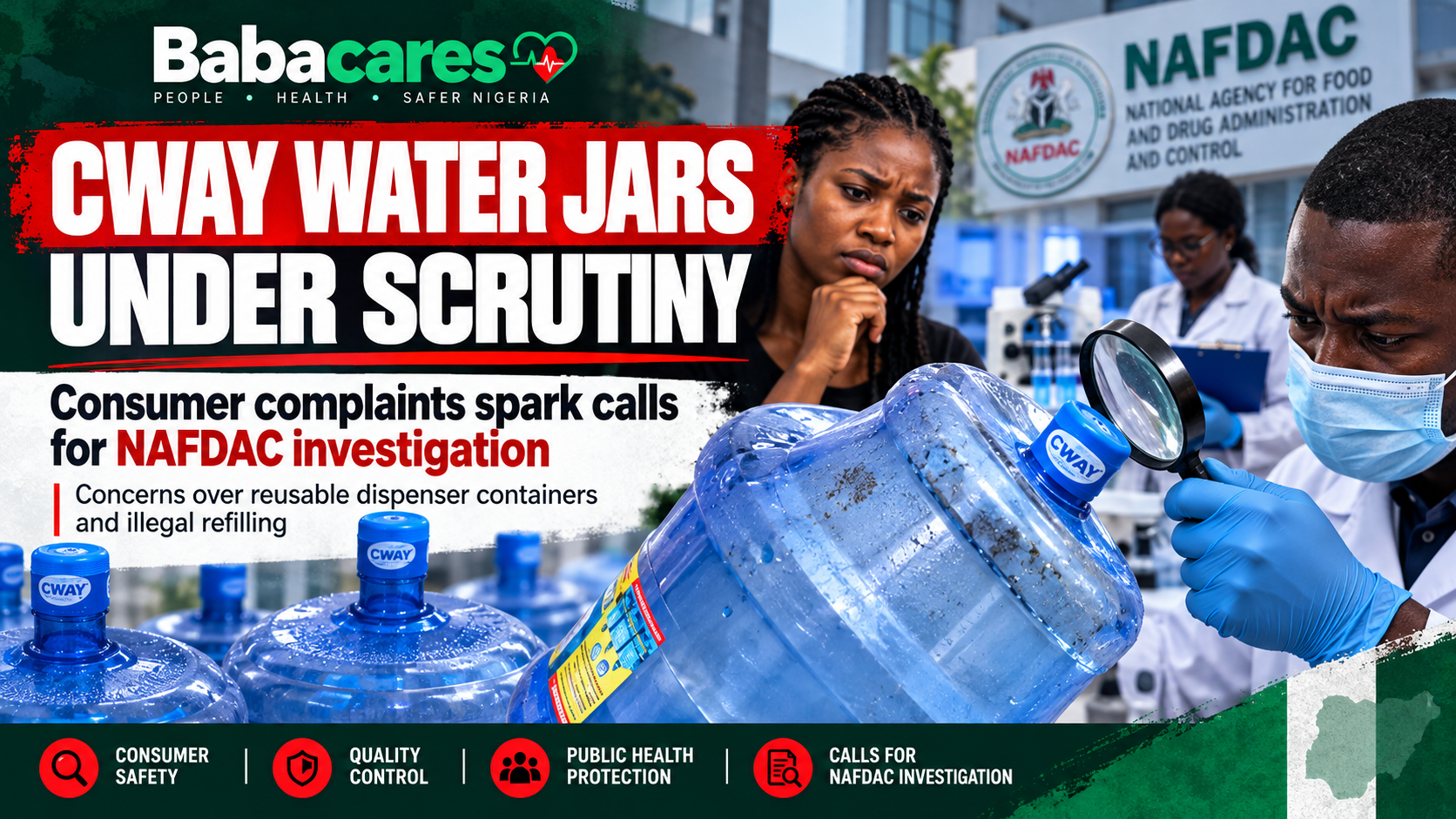
CWAY WATER JARS UNDER SCRUTINY: CONSUMER COMPLAINTS SPARK CONTAMINATION FEARS AS BABACARES CALLS FOR NAFDAC INVESTIGATION
Following viral videos questioning the cleanliness of reusable CWAY water containers, Lagos authorities have inspected the company's facility. Separate revelations about the illegal refilling of branded water jars raise further concerns about consumer safety.
By Babacares Health and Public Affairs Desk | October 23, 2026
How safe is the water Nigerians drink from the large refillable dispensers found in homes, offices, hospitals, hotels and restaurants?
This question has returned to public attention following complaints about the condition of CWAY-branded water dispenser containers.
A video circulated by Nigerian social-media commentator Scott Iguma shows several blue water dispenser jars, with the presenter questioning their condition and apparent cleanliness.
The footage has attracted significant public attention and raised concerns about whether reusable water containers are being properly inspected, cleaned and maintained before being returned to consumers.
But an important distinction must be made.
A dirty-looking container is a legitimate reason for concern, but it is not scientific proof that the drinking water inside is contaminated.
That determination requires proper sampling, laboratory testing and regulatory assessment.
Nevertheless, the public deserves answers, particularly because packaged drinking water is consumed daily by millions of Nigerians.
Lagos Government Already Investigated Consumer Complaints
On September 24, 2026, the Lagos State Consumer Protection Agency (LASCOPA) conducted an unscheduled inspection of CWAY's water production facility following a viral video and consumer complaints.
Officials examined the production process, including bottle filling, capping, labelling, transportation, storage and distribution.
During the visit, inspectors observed plastic containers that had been separated because they were considered unsuitable for continued use.
CWAY representatives explained that rejected containers were processed for recycling, with company records reportedly indicating that approximately 1,000 bottles were discarded daily.
LASCOPA subsequently recommended stronger controls over container cleaning, handling and replacement.
The agency also advised the company to establish a defined service life for reusable bottles and improve distributor training, particularly concerning transportation and exposure to sunlight.
These recommendations suggest that the safety of reusable containers deserves continuous monitoring throughout their service life.
However, the published findings did not establish that CWAY's water was contaminated or unsafe for consumption.
A More Troubling Discovery: Illegal Refilling of CWAY-Branded Containers
Even before the September inspection, NAFDAC had disclosed another serious problem.
At a media briefing in September 2026, NAFDAC Director-General Professor Mojisola Christianah Adeyeye reported that three companies had been found using empty CWAY-branded 19-litre containers without authorization.
According to her account, the operators collected branded containers, refilled them with water from unapproved sources and distributed the products to hotels and supermarkets.
NAFDAC said the operators had been sanctioned.
This is an important development because it introduces a separate threat to public health: counterfeit water products being presented to consumers in containers associated with a recognized brand.
A genuine-looking CWAY container does not necessarily prove that the water inside came from an authorized CWAY production facility.
The alleged activities of unauthorized refillers must not be confused with the company's legitimate production operations.
Nevertheless, both manufacturers and regulators have a responsibility to strengthen product traceability and protect consumers against fraudulent distribution.
Why Reusable Water Jars Require Strict Hygiene
Large water dispenser containers are typically designed for repeated use.
That makes proper collection, inspection, washing, sanitization, filling and sealing particularly important.
Poorly maintained containers can create opportunities for microbial contamination.
Scratches, damaged surfaces and inadequate washing may make containers harder to clean effectively.
Similarly, contamination can occur after processing if containers are mishandled, refilled improperly or exposed to unsanitary conditions.
According to the United States Centers for Disease Control and Prevention (CDC), safe water storage requires clean, properly sanitized containers that are protected from contamination.
For commercially packaged drinking water, the responsibility goes beyond the water treatment process itself.
The container, dispensing system, transport arrangements and distribution network all matter.
The Public-Health Implications
Contaminated drinking water can transmit disease-causing microorganisms.
Depending on the contaminant, exposure may lead to diarrhoea, vomiting, abdominal discomfort and other illnesses.
Young children, older adults and people with weakened immune systems may face greater risks from certain waterborne infections.
However, Babacares emphasizes that no laboratory evidence reviewed for this article establishes that the specific CWAY jars shown in the viral video contained harmful bacteria or other contaminants.
The concern is about potential exposure and the need for independent testing—not a confirmed outbreak of waterborne disease.
What Should NAFDAC Do?
Babacares calls on the National Agency for Food and Drug Administration and Control to provide a clearer public update on the safety and regulation of reusable dispenser water containers.
Several actions deserve consideration.
First, independent product sampling. NAFDAC should consider risk-based laboratory testing of sealed dispenser water obtained from factories, distributors, retail outlets and consumer delivery points.
Second, container hygiene verification. Inspectors should establish whether returned bottles are adequately examined, washed, sanitized and rejected when no longer suitable.
Third, stronger anti-counterfeiting measures. NAFDAC should publish information that helps consumers identify authorized distributors and suspiciously refilled containers.
Fourth, public disclosure of findings. Where testing identifies contamination or regulatory breaches, authorities should communicate verified results and appropriate corrective actions.
Fifth, continued follow-up inspections. The recommendations already made by LASCOPA should be monitored to determine whether improvements have been implemented.
These steps would help protect consumers while also ensuring that manufacturers are evaluated fairly on evidence.
What CWAY Should Explain to Consumers
CWAY also has an opportunity to address public concerns through transparent communication.
Consumers deserve to understand how reusable containers are collected, inspected, sanitized and returned to service.
The company should explain how it distinguishes authorized refill operations from counterfeit products and how customers can verify the legitimacy of their suppliers.
It would also be useful for CWAY to clarify its procedures for withdrawing scratched, damaged or aging containers.
According to reporting on the September inspection, CWAY maintained that it was committed to producing safe, quality drinking water in accordance with applicable standards.
That position should be considered alongside independent regulatory findings.
Consumer confidence is strengthened by verifiable quality-control systems, not merely assurances.
How Nigerians Can Protect Themselves
Consumers should take reasonable precautions when purchasing refillable dispenser water.
-
Inspect containers for visible dirt, foreign particles, cracks or damaged seals.
-
Check that labels and product identification are clear.
-
Purchase from recognized, authorized distributors.
-
Avoid drinking water from a container if the seal appears compromised or the water has an unusual appearance or odour.
-
Keep receipts, delivery information, batch details and photographs when submitting complaints.
-
Clean household water dispensers according to the manufacturer's recommendations.
If water appears suspicious, consumers should not use it until its safety is established.
They should preserve the container and report the concern to the manufacturer and relevant regulatory authorities.
Consumers should also remember that clear-looking water is not necessarily free from microbiological contamination.
Babacares Perspective: Public Complaints Deserve Scientific Investigation
As a healthcare worker and public-health communicator, I believe Nigerians should never be discouraged from reporting concerns about products they consume.
The viral video raises questions that deserve proper examination.
However, companies should not be declared guilty of contamination simply because of social-media allegations.
The appropriate response is transparent investigation, independent testing and evidence-based regulatory action.
The separate discovery of illegal refilling operations makes this issue even more important.
It demonstrates why protecting drinking water requires oversight not only of manufacturers but also of distribution networks and individuals who may misuse branded containers.
The question is no longer simply whether a water jar looks clean. It is whether consumers can trust the entire process through which drinking water reaches their homes.
Conclusion: Nigerians Deserve Safe Water and Clear Answers
The concerns surrounding CWAY water dispenser jars have already attracted regulatory attention.
LASCOPA has inspected the company's facility and recommended improvements in packaging, handling and distribution.
NAFDAC has separately disclosed enforcement action against unauthorized operators accused of refilling CWAY-branded containers with water from unapproved sources.
These developments justify closer examination of Nigeria's refillable drinking-water supply chain.
They do not, however, establish that all CWAY water is contaminated or unsafe.
Babacares therefore calls for transparent regulatory follow-up, independent laboratory testing where warranted, effective anti-counterfeiting measures and clear public communication.
Safe drinking water is not a luxury. It is a fundamental public-health necessity.
THE BABACARES QUESTION
When Nigerians purchase a sealed 19-litre water dispenser jar, how can they be certain that the water has been properly treated, the container adequately sanitized and the product supplied through an authorized distribution channel?
We invite NAFDAC, LASCOPA, CWAY and concerned consumers to contribute verified information to this important public-health discussion.
READ MORE ON BABACARES.COM, SUBSCRIBE AND SHARE.
References
-
Premium Times. LASCOPA Asks CWAY to Improve Storage, Distribution of Bottled-Water Products, September 24, 2026. https://www.premiumtimesng.com/health/health-news/912140-lascopa-asks-cway-to-improve-storage-distribution-of-bottled-water-products.html
-
TVC News. Lagos Inspects CWAY Water Factory After Viral Video, Flags Packaging Concerns, September 24, 2026. https://www.tvcnews.tv/lagos-inspects-cway-water-factory-after-viral-video-flags-packaging-concerns/
-
Punch. NAFDAC Destroyed N1.5tn Fake Products in Three Years – DG, September 2026. https://punchng.com/nafdac-destroyed-n1-5tn-fake-products-in-three-years-dg/
-
The Guardian Nigeria. NAFDAC Records 64 Convictions in One Year, Intensifies Crackdown on Fake Products, September 2026. https://guardian.ng/news/nafdac-records-64-conviction-in-one-year-intensifies-crackdown-on-fake-products/
-
NAFDAC. Handling Consumer Complaints. https://nafdac.gov.ng/our-services/pharmacovigilance-post-market-surveillance/handling-consumer-complaint/
-
CDC. Safe Water Storage. https://www.cdc.gov/global-water-sanitation-hygiene/about/about-safe-water-storage.html
-
Social-media video attributed to Scott Iguma, supplied to Babacares. The video raises concerns about reusable CWAY-branded containers but does not constitute independent laboratory evidence of contamination.
Editorial disclosure: This investigation separates consumer allegations, reported regulatory findings and Babacares' public-health recommendations. No confirmed laboratory finding of contamination involving the specific containers shown in the supplied video was established during this review.






Comments