

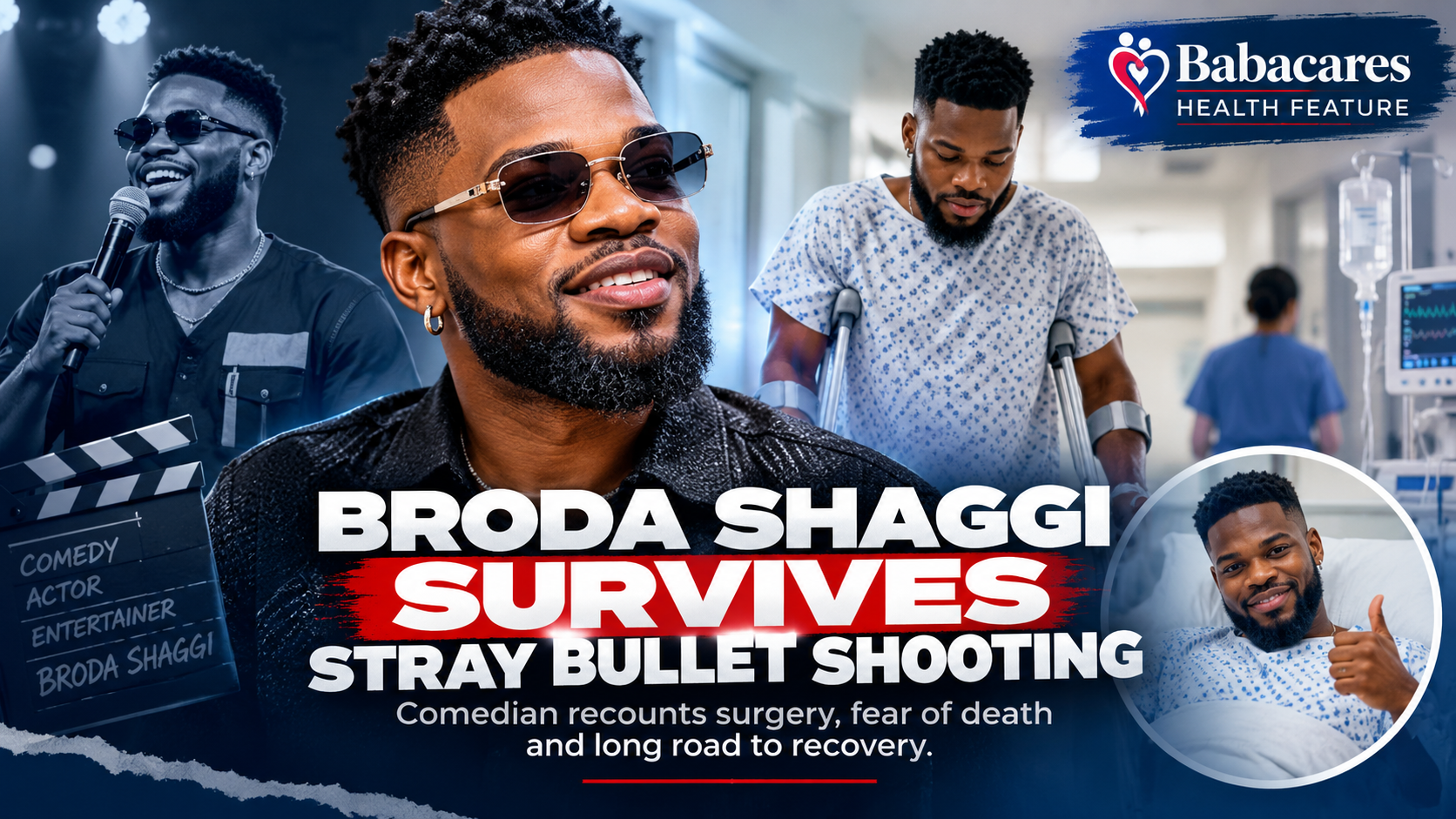
BRODA SHAGGI SURVIVES STRAY BULLET SHOOTING: COMEDIAN RECOUNTS SURGERY, FEAR OF DEATH AND LONG ROAD TO RECOVERY.
After months away from comedy and social media, popular Nigerian entertainer Broda Shaggi shares how a gunshot injury nearly ended his career—and why his experience raises important questions about emergency healthcare, rehabilitation and safety in Nigeria's entertainment industry.
By Babacares Health and Public Affairs Desk | October 22, 2026
For years, he made millions of Nigerians laugh. But when a stray bullet struck him, popular comedian Broda Shaggi found himself confronting something no joke could resolve—the possibility of losing his life and the ability to perform again.
Nigerian skit maker, comedian and actor Samuel Animashaun Perry, popularly known as Broda Shaggi, has returned to public attention with an emotional account of the gunshot injury that kept him away from entertainment for several months.
In a documentary titled Second Chance (The Story), released on October 21, 2026, the entertainer described the fear, pain, medical treatment and difficult recovery that followed the incident.
His experience is not merely a celebrity survival story. It raises serious questions about emergency medical response, trauma care, rehabilitation and the physical and psychological consequences of gun violence.
How Broda Shaggi Was Shot
According to his account, the incident occurred on March 9, 2026, after he and his production team had completed a brand activation assignment.
They were reportedly caught in traffic when he suddenly heard a loud bang.
Moments later, he noticed blood around his hip and realised that he had been struck by what he described as a stray bullet.
Earlier reports placed the incident around the Sango-Ota area, although authorities initially disputed whether it occurred within Ogun State.
The identity of the person who fired the bullet and the precise circumstances of the discharge have not been publicly established.
From Comedy to Emergency Surgery
Broda Shaggi recounted the terrifying journey to hospital, during which he feared he might not survive.
He reportedly lost consciousness before reaching the hospital, where he received initial emergency treatment.
Following further assessment, he underwent surgery in Nigeria.
However, his recovery proved challenging.
The comedian said he was advised that additional treatment and physiotherapy would be necessary.
After approximately four months, he sought further medical care in Dubai.
According to his account, the treatment helped him regain mobility, progressing from being unable to walk to standing with support and eventually using crutches.
As of his October account, he reported that he could stand without crutches but still needed them to support his walking.
His recovery was therefore encouraging, although not necessarily complete.
The Emotional Pain Behind the Laughter
Perhaps the most moving aspect of Broda Shaggi's experience was his fear that the injury could permanently end his career.
Known for energetic comedy, dancing, singing and physical performances, the entertainer struggled with the possibility that he might never return to the activities that defined his professional life.
He also worried that his prolonged absence would cause audiences to forget him.
These fears illustrate an important aspect of serious physical injury that is sometimes overlooked.
Recovery is not simply about healing bones, muscles or damaged tissues.
It can also involve fear, uncertainty, loss of independence, financial concerns and emotional distress.
People recovering from traumatic injuries may experience anxiety, depressed mood, disturbed sleep or trauma-related symptoms.
Some require psychological support alongside physical rehabilitation.
Why Rehabilitation Matters After a Gunshot Injury
A gunshot injury can damage muscles, nerves, bones and blood vessels, depending on the location and severity of the wound.
Treatment may involve emergency stabilization, surgery, wound care, infection prevention, pain management and rehabilitation.
Physiotherapy can help patients regain strength, balance, movement and independence.
However, recovery varies considerably between individuals.
Broda Shaggi's experience demonstrates why trauma care should not end when a patient leaves the operating theatre.
Patients may require months of coordinated follow-up involving surgeons, rehabilitation professionals and other healthcare providers.
A Bigger Question About Nigeria's Emergency Healthcare System
Broda Shaggi's experience also raises a difficult public-health question:
What happens to an ordinary Nigerian who suffers a similarly serious injury but cannot afford prolonged treatment or specialized rehabilitation?
Emergency medical care must be accessible beyond major urban centres and private hospitals.
Victims of traumatic injuries may face challenges involving ambulance availability, transport delays, surgical capacity, treatment costs and rehabilitation services.
An effective trauma-care system should provide timely treatment and continuity of care, regardless of the patient's financial circumstances.
His case does not, by itself, prove that his Nigerian medical care was inadequate. However, his decision to seek additional treatment abroad raises broader questions about the availability and affordability of specialist rehabilitation within Nigeria.
Safety in Nigeria's Creative Industry
The incident should also prompt conversations about the safety of actors, skit makers and production crews.
Content creators frequently work on busy streets, highways, markets and other public locations.
Production teams should assess potential hazards, secure appropriate filming permissions and establish emergency response plans.
Where necessary, trained safety personnel should be available.
Creative work should not expose entertainers and crew members to avoidable dangers.
However, the available evidence does not establish that failures in Broda Shaggi's production arrangements caused the shooting.
Babacares Perspective: Healing Is More Than Surviving
As a healthcare worker and public-health communicator, I believe Broda Shaggi's story highlights something important about recovery.
Surviving a traumatic injury is a major achievement, but rebuilding mobility, independence and emotional confidence can take much longer.
His courage in discussing his fears may encourage other injury survivors to recognize that recovery is not always straightforward.
It also reminds us of the importance of rehabilitation, family support, mental-health care and continuity of treatment.
The comedian's return is encouraging, but his experience should also inspire discussion about improving trauma care for people who do not have the resources or public recognition of a successful entertainer.
Conclusion: A Second Chance at Life
Broda Shaggi's journey from a life-threatening shooting to a gradual return to entertainment is a story of survival, resilience and medical rehabilitation.
For someone whose profession revolves around making others laugh, the months of pain and uncertainty represented an extraordinary personal challenge.
His return offers hope to fans and encouragement to people recovering from serious injuries.
But the bigger lesson is that surviving an emergency should not depend on fame, wealth or the ability to travel abroad for specialized treatment.
Every Nigerian deserves timely emergency care and appropriate rehabilitation.
THE BABACARES QUESTION
If an ordinary Nigerian suffered a similar gunshot injury, would the country's healthcare system provide the emergency treatment, surgery and rehabilitation needed for recovery?
And what more should Nigeria do to protect entertainers and production crews working in public spaces?
We wish Broda Shaggi continued healing, restored strength and a fulfilling return to his career.
READ MORE ON BABACARES.COM, SUBSCRIBE AND SHARE.
References
-
Premium Times. I Didn't Want to Die — Broda Shaggi Opens Up About Stray-Bullet Shooting, Surgery, October 21, 2026. https://www.premiumtimesng.com/entertainment/naija-fashion/919041-i-didnt-want-to-die-broda-shaggi-opens-up-about-stray-bullet-shooting-surgery.html
-
Punch. Broda Shaggi Recounts Survival After Stray Bullet Injury, October 22, 2026. https://punchng.com/broda-shaggi-recounts-survival-after-stray-bullet-injury/
-
BellaNaija. Broda Shaggi Reveals He Was Hit by a Stray Bullet in New Documentary, October 21, 2026. https://www.bellanaija.com/2026/10/broda-shaggi-stray-bullet-survival-return-documentary/
-
Punch. Confusion Trails Alleged Shooting of Broda Shaggi as Police Start Probe, March 14, 2026. https://punchng.com/confusion-trails-alleged-shooting-of-broda-shaggi-as-police-starts-probe/
Editorial note: Broda Shaggi's account confirms that he suffered a gunshot injury and received prolonged medical treatment. The identity of the shooter and full circumstances of the shooting remain unresolved in the public reporting reviewed.







Comments