

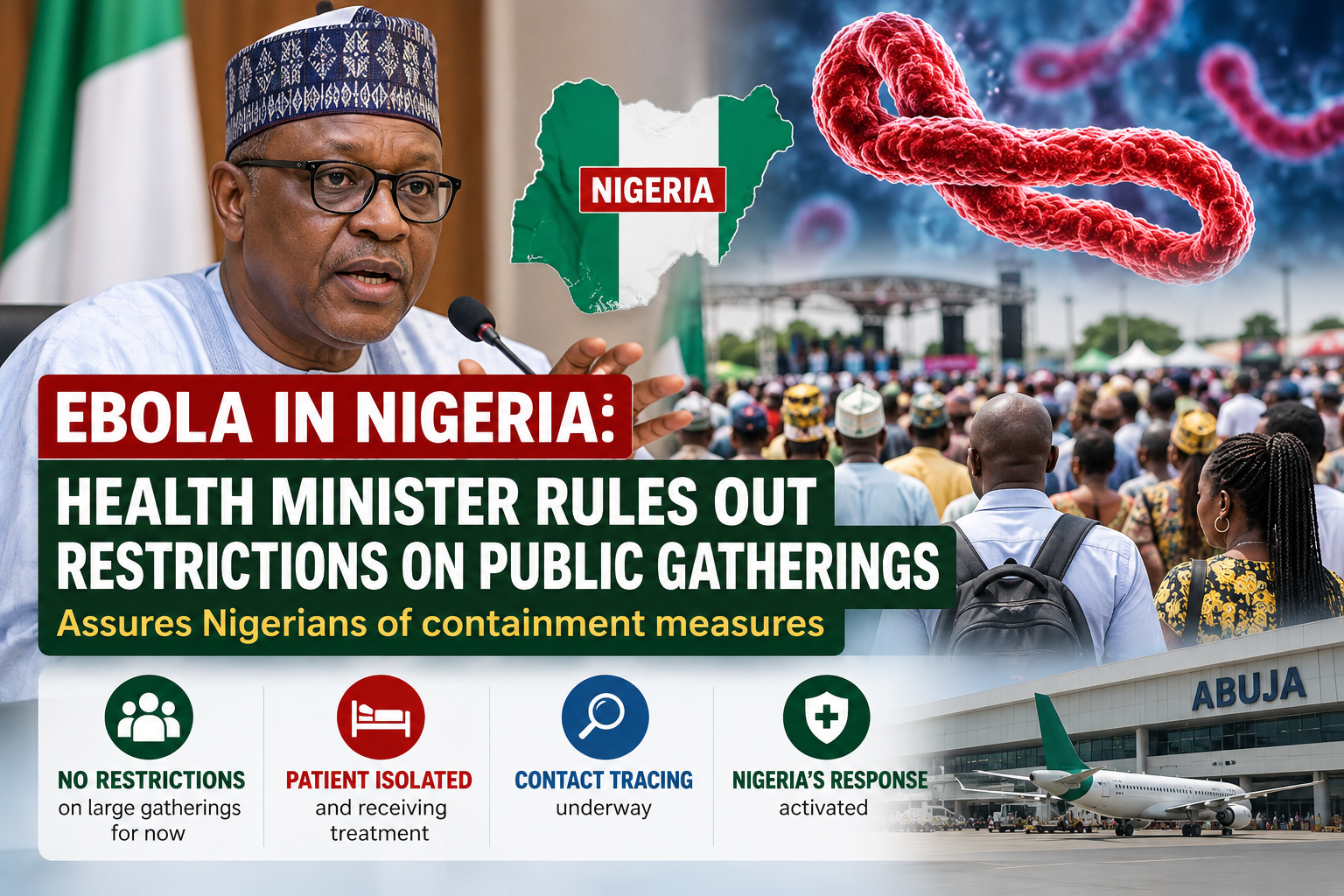
EBOLA IN NIGERIA: HEALTH MINISTER RULES OUT RESTRICTIONS ON PUBLIC GATHERINGS, ASSURES NIGERIANS OF CONTAINMENT
As Nigeria confirms its first Ebola case in more than a decade, Health Minister Muhammad Ali Pate says there is no immediate reason to cancel political campaigns, conferences or other large gatherings.
By Babacares Health and Public Affairs Desk | October 22, 2026
Nigerians can continue attending political rallies, religious programmes, conferences and other large public gatherings despite the confirmation of Ebola in Abuja, according to the Federal Government.
Coordinating Minister of Health and Social Welfare, Professor Muhammad Ali Pate, announced on Thursday, October 22, 2026, that the government had no immediate plans to restrict public gatherings following the confirmation of an imported Ebola case in the Federal Capital Territory.
Speaking at a ministerial briefing in Abuja, Pate explained that any decision to introduce restrictions would depend on scientific evidence and recommendations from public-health experts.
The minister said there was currently no indication requiring the cancellation or alteration of planned gatherings.
However, he warned that the government could reconsider its position if the situation changed.
The message from the government is clear: Nigerians should remain calm, but public-health vigilance must continue.
Nigeria Confirms First Ebola Case Since 2014
The Federal Government confirmed an imported case of Ebola virus disease on October 20, 2026.
According to the World Health Organization (WHO), the patient is a woman who recently travelled from Uganda and arrived in Nigeria on October 3.
She reportedly developed symptoms on October 7 and sought medical attention at a private healthcare facility in Abuja on October 11.
Laboratory testing confirmed infection with the Bundibugyo Ebola virus on October 20.
The patient was subsequently placed in isolation and has been receiving medical care.
Nigeria's health authorities have launched investigations to establish her possible exposure history and identify people who may have had contact with her.
Health Minister Says Patient Is Improving
Providing an update, Professor Pate disclosed that the patient's laboratory results were showing signs of improvement.
However, he cautioned that her recovery was not yet certain.
The minister also explained that there was currently no evidence that the infection had spread into the wider community.
The distinction is important: one confirmed case does not automatically mean widespread community transmission.
Nevertheless, the government is continuing surveillance and contact tracing to prevent further infections.
Government Intensifies Contact Tracing
The WHO initially reported that 44 contacts had been identified for monitoring.
Nigeria's aviation authorities subsequently announced a 21-day no-fly restriction covering 46 identified contacts.
The two figures reflect different announcements as investigations progressed.
High-risk contacts have been placed under quarantine arrangements, while others are being monitored according to their assessed level of exposure.
Health authorities are also strengthening disease surveillance at airports and other points of entry.
The Nigeria Centre for Disease Control and Prevention (NCDC) is coordinating the operational response alongside state health authorities and international partners.
Why the Delay in Diagnosis Matters
One important aspect of the case is the period between the patient's first symptoms and laboratory confirmation.
According to WHO's reported timeline, symptoms began on October 7, but Ebola was not confirmed until October 20.
That represents approximately 13 days.
From a public-health perspective, such a delay can complicate contact tracing and increase the importance of reviewing infection-prevention measures in facilities where the patient received care.
Early Ebola symptoms can resemble malaria, typhoid fever and other common illnesses.
Fever, weakness, headache, muscle pain, vomiting and diarrhoea may occur.
This makes clinical awareness, travel-history assessment and timely testing essential.
Babacares believes Nigeria must examine how quickly both public and private healthcare facilities can identify suspected Ebola cases.
What Nigerians Should Know About Ebola
Ebola is a serious infectious disease that spreads mainly through direct contact with the blood or other bodily fluids of an infected person who has developed symptoms, or through contaminated materials.
It is not spread simply by being near a person who has no symptoms.
The incubation period generally ranges from two to 21 days.
Anyone who develops compatible symptoms after possible exposure should promptly contact public-health authorities and follow their instructions.
Hand hygiene, appropriate protective measures for healthcare workers, safe handling of potentially contaminated materials and early reporting of suspected infections remain important.
Lessons From Nigeria's 2014 Ebola Response
Nigeria successfully contained its Ebola outbreak in 2014 through coordinated public-health interventions.
Contact tracing, rapid isolation, public education and cooperation among healthcare professionals were central to that response.
More than a decade later, the new imported case raises important questions about whether the country has maintained and strengthened those capabilities.
Are healthcare workers adequately trained to recognize suspected Ebola?
Do hospitals have sufficient personal protective equipment?
Can laboratories provide timely diagnosis?
And are public-health agencies communicating effectively with communities?
These questions deserve transparent answers.
Babacares Perspective: No Restrictions Does Not Mean No Risk
Professor Pate's decision not to restrict public gatherings is based on the government's current assessment of the available evidence.
That position may be appropriate while authorities work to contain a single identified case without evidence of community spread.
However, the absence of restrictions must not encourage complacency.
Nigeria's priority should be preventing secondary infections through effective surveillance, contact tracing, healthcare worker protection and accurate public communication.
Public confidence must be supported by visible preparedness and reliable information.
A successful Ebola response is measured not simply by keeping public gatherings open, but by preventing further transmission and protecting lives.
Conclusion
Nigeria's Health Minister has assured citizens that there is presently no need to cancel large gatherings because of Ebola.
The government says the confirmed patient remains isolated, contacts are being monitored and response measures have been activated.
For now, the emphasis is on vigilance rather than widespread restrictions.
But the experience should remind Nigerians that infectious diseases do not respect borders and that early detection remains one of the strongest tools in outbreak control.
THE BABACARES QUESTION
With public gatherings continuing as normal, is Nigeria adequately prepared to prevent one imported Ebola case from developing into a wider outbreak?
Nigerians deserve reassurance, but they also deserve transparency, effective surveillance and a healthcare system capable of responding quickly to infectious disease threats.
READ MORE ON BABACARES.COM, SUBSCRIBE AND SHARE.
References
-
WHO Africa — Nigeria Confirms Imported Case of Ebola Bundibugyo Virus Disease, October 20, 2026
-
Reuters — Nigeria Says Ebola Case Remains Isolated, Urges Calm, October 22, 2026
Editorial note: This article reflects official statements and available reporting as of October 22, 2026. The government's assessment, contact-tracing figures and public-health guidance may change.







Comments