

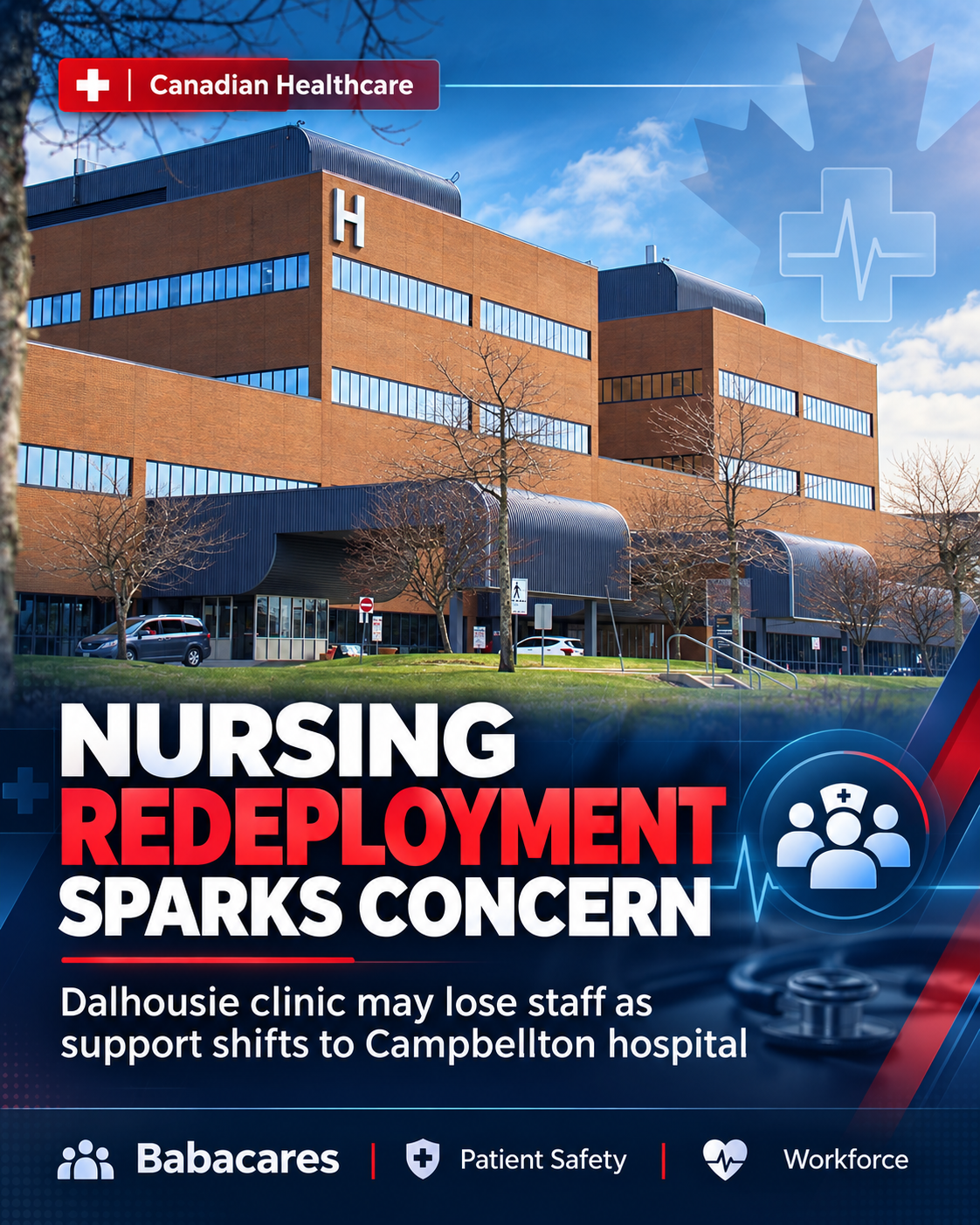
New Brunswick Nursing Redeployment Sparks Concern: Is One Community Losing Healthcare Services to Save Another?
New Brunswick's nurses' union is challenging the reported transfer of nursing staff from Dalhousie to Campbellton Regional Hospital, warning that efforts to address emergency department shortages must not undermine primary healthcare.
What happens when a hospital urgently needs more nurses, but the proposed solution is to take them away from patients who already depend on their care elsewhere?
This is the difficult question confronting parts of northern New Brunswick following reports that nursing staff from St. Joseph's Community Health Centre in Dalhousie have been reassigned to support the emergency department at Campbellton Regional Hospital.
In an October 19 report published by Brunswick News, journalist Trevor McNally described concerns that three licensed practical nurses (LPNs) had been moved from the Dalhousie health centre to Campbellton.
However, a separate official statement issued on October 16 by the New Brunswick Nurses Union (NBNU) specifically referred to plans to redeploy nurse practitioners (NPs), who have different qualifications and responsibilities from LPNs.
This distinction matters because nurse practitioners provide advanced clinical services, including patient assessments, diagnosis, treatment and management of ongoing health conditions within their regulated scope.
The union's statement identifies the proposed redeployment as involving nurse practitioners leaving primary care to work as registered nurses in the Campbellton emergency department.
On October 16, NBNU president Paula Doucet issued a statement opposing what the union described as forced redeployments by Vitalité Health Network.
According to the union, healthcare employers and nursing representatives had previously agreed to a voluntary redeployment initiative to address critical staffing shortages and reduce reliance on expensive travel nurses.
Under that arrangement, qualified nursing professionals could volunteer to work temporarily at facilities experiencing serious staffing challenges.
The union argues that moving staff without their agreement undermines the principle of voluntary participation.
Doucet also expressed concern that transferring nurse practitioners away from their established primary care practices could create new risks for patients in Dalhousie while attempting to address the emergency department's staffing needs in Campbellton.
The union called for an immediate halt to involuntary redeployment.
Why the situation matters for patients
Nursing shortages are not simply workforce problems. They can directly affect how quickly patients receive care, whether appointments remain available and how effectively chronic health conditions are managed.
Nurse practitioners are particularly valuable in primary care because they can assess patients, diagnose many conditions, prescribe medications within their scope and provide ongoing follow-up.
If these professionals are removed from a community clinic without appropriate replacements, possible consequences include longer waits for appointments, interruptions in chronic disease management, delayed assessments and increased pressure on nearby hospitals.
For older adults, people living with disabilities and patients managing multiple health conditions, continuity of care can be especially important.
However, the actual number of cancelled appointments, displaced patients or service reductions resulting from this particular redeployment has not yet been independently established.
A hospital shortage should not create another healthcare shortage
Campbellton Regional Hospital's need for sufficient emergency department staffing must also be taken seriously.
Emergency departments require qualified professionals to assess patients, provide urgent treatment and respond to life-threatening situations.
Hospital administrators may therefore face difficult decisions when staffing shortages threaten essential services.
However, transferring nurses from primary care can become a short-term solution with longer-term consequences if staffing gaps are simply shifted between facilities.
The concern is particularly relevant to rural communities, where access to alternative healthcare providers may already be limited.
In July 2026, Vitalité announced temporary reductions in blood collection services at St. Joseph's Community Health Centre because of staffing shortages. Although that announcement concerned a different service, it demonstrates the centre's previous vulnerability to workforce pressures.
What about consultation with healthcare workers?
The union's criticism also raises an important question about healthcare management.
Should major staffing changes be implemented without meaningful consultation with the professionals responsible for delivering care?
From a workforce perspective, effective redeployment should consider professional qualifications, patient safety, staff availability, continuity of care and the requirements of collective agreements.
Collaboration cannot eliminate every staffing shortage, but involving frontline professionals can help identify risks before changes are introduced.
The union maintains that a voluntary staffing arrangement already exists and should be respected.
Vitalité's full explanation of the reported transfers, including the duration of the redeployment and arrangements for affected primary care patients, was not established in the sources reviewed for this article.
Babacares perspective: Patients and healthcare workers both deserve protection
The situation in northern New Brunswick reflects a broader healthcare-management challenge in Canada: how to maintain emergency services without weakening community-based care.
As a publication concerned with healthcare access, patient safety and workforce development, Babacares believes the discussion should focus on three priorities:
-
Patient safety: Ensure that emergency and community healthcare services have adequate staffing.
-
Workforce consultation: Involve nurses and other healthcare professionals in decisions affecting their work and patients.
-
Continuity of care: Establish clear replacement staffing and patient communication plans before removing essential personnel from existing services.
There is also a wider lesson for healthcare planners: improving access to primary care can help patients receive treatment earlier and avoid unnecessary emergency department visits.
Weakening primary care to strengthen emergency services may therefore create additional pressure elsewhere in the healthcare system.
Questions Vitalité Health Network should answer
For transparency and public confidence, several matters require clarification.
How many staff were actually redeployed, and were they LPNs, nurse practitioners or both? Was the arrangement voluntary? How long will it last? What replacement services are available to patients in Dalhousie? And what longer-term recruitment measures are being introduced to stabilize Campbellton Regional Hospital?
Conclusion: Healthcare should not become a competition between communities
Residents of Campbellton deserve accessible and properly staffed emergency services.
Equally, residents of Dalhousie deserve dependable primary healthcare without unnecessary disruption.
The objective should not be to decide which community deserves nurses more. It should be to ensure that both communities can access safe, timely and continuous healthcare.
Staffing decisions must balance immediate emergencies with the long-term needs of patients, while respecting the professionals who deliver those services.
READ MORE ON BABACARES.COM, SUBSCRIBE AND SHARE.
References
-
Brunswick News — Clinic to be short of help after nurses moved to support hospital, Trevor McNally, October 19, 2026. Original report supplied for this article; the full article was not accessible for independent review.
-
New Brunswick Nurses Union — Statement calling for a stop to forced redeployments, October 16, 2026.
New Brunswick Nurses' Union
-
Francophone leader serving its communities
Editorial clarification: The Brunswick News excerpt refers to three LPNs, while the union's official statement refers to nurse practitioners. These are distinct nursing professions. Babacares has not independently confirmed whether both groups were affected or resolved the difference between the accounts. The reported patient-safety risks are concerns requiring investigation, not established findings of patient harm.











Comments