

NAFDAC Uncovers Suspected ₦500 Million Fake Whisky Factory in Aba: What Nigerians Must Know About the Health Risks
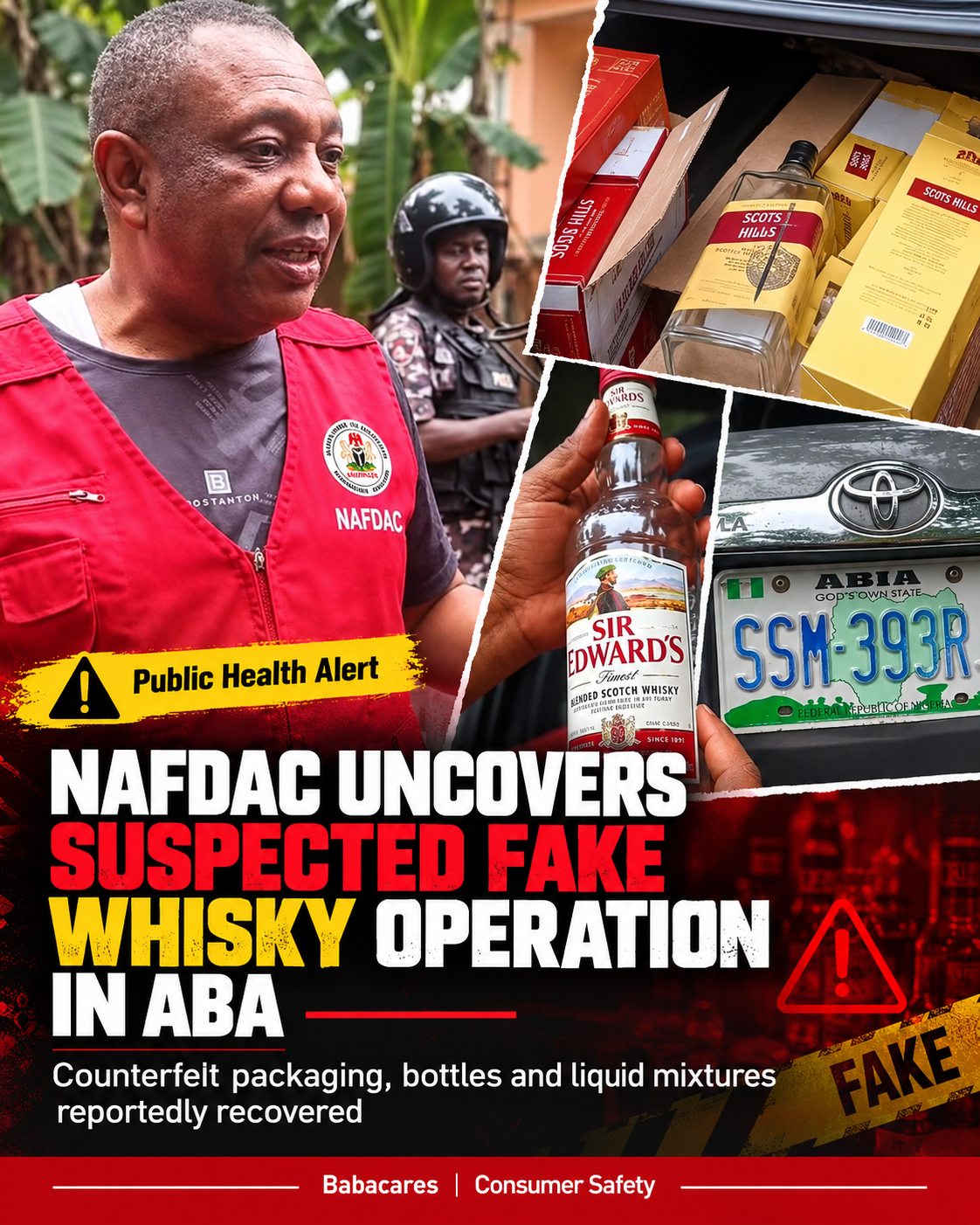
Counterfeit packaging bearing the names Sir Edwards Scotch Whisky and Scottish Hills Whisky, chemical mixtures, empty bottles and unhygienic production equipment were reportedly discovered during a NAFDAC enforcement operation in Abia State.
What if the bottle of whisky served at a birthday party, wedding reception, nightclub or family celebration contains something entirely different from what the label promises?
That troubling possibility has returned to public attention following the discovery of a suspected counterfeit alcoholic drinks production facility in Aba, Abia State, by Nigeria's National Agency for Food and Drug Administration and Control (NAFDAC).
According to information released by the agency on October 19, 2026, enforcement officials uncovered the facility at No. 25 Omenazu Street, Aba, following credible intelligence about suspected illegal manufacturing activities.
The facility was reportedly operating under unhygienic conditions, while equipment, packaging materials and other items found at the premises were valued at more than ₦500 million.
For Babacares, the disturbing issue is not merely the financial value of the discovery. It is the potential danger to consumers who may unknowingly purchase and drink alcohol produced in unregulated conditions.
What NAFDAC reportedly discovered
According to NAFDAC, the suspected operator fled when enforcement officers arrived, leaving behind a vehicle containing materials believed to be connected to the operation.
Among the items reportedly discovered were:
-
Packaging materials bearing the names Sir Edwards Scotch Whisky and Scottish Hills Whisky.
-
Empty alcoholic beverage bottles, cartons, caps and sealing machines.
-
A drum containing approximately 200 litres of liquid.
-
Tanks containing various unidentified liquid mixtures.
-
Dirty sieves and other equipment suspected to have been used in production.
-
Plastic buckets and drums containing ethanol, including tree bark immersed in ethanol.
NAFDAC estimated the value of the equipment, materials and facility components at over ₦500 million. That figure should not be confused with the value of counterfeit drinks proven to have entered the market.
The photographs and video shared with Babacares show bottles and cartons carrying whisky brand names, alongside images of the enforcement operation. However, images alone cannot establish the chemical composition or authenticity of the liquids.
The discovery of suspected counterfeit packaging also does not mean that genuine products sold under those brand names are themselves counterfeit or unsafe.
Why this discovery is a public-health concern
Counterfeit alcoholic drinks present risks that go beyond trademark infringement and economic losses.
When alcohol is produced without appropriate manufacturing controls, consumers may be exposed to substances whose composition, concentration and safety have not been verified.
One particular concern is the possibility of toxic alcohol contamination, including methanol.
Unlike ethanol, the alcohol normally present in alcoholic beverages, methanol can cause severe poisoning when swallowed.
Methanol poisoning can lead to nausea, abdominal pain, headache, visual disturbances, metabolic acidosis, permanent blindness and, in severe cases, death.
Importantly, NAFDAC has not, in the information reviewed for this article, announced laboratory findings confirming methanol in the liquids recovered from the Aba facility.
The presence of ethanol, tree bark and unidentified mixtures raises safety questions, but laboratory analysis is necessary to establish precisely what the seized liquids contained.
The danger of attractive packaging
One of the most concerning aspects of counterfeit alcohol production is the potential use of packaging that resembles familiar commercial brands.
A consumer may see a recognizable bottle, label or carton and assume that the contents have been manufactured and distributed through legitimate channels.
Unfortunately, packaging alone is not a guarantee of authenticity.
Counterfeiters may reuse genuine bottles or imitate labels, caps and seals, making detection difficult for ordinary consumers.
This is particularly troubling in a market where alcoholic beverages are sold through shops, entertainment venues, restaurants, parties and informal distributors.
A product's appearance may create confidence, even when its contents have not undergone appropriate safety testing.
What consumers should do
NAFDAC's discovery provides an opportunity to remind Nigerians about practical precautions.
Consumers should purchase alcoholic beverages through reputable and traceable retailers, inspect packaging for signs of tampering, be cautious of unusually cheap products and report suspicious drinks to the appropriate authorities.
However, even an apparently intact seal does not guarantee authenticity.
Anyone who develops vomiting, severe headache, confusion, unusual visual symptoms or difficulty breathing after consuming suspected alcohol should seek emergency medical care immediately and tell healthcare professionals about the possible exposure.
Do not wait for all symptoms to appear. Some forms of toxic alcohol poisoning can have delayed effects, and early treatment can be lifesaving.
Babacares calls for stronger enforcement and consumer education
The Aba discovery raises important questions about how counterfeit alcoholic beverages are produced, packaged, transported and distributed.
Beyond shutting down suspected illegal facilities, Babacares believes Nigerian authorities should strengthen surveillance of distribution networks and collaborate more closely with manufacturers, retailers, hospitality businesses and consumer-protection organizations.
NAFDAC should also consider publishing laboratory findings when available, providing product-specific alerts where evidence supports them, and informing the public about any confirmed distribution channels linked to the facility.
The Standards Organisation of Nigeria, consumer-protection authorities, the National Orientation Agency and public-health institutions also have roles to play in raising awareness and promoting responsible reporting.
The long-term objective should not simply be to seize counterfeit goods, but to reduce the likelihood that dangerous products reach consumers in the first place.
Questions that still require answers
While NAFDAC's discovery is significant, several questions remain unresolved:
-
What substances were actually contained in the recovered liquids?
-
Had any beverages produced at the facility already entered commercial distribution?
-
Were other locations or distributors connected to the suspected operation?
-
Will laboratory results and any subsequent enforcement action be made public?
Until those questions are answered, it is important to distinguish the reported enforcement findings from possible health consequences that have not been confirmed in this particular case.
Conclusion: Consumer safety must come first
The reported discovery of a suspected counterfeit alcohol production facility in Aba is another reminder that product safety is a shared responsibility.
NAFDAC's enforcement efforts are important, but effective protection also requires public education, reliable product traceability, independent testing and prompt reporting of suspicious products.
No consumer should have to risk their health because the contents of a bottle do not match what its label promises.
READ MORE ON BABACARES.COM, SUBSCRIBE AND SHARE.
Sources and references
-
Punch Newspapers — NAFDAC uncovers ₦500m suspected fake alcohol factory in Aba (October 19, 2026).
-
TheCable — NAFDAC uncovers suspected counterfeit alcohol factory in Abia (October 19, 2026).
-
Galaxy TV — Details of materials recovered during the enforcement operation.
Editorial note: This story is based on NAFDAC's reported findings, the footage supplied to Babacares and published news reports. The public-health discussion explains potential risks; it does not establish that the recovered liquids contained methanol or caused any confirmed poisoning.
Photo/video credit: NAFDAC, via its social media publication.





Comments