

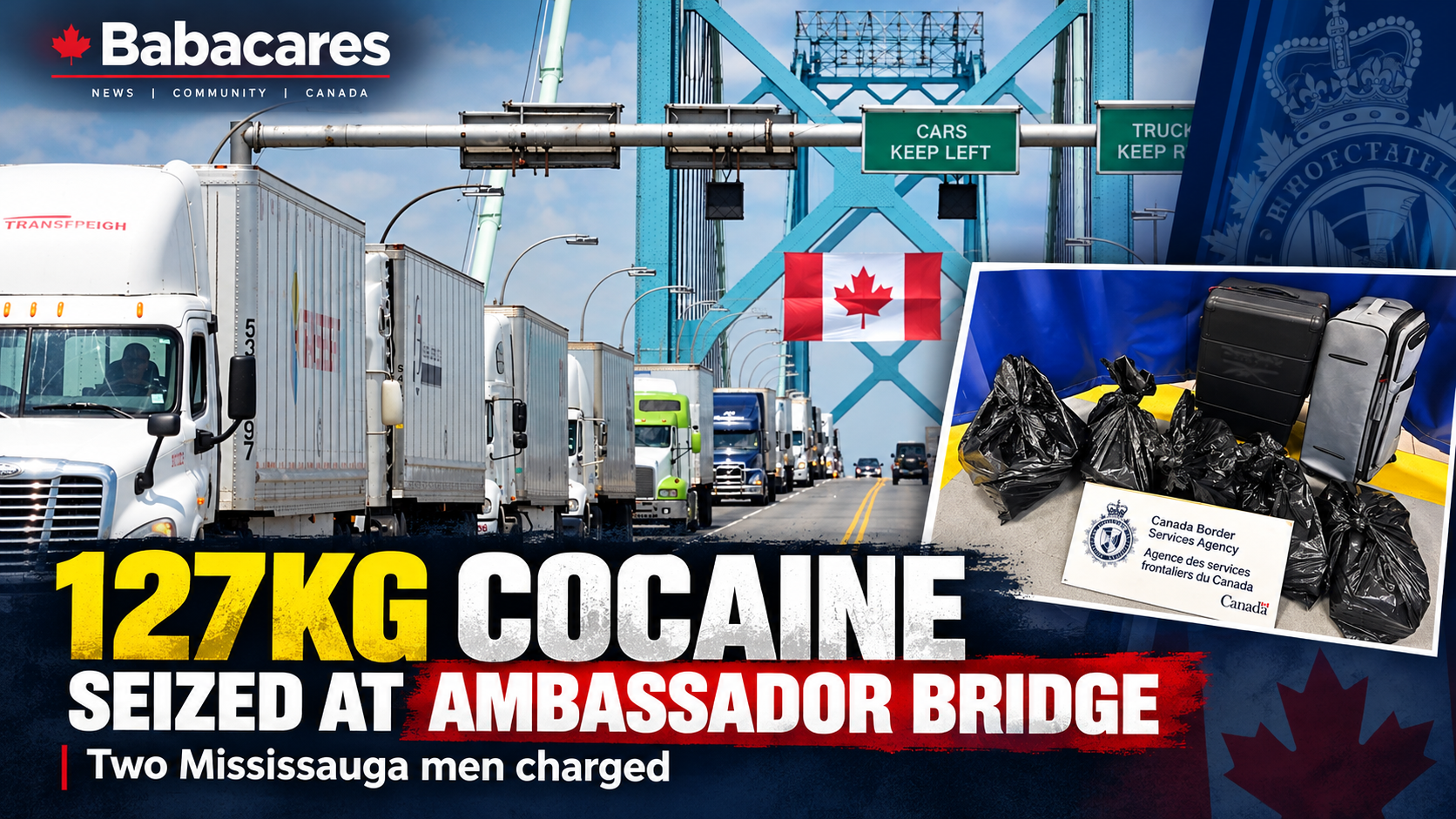
127KG OF COCAINE SEIZED AT CANADA–US BORDER: TWO MISSISSAUGA MEN CHARGED AS DRUG TRAFFICKING RAISES PUBLIC HEALTH CONCERNS
Canadian border officers intercept a major suspected cocaine shipment at Windsor's Ambassador Bridge, raising fresh concerns about cross-border drug trafficking, addiction, organized crime and community safety.
By Babacares Editorial | October 19, 2026
What could have happened if 127 kilograms of cocaine had successfully crossed Canada's border and found its way into communities across Ontario?
That is the troubling public-health question emerging from a major drug seizure at the Ambassador Bridge, which connects Windsor, Ontario, with Detroit, Michigan, in the United States.
On Monday, October 19, 2026, the Canada Border Services Agency (CBSA) announced that its officers had intercepted 127 kilograms of suspected cocaine concealed inside a commercial truck entering Canada from the United States.
The discovery was made on September 11, 2026, when border officers referred the truck for a secondary inspection.
With the assistance of a trained detector dog, officers discovered the suspected illegal drugs inside the vehicle's trailer.
The seizure has resulted in criminal charges against two Mississauga residents and renewed attention to the scale of illegal drug trafficking across Canada's southern border.
TWO MISSISSAUGA MEN ARRESTED AND CHARGED
According to the official statement released by the CBSA and the Royal Canadian Mounted Police (RCMP), the arrested individuals are:
-
Vasyl Galychyn, 61, of Mississauga, Ontario.
-
Anton Chernyshov, 41, also of Mississauga, Ontario.
Both men were arrested by CBSA officers before being transferred, along with the seized substances, to the RCMP.
The RCMP subsequently charged them with importing cocaine and possession of cocaine for the purpose of trafficking under Canada's Controlled Drugs and Substances Act.
The matter is currently before the Ontario Court of Justice in Windsor, and the charges remain subject to validation by the court.
It is important to emphasize that criminal charges are allegations. Both men are presumed innocent unless proven guilty in a court of law.
1.67 TONNES OF COCAINE SEIZED IN SOUTHERN ONTARIO IN 2026
The Ambassador Bridge discovery is not an isolated enforcement incident.
According to figures released by the CBSA on October 19, officers operating within its Southern Ontario Region have seized approximately 1.67 metric tonnes of cocaine so far in 2026.
CBSA SOUTHERN ONTARIO REGION — 2026
1,670 kg
Approximate total cocaine seized
127 kg
Ambassador Bridge seizure
7.6% from this seizure
92.4% other seizures
Calculated from the CBSA figures reported October 19, 2026. The statistics describe intercepted drugs, not the total amount trafficked.
These figures underline the importance of border inspections and intelligence gathering in disrupting illegal drug shipments.
However, seizure statistics alone cannot establish how much cocaine successfully enters Canada or whether trafficking has increased compared with previous years.
BEYOND THE ARRESTS: WHY THIS IS A PUBLIC-HEALTH EMERGENCY
At Babacares, we believe this development deserves serious attention beyond the criminal charges.
Cocaine trafficking is not merely a border-security issue. It is also a public-health challenge affecting individuals, families, schools, healthcare institutions and communities.
Cocaine is a powerful stimulant that affects the brain, nervous system and cardiovascular system.
According to Health Canada, cocaine use can lead to serious health complications, including:
-
Heart attacks, irregular heartbeats and strokes.
-
Anxiety, paranoia and other psychiatric symptoms.
-
Addiction and substance-use disorders.
-
Seizures, overdose and potentially fatal complications.
-
Serious social, financial and emotional consequences for individuals and their families.
Another major concern is the unpredictable composition of illegally manufactured or distributed drugs.
Substances sold as cocaine may contain other drugs or harmful adulterants. This increases the danger for people who may not know exactly what they are consuming.
THE HIDDEN COST TO CANADIAN FAMILIES
Behind the statistics on drug trafficking are families dealing with the consequences of substance-use disorders.
Parents may struggle to support children experiencing addiction. Relationships may deteriorate, workplaces may lose productivity, and healthcare facilities may face additional demand from drug-related emergencies.
In serious cases, cocaine use can result in fatal overdose or long-term health complications.
These consequences explain why governments must approach illegal drug trafficking from two complementary directions: strong law enforcement and effective public-health intervention.
Intercepting illegal drugs can disrupt their distribution, but prevention, treatment, rehabilitation and community education are also essential.
CANADA'S AUTHORITIES RESPOND
Michael Prosia, CBSA's Regional Director General for Southern Ontario, commended the efforts of border officers and emphasized the importance of experience, technology and cooperation with law-enforcement partners.
Public Safety Minister Gary Anandasangaree also praised the CBSA and RCMP for their efforts to protect Canadian communities from cross-border organized crime and illegal drugs.
The federal government says it is investing $1.3 billion through its Border Plan to strengthen border security and the immigration system.
Meanwhile, RCMP officials reaffirmed their commitment to working with border authorities to intercept illegal drugs entering Canada.
WHAT SHOULD CANADA DO NEXT?
From a public-health perspective, the Ambassador Bridge seizure raises important questions about prevention and community protection.
1. Strengthen border inspections: Canadian authorities must continue investing in intelligence, detection technology and collaboration with international law-enforcement agencies.
2. Expand drug education: Schools, parents, healthcare professionals and community organizations need accurate information about the dangers of cocaine and other illegal substances.
3. Improve access to addiction treatment: People experiencing substance-use disorders should have timely access to evidence-based treatment, mental-health services and recovery support.
4. Investigate trafficking networks: Beyond individual arrests, law-enforcement agencies must continue efforts to identify the criminal structures responsible for financing, organizing and distributing illegal drugs.
5. Reduce stigma: Addiction is a health condition requiring compassionate, evidence-based responses. People should be encouraged to seek help before their circumstances become life-threatening.
BABACARES PERSPECTIVE: BORDER SECURITY ALONE CANNOT END THE DRUG CRISIS
The seizure of 127 kilograms of suspected cocaine at the Ambassador Bridge represents a significant interception by Canadian border authorities.
But it also invites a larger conversation.
How many people understand the health consequences of cocaine use? Are vulnerable young people receiving adequate preventive education? Can individuals struggling with addiction access treatment before suffering serious harm?
These questions deserve the attention of policymakers, healthcare professionals, educators and community leaders.
A successful drug seizure may stop a shipment, but sustained public-health investment can help prevent drug-related harm and save lives.
At Babacares, we believe Canada must continue protecting its borders while investing in the wellbeing of its people.
The ongoing criminal proceedings must respect the rights and presumed innocence of the accused, while legitimate concerns about illegal drug trafficking and community safety receive appropriate attention.
Ultimately, the fight against dangerous drugs requires more than arrests and seizures. It requires education, prevention, treatment, community responsibility and coordinated government action.
Protecting Canadian communities means stopping illegal drug trafficking while also helping people avoid addiction, access treatment and rebuild their lives.
References
-
Health Canada — Cocaine and crack: Health effects and risks.
-
Public Health Agency of Canada — Latest National Data on Substance-Related Harms (June 15, 2026).
READ MORE ON BABACARES.COM, SUBSCRIBE AND SHARE.
#Babacares #CanadaNews #CocaineSeizure #Mississauga #WindsorOntario #AmbassadorBridge #CBSA #RCMP #DrugTrafficking #PublicHealth #DrugPrevention #CommunitySafety #CanadaBorder








Comments