

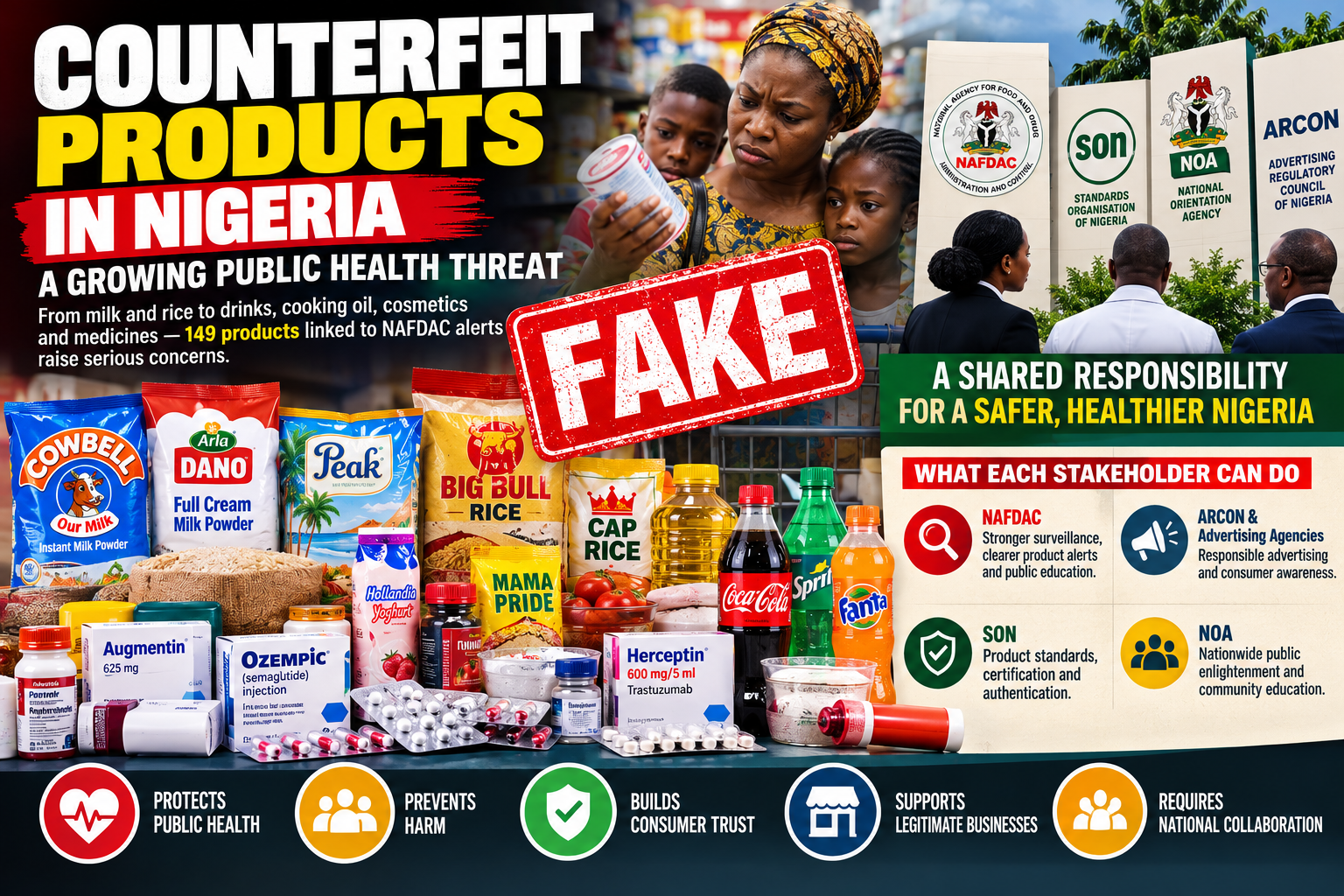
COUNTERFEIT PRODUCTS IN NIGERIA: A GROWING PUBLIC HEALTH THREAT — WHY NAFDAC, SON, ADVERTISING AGENCIES AND NOA MUST WORK TOGETHER
BABACARES | PUBLIC HEALTH, CONSUMER PROTECTION & REGULATORY ACCOUNTABILITY
By Babajide Moronfolu | October 2026
Imagine a mother buying milk for her children, a diabetic patient purchasing medication, or a family preparing a meal with products they have trusted for years—unaware that some of those products could be counterfeit.
The packaging looks familiar. The brand name is recognizable. The product may even carry what appears to be a genuine regulatory registration number.
But what happens when the contents are not what the label promises?
Counterfeit products are no longer simply a problem of trademark infringement or financial loss. They represent a serious public-health challenge that deserves national attention.
A circulating compilation of 149 products and categories reportedly associated with National Agency for Food and Drug Administration and Control (NAFDAC) alerts has raised concerns about the safety of everyday consumer products in Nigeria.
The list includes food, beverages, medicines, cosmetics and other household products.
However, the compilation requires an important clarification: not all 149 entries have been independently verified as counterfeit products, and their inclusion does not establish that they were manufactured in Nigeria. Some are duplicates, broad product categories, recalls or alerts involving products identified outside Nigeria.
What is beyond doubt is that NAFDAC has documented counterfeit versions of several familiar products.
For example, official alerts have identified counterfeit Cowbell Our Milk 12g sachets, Peak 14g Instant Milk Powder and Arla Dano 14g Full Cream Milk Powder.
NAFDAC's August 2025 Cowbell alert specifically described unauthorized use of the brand name, packaging design, registration number and trademark.
NAFDAC
+2
These findings should concern every Nigerian.
But they also raise a much bigger question:
Why should responsibility for detecting dangerous products rest almost entirely on consumers when Nigeria has regulatory institutions, advertising professionals, manufacturers and public-information agencies capable of working together to prevent harm?
The public-health consequences of counterfeit products
As a healthcare professional, my concern extends beyond the financial value of seized counterfeit goods.
Consider what could happen when a patient receives falsified antimalarial medication containing little or no effective ingredient.
The infection may worsen while the patient believes treatment is underway.
Similarly, falsified antibiotics may lead to treatment failure and can contribute to antimicrobial resistance when they contain inadequate active ingredients.
Counterfeit diabetes medications may expose patients to unstable blood glucose levels.
Falsified cancer medicines may delay effective treatment during a critical period.
Counterfeit foods, beverages and cosmetics may also contain undeclared ingredients, allergens, contaminants or hazardous substances.
The actual consequences depend on the composition of the particular product and the level of exposure; not every counterfeit product contains the same hazards.
The World Health Organization estimates that more than one in ten medicines in low- and middle-income countries are substandard or falsified. This is a broad international estimate, not a specific measurement of the Nigerian market.
World Health Organization
Counterfeiting therefore threatens health, undermines trust in healthcare, wastes household income and weakens confidence in legitimate businesses.
1. NAFDAC: Move beyond seizures to sustained public education
NAFDAC remains central to protecting Nigerians from counterfeit and unsafe regulated products.
Its investigations, laboratory testing, product alerts and enforcement operations are essential.
But public-health protection should not end when counterfeit goods are seized.
I believe NAFDAC should strengthen its communication systems so that every major product alert clearly explains:
-
The affected product, batch number and distinguishing packaging features.
-
Whether the problem involves counterfeiting, contamination, substandard quality or an ordinary recall.
-
The geographical areas where affected products were discovered.
-
The potential health risks and actions consumers should take.
-
How the public can report suspicious products.
NAFDAC should also publish accessible follow-up information about product recalls, confirmed laboratory findings and enforcement outcomes, subject to legal and investigative constraints.
An enforcement operation becomes more valuable when the public understands what was discovered and how to avoid the danger.
2. Advertising agencies and ARCON: Consumer protection must become part of advertising ethics
Advertising is one of the most powerful tools for influencing consumer behaviour.
Millions of Nigerians make purchasing decisions based on television commercials, radio jingles, outdoor advertising, social media campaigns, celebrities and digital influencers.
This creates both an opportunity and a responsibility.
The Advertising Regulatory Council of Nigeria (ARCON) is the country's apex advertising regulator, with a mandate that includes responsible advertising and consumer protection.
advertcouncil.gov.ng
Advertising agencies, media organizations and professional advertising associations should collaborate with ARCON and NAFDAC to protect consumers.
What should they do?
First, agencies should strengthen verification before promoting regulated health, food and consumer products. Claims about medical effectiveness, nutritional benefits, safety and regulatory approval should be supported by credible evidence.
Second, agencies should reject misleading advertisements promising miraculous cures or making unsupported health claims.
Third, advertising companies should dedicate part of their corporate social responsibility campaigns to educating Nigerians about counterfeit products.
Imagine short television messages explaining how to recognize suspicious medication packaging or encouraging consumers to verify official NAFDAC alerts before buying.
Fourth, digital advertising platforms and influencers should act quickly when regulators identify advertisements promoting counterfeit or unlawful products.
Finally, agencies should help distinguish legitimate brands from counterfeit imitations.
When criminals copy a popular brand, the public must understand that the original manufacturer is not automatically responsible for the imitation.
Advertising professionals can use their expertise in communication, design and storytelling to explain this distinction.
The advertising industry should not only persuade Nigerians to buy products. It should also help them make informed and safe purchasing decisions.
3. Standards Organisation of Nigeria: Strengthen product verification and traceability
The Standards Organisation of Nigeria (SON) has a major role in quality assurance, product standards, conformity assessment and authentication.
SON already administers product-certification systems, including MANCAP for locally manufactured products and product-authentication measures within its regulatory remit.
Standards Organisation of Nigeria
However, Nigeria needs stronger coordination between SON and NAFDAC, with each agency operating within its statutory responsibilities.
What should SON do?
SON should strengthen verification systems that help consumers and retailers distinguish genuine certified products from fraudulent imitations.
It should expand public education about authentic certification marks and encourage traceability technologies, including secure digital codes where appropriate.
Manufacturers should also be encouraged to introduce stronger anti-counterfeiting features and reliable mechanisms for checking products before purchase.
SON and NAFDAC should work together to exchange relevant intelligence and reduce regulatory gaps, rather than duplicating responsibilities.
An important point: A certification mark or registration number printed on packaging does not automatically establish authenticity. Counterfeiters can copy genuine numbers and marks.
This is why public verification systems must be reliable, accessible and regularly updated.
4. National Orientation Agency: Take the campaign to every community
Perhaps one of the most underutilized opportunities in combating counterfeit products lies in public enlightenment.
The National Orientation Agency (NOA) has a mandate to educate Nigerians, promote civic responsibility and encourage positive behavioural change.
Its work includes communicating government programmes, raising awareness and gathering public feedback.
noa.gov.ng
Counterfeit-product prevention should become part of sustained national public-health education.
What should NOA do?
The agency should collaborate with NAFDAC, SON, ARCON, state governments and community organizations to launch a nationwide consumer-safety campaign.
This campaign should extend beyond Abuja and Lagos into rural communities, markets, schools, religious centres, motor parks and local trading areas.
Messages should be delivered in English, Pidgin and major Nigerian languages.
Market associations, community leaders, religious organizations and local radio stations can help reach people who may not regularly access government websites or social media.
For example, imagine a campaign built around a simple message:
"BEFORE YOU BUY, VERIFY. BEFORE YOU CONSUME, CHECK."
Consumers should learn why unusually cheap products require caution, how to report suspected counterfeit goods, and why purchasing medication from authorized pharmacies matters.
NOA should also educate the public about the dangers of spreading unverified lists that wrongly portray entire brands as unsafe.
Public-health communication must protect consumers without creating unnecessary panic.
5. Manufacturers and distributors must take greater responsibility
Manufacturers are often victims of counterfeiting, but they also have an important role in prevention.
Companies producing food, beverages, medicines and cosmetics should invest in stronger product-security systems.
They should also monitor distribution channels, work with retailers to identify suspicious supply routes, and cooperate promptly with regulatory investigations.
When counterfeit versions of their products are discovered, manufacturers should issue clear public notices explaining how consumers can distinguish genuine products from the affected imitations.
Consumers should not be expected to identify sophisticated counterfeits through packaging inspection alone.
Authenticity must be supported by effective supply-chain controls, not simply attractive product labels.
6. Nigeria needs a coordinated national consumer-safety campaign
Rather than allowing every institution to work independently, I propose a coordinated national initiative involving NAFDAC, SON, ARCON, NOA, manufacturers, professional associations and civil society.
Proposed initiative: KNOW WHAT YOU BUY, PROTECT YOUR HEALTH
A Babacares public-health recommendation—not an existing government programme.
|
NAFDAC |
Product alerts, laboratory evidence, regulatory enforcement and medicine/food safety guidance. |
|
SON |
Standards, quality certification and authentication for products within its remit. |
|
ARCON and advertisers |
Responsible advertisements, consumer-protection campaigns and accurate promotional claims. |
|
NOA |
Community education, multilingual campaigns and public feedback. |
|
Manufacturers |
Supply-chain protection, product traceability and timely counterfeit warnings. |
Such a partnership could produce weekly radio messages, television public-service announcements, school awareness programmes, market demonstrations and verified digital safety alerts.
The campaign should also measure results: How many consumers can verify a product? How quickly are alerts reaching local markets? Are suspicious goods being reported earlier?
Public-health campaigns should be judged not merely by how many people see an advertisement, but by whether the information helps prevent harm.
The Babacares perspective: Counterfeiting is a national health-security issue
As a healthcare professional and public-health advocate, I believe the conversation about counterfeit products must move beyond the number of shops raided or goods seized.
Those operations are necessary.
But they are only one part of the solution.
The real goal should be to prevent unsafe products from reaching consumers in the first place.
A mother buying milk should not have to become a laboratory scientist to protect her children.
A cancer patient purchasing prescribed medication should not have to wonder whether the medicine contains the correct active ingredient.
A retailer should have accessible tools for checking the authenticity of products received from distributors.
And ordinary Nigerians should know exactly where to report suspected counterfeiting.
Consumer safety is a shared responsibility, but government institutions and manufacturers must carry the greater burden of ensuring that products are safe and genuine.
Final thoughts: The time for coordinated action is now
NAFDAC's counterfeit-product alerts highlight a real and continuing public-health challenge.
But Nigeria cannot solve this problem through enforcement alone.
We need a stronger partnership between healthcare regulators, standards authorities, advertising professionals, public-information agencies, manufacturers and consumers.
The advertising industry has the expertise to communicate effectively.
SON has important quality-assurance and product-authentication responsibilities.
NOA has the institutional mandate to reach communities with public education.
NAFDAC has the authority and technical expertise to investigate and regulate foods, medicines and other products under its jurisdiction.
Working together, these institutions can help build a more informed and better-protected society.
The goal should not simply be to catch counterfeiters after harm has occurred. It should be to create a system in which counterfeit products have fewer opportunities to reach Nigerian homes.
At Babacares, our message is clear:
SAFE PRODUCTS SAVE LIVES. CONSUMER EDUCATION PROTECTS FAMILIES. INSTITUTIONAL ACCOUNTABILITY BUILDS TRUST.
📖 **READ MORE ON: https://babacares.co**
🔔 SUBSCRIBE AND SHARE!
Babacares — Promoting Public Health, Consumer Protection and Accountability.
References
1. NAFDAC (2025). Public Alert 026/2025: Counterfeit Cowbell Our Milk.
2. NAFDAC (2023). Public Alert 026/2023: Counterfeit Peak Milk.
3. NAFDAC (2024). Public Alert 03/2024: Counterfeit Arla Dano Milk.
4. World Health Organization. Substandard and Falsified Medical Products.
5. Advertising Regulatory Council of Nigeria. ARCON — Official Website and Regulatory Mandate.
6. Standards Organisation of Nigeria. SON — National Product Certification and Mandate.
7. National Orientation Agency. NOA — Mission, Functions and Public Enlightenment Mandate.






Comments