

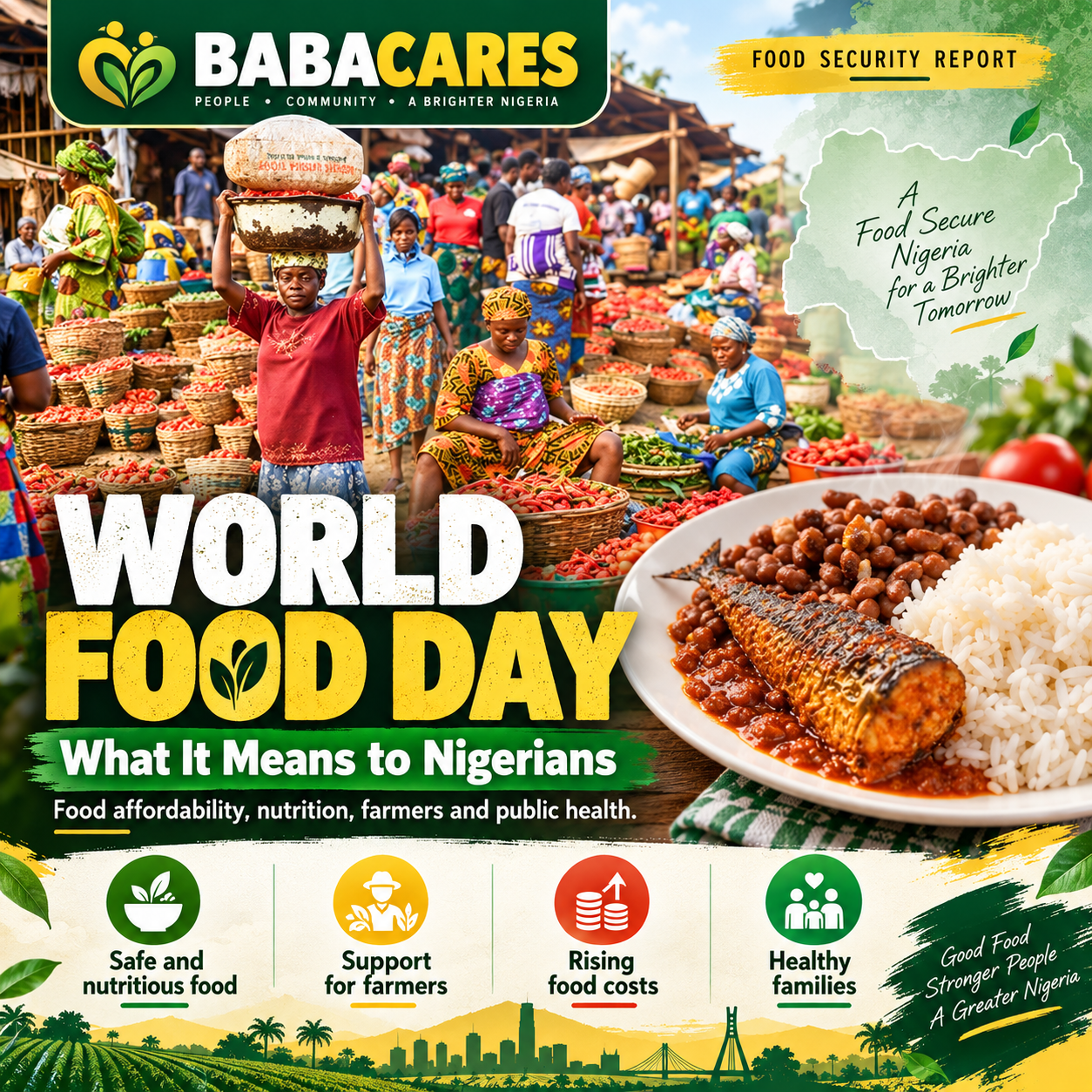
WORLD FOOD DAY 2026: What It Means to Nigerians Struggling With Hunger, Rising Food Prices and Poverty
October 17, 2026 | Babacares Special Report
Yesterday, October 16, the world celebrated World Food Day. But for many Nigerian families, the bigger question is not how to celebrate food—it is how to afford the next nutritious meal.
For a mother trying to feed her children, a pensioner surviving on limited income, a farmer struggling with insecurity or a student managing rising living costs, food security is not an abstract international development goal. It is an everyday concern.
Nigeria is blessed with fertile land, a hardworking farming population, rich food traditions and enormous agricultural potential. Yet millions of people still struggle to access adequate, safe and nutritious food.
As the world commemorates World Food Day 2026, Babacares examines what this occasion means for Nigerians and why tackling hunger must become central to public health, economic development and social responsibility.
World Food Day 2026: What Is the Theme?
World Food Day is observed annually on October 16 to commemorate the establishment of the Food and Agriculture Organization of the United Nations (FAO) in 1945.
The official theme for 2026 is:
“Innovate Today. Nourish Tomorrow.”
The theme calls for innovation, scientific research, traditional knowledge and collective action to ensure everyone has access to safe, diverse and nutritious food while protecting the environment for future generations.
Innovation should not end with new agricultural technologies or government announcements. Its benefits should reach ordinary households through lower food losses, stronger agricultural productivity, better nutrition and more affordable food.
The Reality: Millions of Nigerians Are Still Struggling
Projected acute food insecurity
34.8M
People, June–August 2026
Estimated extreme poverty
123M
People, 2025 estimate
Food inflation
19.59%
Year-on-year, September 2026
Multidimensional poverty
133M
People, 2022 surveySources: FAO–WFP, World Bank, NBS and Reuters. The indicators use different definitions and reference periods.
According to the FAO and World Food Programme, approximately 34.8 million Nigerians were projected to face high levels of acute food insecurity between June and August 2026. The estimate included 1.8 million people facing emergency conditions. These figures are projections for that period, not a confirmed October count.
These figures represent more than statistics. They reflect difficulties that families face when trying to provide balanced meals, pay school fees, access healthcare and maintain a reasonable standard of living.
What World Food Day Means to Ordinary Nigerians
1. To parents: The ability to feed their children properly
Every parent wants their children to grow up healthy, strong and intellectually capable.
But when household income is insufficient, nutritious foods such as eggs, fish, beans, fruits, vegetables and dairy products may become difficult to purchase regularly.
Poor nutrition can affect children's growth, immunity, learning and long-term development.
World Food Day should therefore remind Nigeria of the importance of maternal and child nutrition programmes, affordable healthy diets and effective school feeding initiatives.
2. To farmers: The opportunity to farm safely and profitably
Nigeria's farmers are essential to national food security.
Yet many encounter difficulties related to insecurity, high input costs, poor roads, storage losses, climate shocks and limited access to financing.
Supporting farmers means more than distributing fertiliser during planting seasons.
It requires sustained investment in rural security, irrigation, agricultural extension services, processing facilities and market access.
3. To workers and low-income families: Food that remains affordable
For many working households, earning an income no longer automatically guarantees the ability to maintain a balanced diet.
Food affordability depends not only on agricultural production but also on transportation costs, wages, market conditions and broader economic stability.
Nigeria needs policies that strengthen household purchasing power while encouraging reliable food production and distribution.
4. To young Nigerians: Opportunity in agriculture and food innovation
The 2026 theme should inspire greater investment in young agricultural entrepreneurs.
Nigeria's youth can contribute through food processing, agricultural technology, logistics, irrigation systems, storage solutions and responsible digital services for farmers.
Agriculture should be viewed not merely as subsistence farming but as a modern economic sector capable of generating employment and innovation.
5. To public health professionals: Preventing malnutrition and foodborne disease
Food security is inseparable from healthcare.
Undernutrition can increase susceptibility to illness, while contaminated food can cause diarrhoeal disease and other serious health problems.
A healthy food system must deliver food that is accessible, nutritious and safe.
The responsibility extends from farmers and transporters to food processors, traders, regulators and consumers.
A Recent Reminder From Benin City
A viral video reportedly recorded at Ring Road, Benin City, Edo State, showed individuals gathering spilled rice from a roadside.
Although their circumstances remain unknown, the footage has generated discussion about food affordability and the health risks associated with potentially contaminated food.
The incident reminds us that food security is not simply about having something to eat. It is about having food that is safe, nutritious and accessible.
Rice exposed to polluted water may contain harmful microorganisms or chemical contaminants. Washing and boiling cannot guarantee that all hazards have been eliminated.
World Food Day provides an opportunity to strengthen public education on safe food handling and the importance of protecting food supplies from contamination.
What Should Nigeria Learn From World Food Day?
There are five priorities that deserve particular attention.
First, food affordability must improve. Government efforts to increase production should be accompanied by policies that reduce supply-chain costs and help vulnerable households afford nutritious diets.
Second, farmers need stronger protection and investment. Improving security, rural roads, irrigation and storage can help make farming more productive and financially sustainable.
Third, Nigeria must tackle childhood malnutrition. Nutrition programmes for pregnant women, infants and children should receive sustained attention because early-life nutrition has lifelong consequences.
Fourth, food safety regulation must be strengthened. NAFDAC, relevant state authorities and other regulatory institutions must encourage hygienic food processing, responsible distribution and effective consumer education.
Finally, economic progress must improve everyday living conditions. The World Bank's October 2026 Nigeria Development Update reported improving economic growth and public revenues but emphasised the need for more inclusive growth, better employment and stronger public services.
What Can Ordinary Nigerians Do?
Households and communities also have a role to play.
Families can support healthy eating through affordable, locally available foods such as beans, eggs, vegetables, groundnuts and seasonal fruits, according to their dietary needs and circumstances.
Consumers should pay attention to food hygiene, clean water, proper cooking and safe storage.
Community organisations, businesses and individuals can support food banks, nutrition education and initiatives that reduce food waste.
However, personal responsibility cannot replace the need for policies that make safe, nutritious food accessible to everyone.
Babacares Perspective: World Food Day Must Mean More Than Celebration
For Nigeria, World Food Day should not be another annual event marked by speeches, banners and ceremonial activities.
It should remind us of the families who struggle to feed their children, the farmers whose livelihoods depend on access to land and markets, and the vulnerable people whose health is affected by inadequate nutrition.
Food insecurity affects education, productivity, family wellbeing and national development.
A country cannot build a healthy future when large numbers of its citizens struggle to afford nutritious meals.
The message of World Food Day 2026 — Innovate Today. Nourish Tomorrow — should therefore inspire measurable action from government, agricultural institutions, businesses, civil society and communities.
Nigeria has the human resources, agricultural potential and ingenuity needed to strengthen its food system.
The challenge is ensuring that these advantages translate into meaningful improvements in people's lives.
Because the real meaning of World Food Day is not simply celebrating food. It is working towards a future where nobody is left hungry, and every family has access to safe and nutritious meals.
A question for Nigerians: What should be the government's most urgent priority: reducing food prices, supporting farmers, expanding food assistance or improving nutrition programmes?
Babacares — Your Health, Your Right to Know.
References
-
FAO — World Food Day 2026: Innovate Today. Nourish Tomorrow.
FAOHome
-
FAO — World Food Day 2026 Official Commemoration, October 16, 2026
FAOHome
-
FAO–WFP — Hunger Hotspots Report, June 2026
FAOHome
-
World Bank — Nigeria Development Update, October 2026
World Bank
-
National Bureau of Statistics — Multidimensional Poverty Index, 2022
National Bureau of Statistics
-
Reuters — Nigeria's September 2026 Inflation Report
Reuters
Editorial note: Poverty, inflation and acute food insecurity figures cited above measure different conditions and cover different periods. The recommendations represent Babacares' public-health and social-development analysis.









Comments