

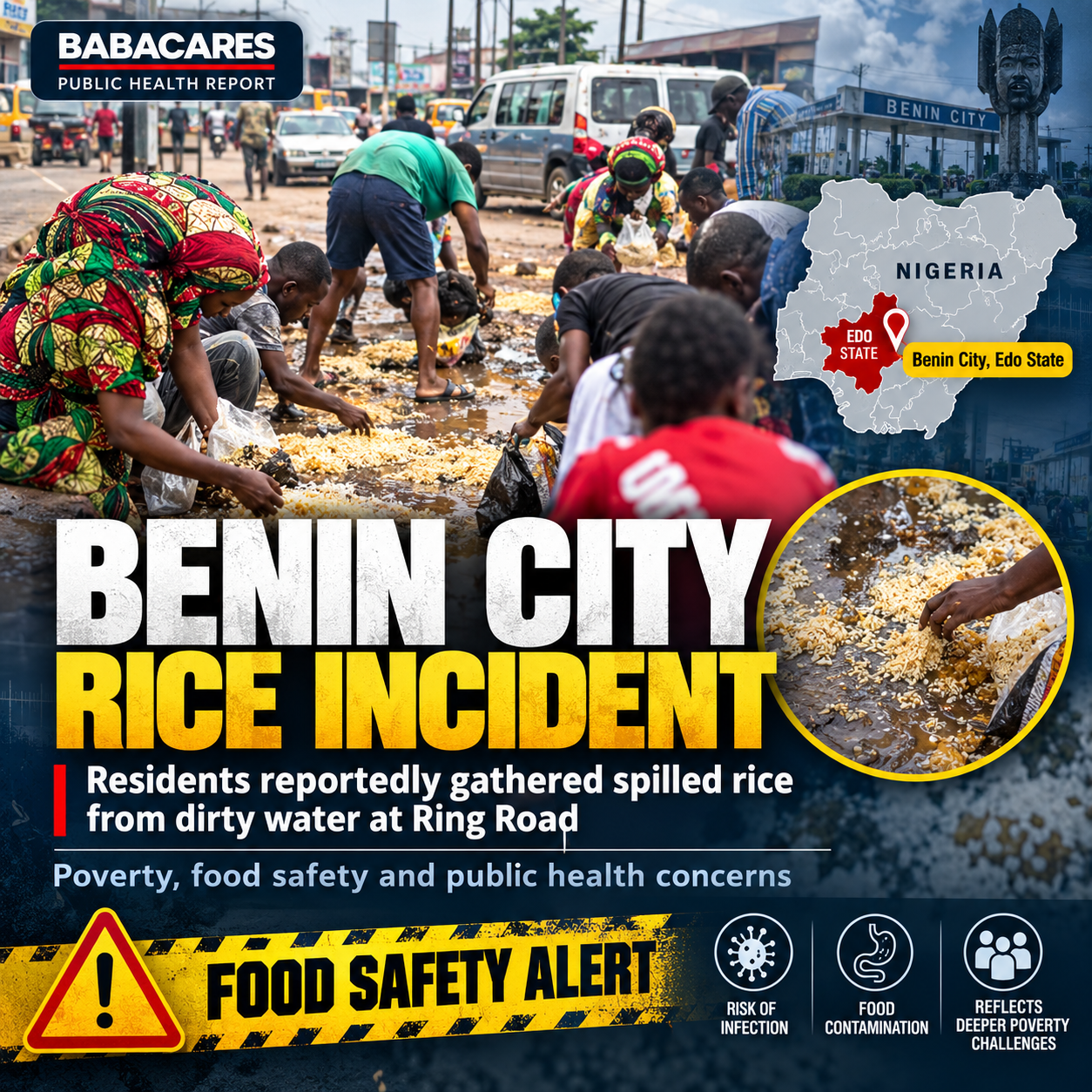
BENIN CITY RICE INCIDENT: Residents Reportedly Collect Rice From Dirty Water as Poverty and Public Health Concerns Grow
October 17, 2026 | Babacares Investigation
How difficult must life become before people consider picking rice from dirty water?
This question arises from a disturbing video circulating on social media, reportedly recorded at Ring Road, Benin City, Edo State, where several residents were seen gathering rice that had spilled onto the ground and into what was described as dirty water.
According to a report published by Akelicious on October 17, the incident happened on Friday, October 16, 2026. The report claims that the owner abandoned the rice after it fell into dirty water, before some residents began collecting it.
The footage has attracted attention not only because of the circumstances surrounding the rice, but also because of what it suggests about food insecurity, economic hardship and public health in Nigeria.
However, the exact circumstances of the incident, the identities of those collecting the rice and what happened to the grains afterwards have not been independently established.
Poverty in Nigeria: When Getting Enough Food Becomes a Struggle
Nigeria is blessed with abundant natural resources, agricultural potential and a large working population. Yet millions of citizens continue to experience poverty and economic hardship.
People in multidimensional poverty
133 million
2022 NBS national survey
Share of population affected
63%
2022 survey, not a current 2026 measurementNational Bureau of Statistics, Nigeria Multidimensional Poverty Index, 2022.
Multidimensional poverty goes beyond income. It includes deprivation in healthcare, education, sanitation, housing and other essential living conditions.
In its October 2026 Nigeria Development Update, the World Bank reported improvements in economic growth and government revenues, but emphasised the need for these improvements to translate into more jobs, poverty reduction and better living standards.
For struggling households, the reality can be difficult. Families may reduce the number of meals they eat, purchase cheaper foods of lower nutritional quality or sacrifice other essential needs simply to keep food on the table.
The Benin City incident cannot, by itself, prove that those collecting the rice were driven by hunger. But it is a powerful starting point for discussing the wider challenges of food affordability and social protection.
The Hidden Public Health Danger of Rice Collected From Dirty Water
Beyond the social and economic concerns lies a potentially serious health risk.
Rice exposed to dirty water, roadside drainage or contaminated surfaces may carry hazards that are not visible to the naked eye.
These include:
-
Bacterial contamination: Disease-causing organisms may be present in polluted water, potentially leading to diarrhoea, vomiting and gastrointestinal infections.
-
Chemical exposure: Roadside water may contain petrol, engine oil, pesticides or other harmful substances.
-
Physical contamination: Sand, broken glass, sharp metal particles and other debris may become mixed with the grains.
-
Additional risks to vulnerable groups: Children, pregnant women, older adults and people with weakened immune systems may suffer more serious consequences from foodborne illness.
The World Health Organization warns that unsafe food can transmit harmful microorganisms and chemical substances capable of causing serious illness.
There is no laboratory evidence confirming that the specific rice shown in the video was contaminated. Nevertheless, contact with visibly dirty or potentially polluted water is a legitimate food safety concern.
Can Washing and Boiling Make Such Rice Safe?
Some people may believe that washing rice repeatedly or cooking it thoroughly eliminates every health risk.
Unfortunately, this is not always true.
Cooking can kill many harmful bacteria, but it does not reliably eliminate all chemical contaminants or certain toxins.
Rice exposed to sewage, fuel, chemical waste or unidentified polluted water should not be regarded as safe for consumption simply because it has been washed and boiled.
The WHO recommends using safe water and wholesome raw materials as essential components of food safety.
Babacares therefore strongly advises against eating, repackaging or selling rice that may have been contaminated by roadside drainage or other unknown substances.
A Bigger Question: Is Poverty Putting Nigerians' Health at Risk?
The Benin City footage raises a wider question about the relationship between poverty and public health.
When people cannot consistently afford nutritious food, they may become vulnerable to malnutrition and food insecurity.
Inadequate diets can affect children's physical growth, learning and development. They can also reduce adults' strength and productivity.
Foodborne illness can further worsen financial hardship when families must spend limited resources on medication, hospital treatment and transportation to healthcare facilities.
This creates a damaging cycle in which poverty increases health vulnerability and illness deepens economic difficulties.
The solution must therefore go beyond warning people about unsafe food. It must also address why safe and nutritious food remains unaffordable for many households.
What Should the Federal and Edo State Governments Do?
The incident calls for renewed attention to food security, poverty reduction and preventive healthcare.
Government interventions should prioritise affordable staple foods, targeted food assistance for vulnerable households, better employment opportunities and stronger support for local agricultural production.
Edo State authorities should also encourage food safety education and strengthen the monitoring of food sold in markets, especially products that may have been exposed to unsafe handling or contamination.
Community food banks, transparent emergency food assistance and school nutrition programmes can provide additional support for people experiencing severe hardship.
While Nigeria's economic reforms may produce measurable national gains, the ultimate test of progress should include whether families can afford safe food, healthcare and other essential needs.
Babacares Public Health Warning
If rice or other food products have fallen into dirty roadside water, avoid consuming or selling them unless their safety can be reliably established.
Anyone who experiences severe diarrhoea, persistent vomiting, bloody stools, fever or dehydration after consuming potentially contaminated food should seek medical attention promptly.
Parents and caregivers should be particularly cautious when preparing food for children and other vulnerable family members.
Babacares Perspective: This Should Inspire Compassion, Not Ridicule
What happened at Ring Road in Benin City deserves thoughtful discussion.
The people seen collecting rice should not be mocked, humiliated or automatically labelled as poor. Their individual circumstances remain unknown.
Instead, the incident should encourage reflection on Nigeria's wider social and economic conditions.
A nation cannot measure development solely by government revenue, economic growth or infrastructure projects while neglecting the everyday struggle of families to obtain adequate nutrition.
Food security is not a luxury. It is a foundation of public health, human dignity and national development.
For Babacares, the message is clear: Nigerians need access to food that is not only affordable but also safe.
And when people face economic hardship, the answer should be compassion, practical assistance and effective public policies—not public ridicule.
A question for Nigerians: What should the Federal Government and Edo State Government do to improve food affordability and protect vulnerable households?
Babacares — Your Health, Your Right to Know.
References
-
Akelicious — Residents Reportedly Collect Rice From Dirty Water in Benin City, October 17, 2026.
-
National Bureau of Statistics — Nigeria Multidimensional Poverty Index, 2022.
Editorial clarification: Ring Road, Benin City, and October 16, 2026, are the location and date reported by Akelicious, not independently verified by Babacares. The footage does not establish the collectors' financial circumstances, that the rice was consumed or that anyone became ill.








Comments