

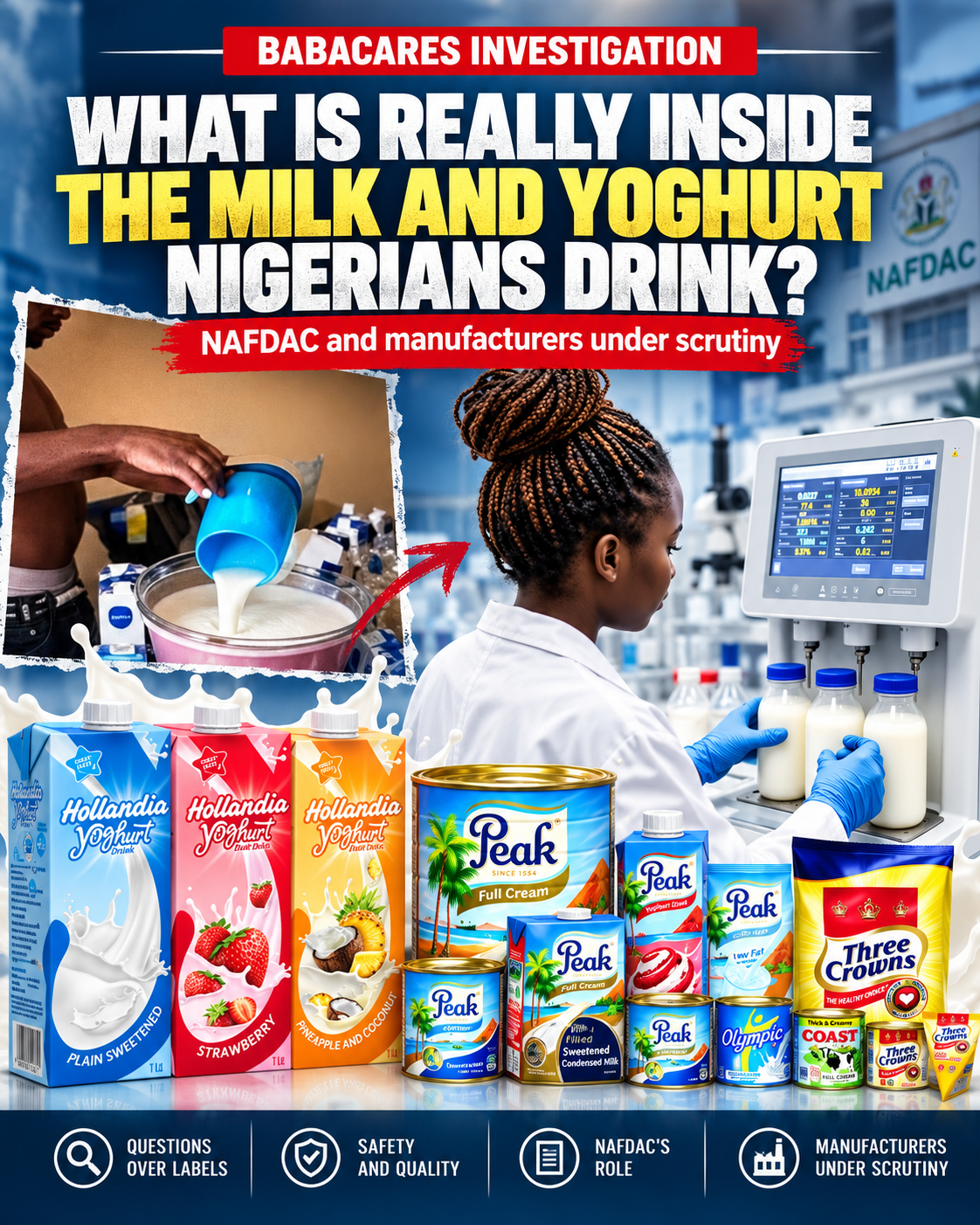
WHAT IS REALLY INSIDE THE MILK AND YOGHURT NIGERIANS DRINK? BABACARES ASKS NAFDAC AND MANUFACTURERS FOR ANSWERS.
From Hollandia to Peak, Three Crowns and other household dairy brands, Babacares examines the importance of ingredients, product authenticity, nutritional labelling and the responsibility of food regulators to protect Nigerian consumers.
Millions of Nigerian families begin their mornings with milk. Children take yoghurt to school. Parents pour dairy products into tea, pap and breakfast cereals, trusting that what they are consuming is exactly what the packaging promises.
But how many families truly know what is inside these products?
Are consumers buying real dairy products, milk-based beverages, filled milk or sweetened drinks without understanding the differences?
Are manufacturers providing enough information about ingredients, sugar content and nutritional value?
And perhaps most importantly, how regularly are the products on Nigerian supermarket shelves independently tested to ensure that their contents match their labels?
These are questions Babacares believes deserve public attention.
The Hollandia controversy that revived the debate
A recent Instagram statement attributed to Nigerian social media commentator Dr Kemi (@drkemiofnigeria) has brought renewed attention to the safety of packaged dairy products.
In the post, she alleged that Hollandia Yoghurt packaged in Nigeria is counterfeit and adulterated. She also criticised the National Agency for Food and Drug Administration and Control (NAFDAC), suggesting that consumer protection is inadequate.
Her claims included concerns about kidney disease and calls for greater public scrutiny of the country's food regulatory system.
However, Babacares must emphasise an important distinction.
No independently verified laboratory evidence has been established in our review showing that genuine Hollandia Yoghurt currently manufactured in Nigeria is adulterated or causes kidney disease.
The allegation requires investigation, not automatic acceptance.
Nevertheless, it provides an opportunity to examine a much broader issue: what Nigerians are purchasing, consuming and feeding their children.
Milk is not always the same as a milk-based beverage
One of the most important issues in the dairy market is the difference between various products sold under milk-related descriptions.
Consumers may encounter:
-
Whole milk: Milk retaining its naturally occurring milk fat, subject to processing and standardisation.
-
Skimmed milk: Milk from which most of the fat has been removed.
-
Evaporated milk: Concentrated milk produced by removing part of its water.
-
Filled milk: A formulated product in which milk fat is partly or wholly replaced with another fat, often vegetable oil, according to the applicable product standard.
-
Yoghurt: A fermented milk product produced using appropriate bacterial cultures.
-
Yoghurt drinks: Products that may contain fermented milk, added sugar, flavours, stabilisers or other permitted ingredients, depending on the formulation.
These distinctions do not mean that filled milk, flavoured milk or sweetened yoghurt is inherently dangerous.
Instead, they raise a fundamental consumer-rights question:
Does the packaging clearly explain what the consumer is buying?
A product containing vegetable fat is not automatically adulterated when the fat is permitted, properly declared and consistent with the product's approved identity.
But substituting ingredients without appropriate disclosure or making misleading product claims would raise legitimate regulatory concerns.
What about Peak, Three Crowns, Hollandia and other brands?
Peak and Three Crowns are established dairy brands associated with FrieslandCampina WAMCO Nigeria, while Hollandia is associated with Chivita|Hollandia.
These products have different formulations and product categories.
Babacares is not alleging that these manufacturers are selling unsafe products.
Rather, we believe that consumers should be able to compare their products using information that is readily available, understandable and verifiable.
For instance, Nigerians deserve clear answers to questions such as:
What proportion of a particular product is derived from milk?
Does it contain added vegetable oil?
How much sugar does a serving contain?
Are vitamins and minerals naturally present or added during production?
Has the formulation changed over the years?
And does the product sold in Nigeria have the same formulation as products sold under a similar brand name in other countries?
There can be legitimate reasons for differences in formulations between markets, including regulations, consumer preferences and available ingredients.
The issue is not necessarily whether formulations differ. It is whether consumers are properly informed about those differences.
Why sugar content deserves closer examination
Milk contains lactose, a naturally occurring sugar.
Some flavoured milk drinks and yoghurts also contain added sugars.
This makes nutritional labelling particularly important, especially where parents assume a product is healthy simply because it contains milk or yoghurt.
A sweetened yoghurt may supply protein, calcium and other nutrients while also containing substantial added sugar.
Consumers need to understand both sides of that nutritional picture.
The presence of sugar does not make a product counterfeit or adulterated. However, frequent consumption of excessive added sugar can contribute to unhealthy dietary patterns and increase the risk of dental decay, weight gain and metabolic disease.
Parents should be able to identify total sugars, added sugars where declared, serving sizes and other relevant nutritional information.
Food contamination is a serious public-health issue
According to the World Health Organization's updated June 2026 estimates, unsafe food causes approximately 866 million illnesses and 1.52 million deaths globally each year.
These figures are worldwide estimates, not statistics specifically attributed to Nigeria or dairy products.
Foodborne illness may result from bacteria, viruses, parasites or chemical contaminants.
Milk and yoghurt safety depends on several factors, including production hygiene, appropriate processing, packaging integrity, storage conditions and distribution practices.
Some dairy products require continuous refrigeration, while others are specially processed and packaged for shelf-stable storage before opening.
This is why consumers should follow the specific storage instructions printed on each product rather than assume that all milk or yoghurt requires identical handling.
It is also important not to attribute kidney disease to a particular dairy brand without medical and laboratory evidence demonstrating such a connection.
What does Nigerian law require?
NAFDAC regulates the manufacture, importation, distribution, sale and use of food and other regulated products in Nigeria.
Its published food-industry guidance requires important product information, including ingredient composition, net quantity, manufacturer details, batch identification, production and expiry dates, storage instructions and NAFDAC registration details.
Furthermore, the NAFDAC Food Hygiene Regulations 2025 require food products to carry appropriate information for safe handling, storage and consumption, while referencing the country's pre-packaged food labelling requirements.
However, compliance should not end with approval at the point of registration.
Manufacturing conditions may change. Supply chains may become compromised. Counterfeiters may imitate legitimate packaging.
That makes continued market surveillance and prompt investigation of consumer complaints essential.
Babacares asks NAFDAC seven important questions
Under the leadership of Professor Mojisola Adeyeye, NAFDAC has a responsibility to safeguard public health and maintain confidence in regulated products.
Babacares believes the agency should provide accessible information on the following issues:
-
How frequently are registered milk and yoghurt products sampled from Nigerian retail markets for independent laboratory analysis?
-
Are manufacturers required to notify NAFDAC when they change a registered dairy product's formulation?
-
What procedures are used to identify counterfeit or adulterated versions of established dairy brands?
-
Are routine surveillance findings made accessible to consumers?
-
How does NAFDAC verify that ingredients and nutritional declarations accurately reflect a product's contents?
-
What steps are taken when complaints concerning dairy-product quality or safety are received?
-
Has NAFDAC received or investigated any recent, specific allegations concerning Hollandia Yoghurt?
These questions are intended to encourage transparency, not to presume regulatory misconduct.
Babacares also challenges dairy manufacturers to explain their products
Manufacturers should be willing to answer equally important questions.
What quality-assurance systems operate in their factories?
How are ingredients sourced and verified?
How frequently are finished products tested?
What measures prevent counterfeiters from imitating their packaging?
Are there independent testing programmes?
And when formulations change, how are consumers informed?
Food manufacturers have a commercial interest in maintaining trust, but public confidence should ultimately rest on transparent information and demonstrated compliance.
What an independent investigation should test
Babacares believes a credible investigation would go beyond comparing packages or watching viral videos.
It should involve collecting samples of different dairy products from retailers across Nigerian cities, documenting their batch numbers and storage conditions, and submitting them to competent, accredited laboratories.
Depending on the products and suspected risks, testing could examine protein and fat composition, sugar content, microbial contamination, undeclared ingredients, product authenticity and relevant chemical contaminants.
Results should be assessed against the correct legal standards for each product category.
A single laboratory finding should not automatically be presented as evidence of a nationwide problem. Meaningful conclusions require appropriate sampling, validated test methods and an opportunity for manufacturers and regulators to respond.
Babacares has not yet conducted such testing or obtained laboratory findings for the brands discussed in this article.
What Nigerian parents can do immediately
Consumers do not need to wait for a major investigation before making more informed purchasing decisions.
Start by reading product labels, checking expiry dates and looking at ingredient lists.
Compare the nutritional information on different brands, particularly sugar and protein content per 100 ml or per serving.
Check that packaging is intact and that the product has been stored according to its instructions.
Consumers can also verify registration numbers through NAFDAC's official product verification portal.
If a product appears suspicious, retain the packaging, receipt, batch number and photographs when possible.
Complaints can be submitted to NAFDAC at reforms@nafdac.gov.ng or through its complaints line, 0800-1-623322.
Conclusion: Nigerians deserve to know what they are drinking
We have reached a point where the conversation about food safety should go beyond sensational social media accusations.
For generations, Nigerian parents have trusted familiar dairy brands to provide nourishment for their families.
That trust should be protected by accurate labelling, reliable quality-control systems, responsible marketing and effective public regulation.
We must not unfairly condemn manufacturers without evidence. Equally, we must not dismiss legitimate consumer concerns simply because a product belongs to a popular brand.
The duty of independent journalism is to ask questions, verify claims and pursue answers.
At Babacares, our position is simple:
If a product is safe, demonstrate its safety. If its ingredients change, inform consumers. If there is a credible allegation of adulteration, investigate it. And if a violation is established, take appropriate action.
The health of Nigerian families deserves nothing less.
Our final question to NAFDAC and Nigeria's dairy manufacturers is this: Can consumers readily access independent evidence showing that the products they buy contain what their labels promise?
Until that question receives a clear answer, public education, consumer vigilance and transparent regulatory oversight must remain priorities.
Babacares — Caring for Lives, Protecting Consumers, Promoting Public Health.




Comments