

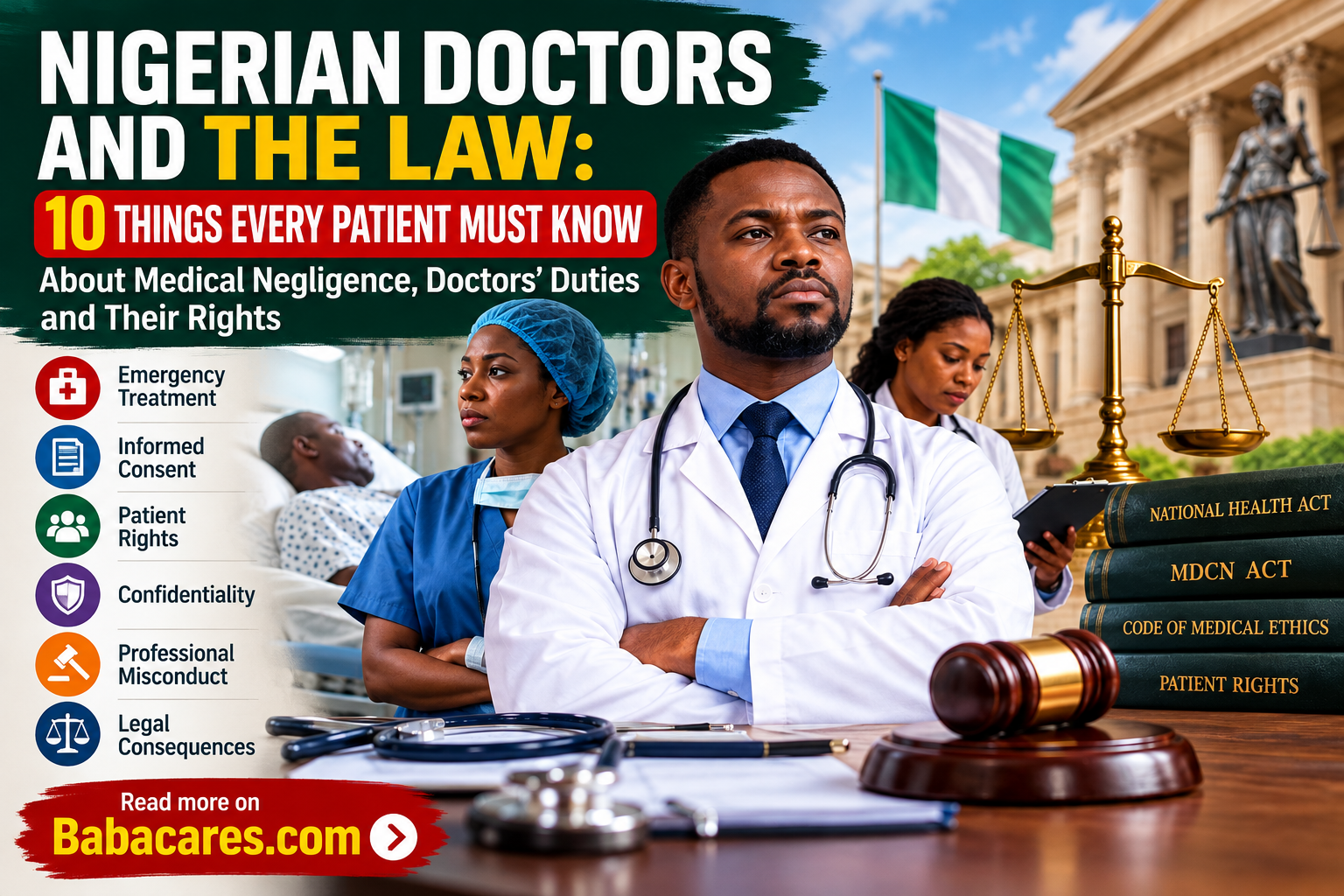
Nigerian Doctors and the Law: 10 Things Every Patient Must Know About Medical Negligence, Doctors' Duties and Their Rights.
By Babajide Moronfolu | Babacares Health & Society
What happens when the person trusted to save your life becomes the subject of a medical complaint?
Imagine rushing a seriously ill relative to a hospital, only to be told that treatment cannot begin until a deposit is paid.
Imagine undergoing surgery without fully understanding its risks, or discovering that confidential information shared with your doctor has been disclosed to someone else without your permission.
Now imagine a patient dying following medical treatment, leaving the family wondering whether the death was unavoidable or the result of professional negligence.
Who is responsible? Who investigates? And what does Nigerian law actually say?
These questions deserve serious attention.
The reality is that Nigeria has laws intended to regulate medical professionals, protect patients and provide mechanisms for investigating professional misconduct.
Unfortunately, many Nigerians are unfamiliar with these protections.
For Babacares, this is an opportunity to examine ten important things every Nigerian should understand about doctors, medical ethics, patient rights and professional accountability.
1. Every doctor practising in Nigeria must be properly registered
Possessing a medical degree does not, by itself, provide unrestricted authority to practise medicine in Nigeria.
The Medical and Dental Practitioners Act, Cap M8, Laws of the Federation of Nigeria 2004, establishes the framework for regulating medical and dental practitioners.
The Medical and Dental Council of Nigeria (MDCN) is responsible for professional registration, standards and discipline.
Doctors must meet applicable registration and licensing requirements before practising.
This means that a patient is entitled to question the professional credentials of someone claiming to be a doctor.
The MDCN provides a practitioner-status verification service through its official website.
2. Doctors cannot refuse emergency treatment simply because a patient has no money
This is one of the most important legal protections Nigerians should understand.
Section 20 of the National Health Act 2014 prohibits healthcare providers, health workers and health establishments from refusing emergency medical treatment.
The law provides for a fine of ₦100,000, imprisonment for up to six months, or both, upon conviction for violating the provision.
Consider a person rushed to hospital following a road accident.
Should the hospital insist that relatives first produce a substantial deposit before any emergency intervention can begin?
The law requires emergency treatment to take priority.
This does not mean every hospital must provide every specialist procedure or that all subsequent treatment is free. A facility may need to stabilise and appropriately refer a patient according to its capabilities.
Nevertheless, financial demands should not be used to deny urgently required emergency care.
3. Patients have a right to information about their medical condition
A doctor should not expect patients simply to accept treatment without receiving relevant information.
Section 23 of the National Health Act addresses the information healthcare providers must give patients.
This includes information about their health status, diagnostic procedures, treatment options, risks, benefits, costs and the consequences of refusing treatment.
Where possible, information should be communicated in a language and manner the patient understands.
This is particularly important in a multilingual country like Nigeria.
A patient who speaks Yoruba, Igbo, Hausa or another language should not be disadvantaged merely because complex medical explanations are presented in unfamiliar terminology.
There are legally recognised circumstances in which disclosure may be limited, but these should not become excuses for routinely keeping patients uninformed.
4. Medical procedures generally require informed consent
A doctor's professional qualifications do not automatically grant unlimited permission to perform procedures on a patient.
Informed consent means that a patient with decision-making capacity is given sufficient information to make a voluntary decision about proposed treatment.
For example, before a major operation, patients should ordinarily understand:
-
The purpose of the procedure.
-
Material risks and expected benefits.
-
Reasonable alternatives.
-
What may happen if treatment is declined.
Emergency situations, incapacity and other legally recognised circumstances may justify exceptions.
A signature on a consent form is important, but informed consent is more than paperwork. It involves meaningful communication between the healthcare professional and the patient.
5. Doctors must protect patients' confidential medical information
Suppose a patient visits a hospital for treatment of HIV, infertility, a mental health condition or another sensitive medical issue.
Can the doctor disclose the patient's condition to neighbours, employers or relatives simply because they are curious?
Generally, no.
Section 26 of the National Health Act protects confidential patient information, subject to legally recognised exceptions.
Disclosure may be permitted or required in circumstances involving patient consent, court orders, other legal duties, authorised representatives or serious public-health threats.
Professional medical ethics also require doctors to respect patient confidentiality.
In an age of smartphones, WhatsApp groups and social media, this responsibility is especially important.
A patient's medical history is not entertainment, gossip or material for online publicity.
6. Doctors must exercise reasonable professional skill and care
Medicine is complex, and even highly experienced doctors cannot guarantee that every patient will recover.
Nevertheless, medical practitioners have a professional duty to exercise appropriate care, knowledge, skill and judgment.
Negligence may arise where a doctor breaches the applicable standard of care and that breach causes legally recognised harm.
Examples that may warrant investigation include operating on the wrong body part, failing to respond appropriately to serious symptoms, administering a clearly inappropriate medication, or failing to take reasonable precautions during treatment.
However, an unexpected complication, unsuccessful operation or patient death does not automatically establish negligence.
Medical records, expert evidence, the circumstances of treatment and the link between the alleged error and the harm are often essential in determining responsibility.
7. Doctors can face disciplinary proceedings for professional misconduct
Many Nigerians assume that complaints against medical doctors can only be resolved through the police or courts.
That is not correct.
The Medical and Dental Council of Nigeria has statutory disciplinary structures.
The Medical and Dental Practitioners Investigation Panel examines allegations of professional misconduct.
Where appropriate, matters may proceed before the Medical and Dental Practitioners Disciplinary Tribunal.
Under Section 16 of the Medical and Dental Practitioners Act, available disciplinary sanctions include an admonition, suspension from practice for a period not exceeding six months, or removal from the professional register.
These are professional disciplinary measures, distinct from criminal penalties or civil damages.
A doctor accused of misconduct is also entitled to due process.
8. Can a doctor be arrested or imprisoned for medical negligence?
Yes, a doctor may face criminal liability where the facts establish an applicable criminal offence.
However, not every medical mistake is a crime.
There is an important difference between professional misconduct, civil negligence and criminal wrongdoing.
A patient may pursue compensation through civil proceedings where the legal requirements for negligence are established.
Professional misconduct may lead to disciplinary consequences.
Criminal prosecution requires proof of a criminal offence, under the applicable law and required standard of proof.
For instance, an allegation of grossly negligent conduct leading to death may raise criminal-law questions depending on the facts and applicable jurisdiction.
Doctors should not be treated as criminals merely because a patient dies, but neither should professional status shield anyone from legitimate investigation.
9. Doctors also have rights under Nigerian law
Any meaningful discussion of medical accountability must recognise the rights of healthcare workers.
Section 21 of the National Health Act addresses the rights and protection of healthcare personnel.
Healthcare establishments have responsibilities relating to the safety of personnel, including measures aimed at minimising injuries and disease transmission.
Doctors deserve safe working environments, appropriate protections against violence and fair procedures when complaints are made against them.
Healthcare professionals in Nigeria frequently work under difficult conditions, including inadequate equipment, overwhelming patient numbers, workforce shortages and infrastructure challenges.
These difficulties do not eliminate professional responsibilities.
However, determining accountability may require examining both individual conduct and institutional failures.
A doctor cannot reasonably be expected to perform a procedure requiring equipment that is unavailable, but the doctor and facility remain responsible for taking appropriate steps within their capabilities, including referral where necessary.
Protecting patients and protecting responsible medical professionals are complementary goals.
10. Patients have the right to complain and seek redress
When patients or relatives suspect misconduct, there are practical steps they can take.
They should document what happened, preserve relevant receipts and correspondence, request medical records through lawful procedures, and seek an independent medical opinion where appropriate.
Complaints about doctors' professional conduct can be directed to the Medical and Dental Council of Nigeria.
Patients may also use hospital complaints channels, applicable state healthcare regulators and other legally available redress mechanisms.
In Lagos State, for example, the Health Facility Monitoring and Accreditation Agency (HEFAMAA) provides information on patients' rights and regulates health facilities within its mandate.
Where serious negligence or an unlawful act is suspected, affected persons may seek qualified legal advice about possible civil or criminal proceedings.
A complaint is not proof of wrongdoing. Investigations must be evidence-based and fair to everyone involved.
Beyond the law: Nigeria needs a stronger culture of medical accountability
One of the greatest challenges facing healthcare systems is not simply the existence of laws, but whether patients and professionals understand and follow them.
A law protecting emergency patients has little practical value if families do not know it exists.
A professional code requiring informed consent becomes ineffective when patients are discouraged from asking questions.
A disciplinary process cannot build public confidence if people do not know how to submit complaints or what to expect afterward.
Nigeria needs stronger patient education, transparent complaints procedures, better medical documentation, effective professional oversight and institutional investment in healthcare quality.
Medical associations, hospital administrators, professional regulators, civil society organisations and the media all have roles to play.
Final thoughts: A white coat is a symbol of trust, not immunity
Doctors hold a special place in society because human lives are frequently placed in their hands.
Most enter the profession with a commitment to healing, relieving suffering and serving humanity.
That responsibility deserves respect.
But respect must coexist with accountability.
Patients deserve dignity, truthful information, confidentiality, emergency care and competent treatment.
Doctors deserve safe workplaces, fair investigations and protection from unjust accusations.
The law must protect both sides of the hospital bed.
The next time you visit a hospital in Nigeria, remember that you are not simply a patient hoping for help.
You are a person with rights.
And the professional treating you has both responsibilities and legal protections.
At Babacares, we believe that greater awareness of these rights and duties can help build a healthcare system founded on trust, professionalism, safety and accountability.
Babacares — Promoting Health Awareness, Patient Safety and Informed Living.
Disclaimer: This article provides general public-health and legal information, not legal advice. Individual cases should be assessed by qualified Nigerian legal and medical professionals.









Comments