

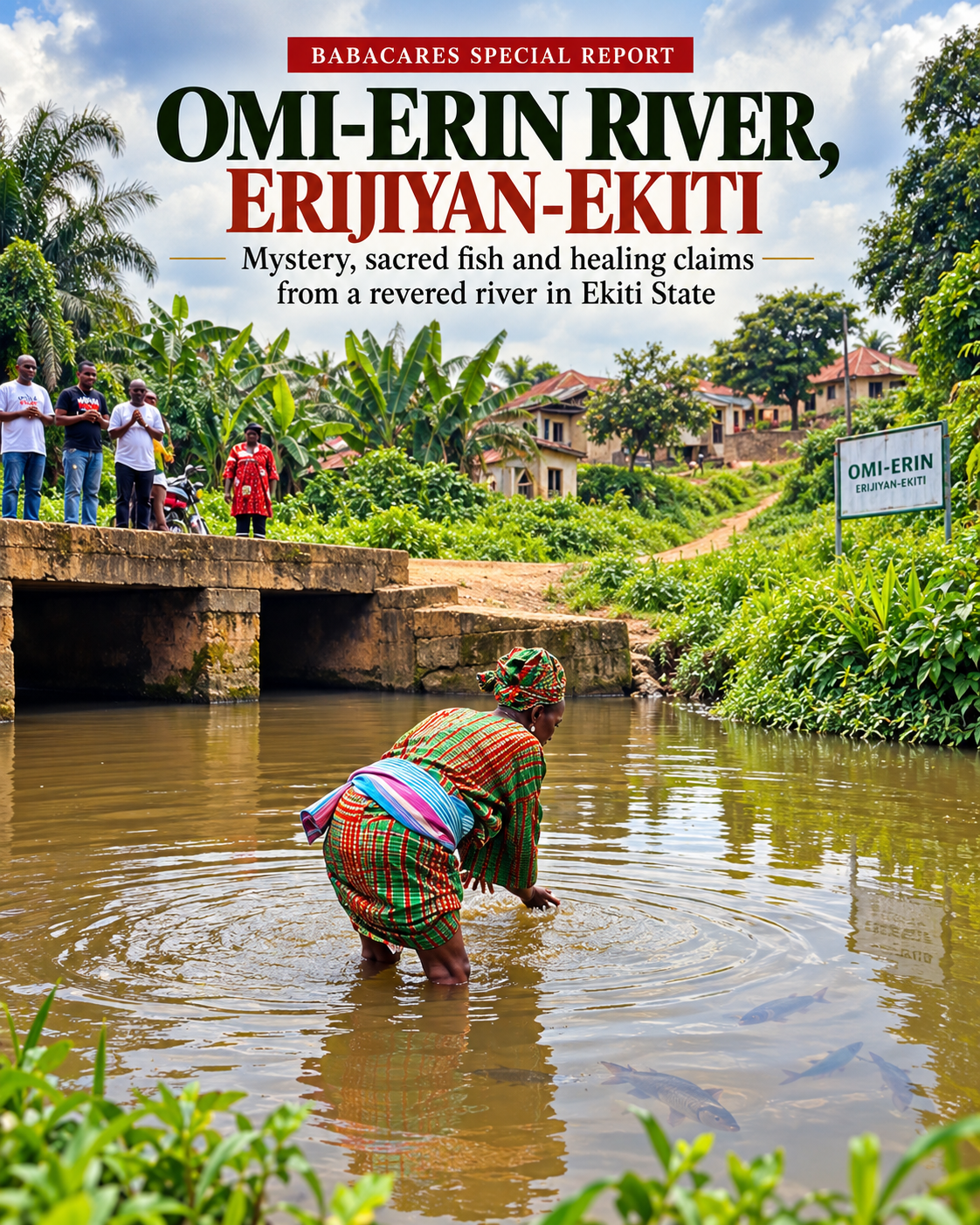
OMI-ERIN RIVER, ERINJIYAN-EKITI: The Mysterious River Where Fish Allegedly Return to Life, Sacred Waters Heal and Miracles Are Sought
Inside the extraordinary beliefs surrounding an Ekiti State river, as award-winning Nollywood movie director Okiki Afolayan visits a sacred site where tradition, spirituality and science raise fascinating questions.
By Babajide Moronfolu | Babacares.com
What if a fish cut into pieces for cooking could mysteriously become whole again?
Imagine catching a fish from a river, cutting it into pieces, placing it inside a cooking pot and returning later to discover something seemingly impossible: the fish has become whole again!
Unbelievable? Certainly. Scientifically established? No. But this is one of the extraordinary stories surrounding Omi-Erin River in Erijiyan-Ekiti, Ekiti State, Nigeria.
Now imagine being told that the same river possesses spiritual powers capable of bringing healing to the sick, helping women seeking children, answering prayers and even assisting people hoping to secure visas to travel abroad.
And there is more.
The fish in the river are reportedly regarded as sacred and forbidden for consumption. Even the surrounding palm trees are said to possess mysterious qualities.
Is this a place of miracles, an ancient spiritual sanctuary, or an extraordinary example of Yoruba folklore that has survived generations?
These questions came into sharper focus when award-winning Nollywood movie director and filmmaker Okiki Afolayan visited the river with his team and shared footage of their encounter on Facebook.
What they heard from a woman devotee at the river was enough to leave visitors astonished.
In the video, the woman, dressed in colourful traditional attire, describes the river's spiritual importance and the remarkable beliefs surrounding its water and aquatic life.
She also makes an intriguing personal declaration: she is a child from the river.
But what exactly makes Omi-Erin River so special?
And what can we learn from the encounter about faith, healing, culture and the relationship between traditional beliefs and modern scientific understanding?
The mysterious fish that must never be eaten
Among the claims attributed to the woman devotee, perhaps none is more astonishing than the story of the river's fish.
According to her account, the fish must not be caught and eaten.
She claims that even if someone attempts to cook one, cutting it into pieces beforehand, the fish will mysteriously return to its original whole form.
For believers, such stories may reinforce the sacred status of the river and the need to respect its traditional prohibitions.
From a scientific standpoint, however, there is no established biological process by which a dead, dismembered fish can reassemble itself during cooking.
The account should therefore be understood as an extraordinary traditional claim, not a demonstrated natural phenomenon.
Interestingly, prohibitions against catching or eating fish can sometimes serve an environmental purpose. Where communities protect certain aquatic species through cultural or religious rules, those traditions may contribute to wildlife conservation.
Whether that is an intended function of the beliefs surrounding Omi-Erin River would require further local investigation.
The water that allegedly heals, answers prayers and brings children
Another striking aspect of the woman's testimony concerns the spiritual benefits associated with the river.
She describes the water as a place where people seek answers to difficult personal circumstances.
According to the account, people visit for prayers concerning illness, childlessness, personal struggles and opportunities to travel abroad.
The woman suggests that the river is particularly significant to women seeking children.
Such beliefs reflect the important relationship between fertility, motherhood and spirituality in many African traditional communities.
For centuries, rivers and other natural sites have occupied significant places in indigenous religious traditions, sometimes becoming centres of prayer, purification and thanksgiving.
However, claims that river water can cure diseases, treat infertility or influence visa decisions have not been scientifically established.
Infertility can have many medical causes affecting either partner, and people experiencing difficulty conceiving should have access to appropriate medical assessment and treatment.
Faith and personal spiritual practices may provide emotional comfort, but they should not replace necessary healthcare.
The mysterious prohibition against taking water home
Another part of the woman's account concerns restrictions on removing water from the river.
According to the testimony, visitors are not supposed to take the water home for ordinary domestic purposes, particularly cooking.
This creates an interesting contrast because the river is also described as a place used for bathing, washing and drinking.
Such distinctions are not unusual in sacred traditions, where the permitted use of a natural resource may depend on customary rules, ritual context or beliefs about its spiritual significance.
Nevertheless, the distinction raises important questions about how local residents understand and manage the river.
Does the prohibition apply to everyone? Are there special circumstances in which the water may be collected? Who determines the rules?
These are questions worth exploring through interviews with traditional custodians and community leaders.
Even the palm trees are surrounded by mystery
The devotee also refers to mysterious qualities associated with palm trees around the river.
Although the precise origins of these beliefs remain unclear from the account provided, their inclusion suggests that the river's sacred significance may extend beyond the water itself.
In many indigenous traditions, a sacred landscape can include trees, rocks, forests, animals and waterways, each contributing to a broader cultural and spiritual identity.
The stories surrounding Omi-Erin River may therefore represent more than isolated supernatural claims.
They may form part of a larger system of oral traditions that deserves careful documentation before valuable cultural knowledge disappears.
A public-health question: Is the river water safe?
Beyond the mystery and spirituality, one aspect of the account deserves particular attention.
The woman reportedly says the water is used for drinking, washing and bathing.
From a public-health perspective, this raises a crucial question: has the water been tested for human consumption?
Natural rivers may contain disease-causing microorganisms, parasites, agricultural runoff or other contaminants.
Water that looks clear or has been considered sacred for generations is not automatically safe to drink.
Untreated surface water can expose people to illnesses such as diarrhoeal infections, including cholera where the relevant bacteria are present.
Bathing in contaminated freshwater may also carry risks, including exposure to parasites in areas where they occur.
Without laboratory testing, it is impossible to determine whether Omi-Erin River is safe for drinking or other uses.
Its cultural significance deserves respect, but spiritual beliefs should not be mistaken for evidence of microbiological safety.
Local authorities and environmental-health professionals could help protect both residents and visitors through appropriate water-quality assessment.
Yoruba heritage: When rivers become sacred
The story of Omi-Erin River should also be examined within the broader cultural history of the Yoruba people.
Across Yorubaland, rivers and other natural features have long occupied important places in traditional belief systems.
One widely documented example is the Osun-Osogbo Sacred Grove in Osun State, associated with the Yoruba river deity Osun and recognized as a UNESCO World Heritage Site.
Such places illustrate how spirituality, nature, historical memory and communal identity can become deeply interconnected.
This does not establish that the particular claims made about Omi-Erin River are true, nor does it mean the river shares exactly the same traditions as Osun-Osogbo.
Rather, it demonstrates why sacred rivers should not be viewed merely as curiosities.
They can also represent important elements of indigenous knowledge, cultural continuity and community heritage.
Okiki Afolayan's visit and the importance of documenting local traditions
The visit by Okiki Afolayan and his team provides an opportunity to consider the growing importance of documentary storytelling in preserving African cultural heritage.
As an award-winning Nollywood movie director and filmmaker, Afolayan is associated with the storytelling tradition that has helped bring Nigerian experiences, histories and cultural expressions to audiences far beyond the country.
His decision to share a visit to Omi-Erin River introduces viewers to a location they might otherwise never have encountered.
Beyond the extraordinary claims, the footage draws attention to the landscape, the devotee's testimony and the continuing relevance of traditional beliefs.
It also raises questions that merit further investigation.
Who are the traditional custodians of Omi-Erin River? How old are its sacred traditions? Are there documented historical accounts? Has any research been carried out on the fish or water quality?
Answering these questions would help distinguish oral tradition, observable facts and claims requiring independent verification.
Between faith and science: Must one cancel the other?
Stories like Omi-Erin River frequently generate disagreement.
Some people may see them as compelling evidence of spiritual power. Others may dismiss them entirely.
But a more thoughtful approach begins by recognizing the distinction between cultural significance and scientific evidence.
A community's traditional beliefs can be worthy of preservation even when supernatural explanations cannot be independently confirmed.
Similarly, investigating extraordinary claims does not necessarily amount to disrespecting the people who hold them.
The challenge is to approach such stories with intellectual curiosity, cultural sensitivity and a commitment to factual accuracy.
Traditional knowledge may preserve valuable historical and ecological information. At the same time, claims involving health, fertility or physical transformations require credible evidence before they can be presented as established facts.
Why Babacares believes this story matters
At Babacares, we believe health is not merely the absence of disease.
It also involves emotional well-being, social relationships, cultural identity and the different ways people understand suffering and recovery.
The story of Omi-Erin River touches on several of these dimensions.
People seeking healing, children or a breakthrough in difficult circumstances may find comfort in spiritual practices and traditional places.
But hope also creates vulnerability.
That is why claims of healing should be examined responsibly, especially when desperate individuals might abandon proven medical treatment or expose themselves to health risks.
At the same time, the cultural heritage surrounding such locations deserves attention and protection.
We can respect people's beliefs without presenting unverified miracles as established facts.
That balance is essential to responsible storytelling.
Conclusion: A river of mysteries or a mirror of human belief?
Omi-Erin River in Erijiyan-Ekiti remains a fascinating subject.
From tales of fish that allegedly become whole again after being cut, to claims of healing waters, fertility blessings and spiritual intervention, the river occupies a remarkable place in the testimony shared during Okiki Afolayan's visit.
Whether the stories represent miracles, folklore, symbolic traditions or a combination of deeply held beliefs, they reveal something profound about humanity.
Across generations, people have searched for healing, protection, fertility, prosperity and answers to life's uncertainties.
Some turn to hospitals. Others turn to prayer. Many combine medical care with spiritual practices.
And in communities such as Erijiyan-Ekiti, rivers may remain powerful symbols of that search.
But one question remains: If the mysteries of Omi-Erin River have endured for generations, should they be investigated scientifically, preserved culturally, or both?
Perhaps the most valuable response is to document the traditions, listen respectfully to their custodians, protect the environment and investigate the claims without prejudice.
Because sometimes, the story behind a mysterious river tells us as much about human hope and cultural identity as it does about the water itself.
Babacares Editorial Note: The extraordinary claims reported in this article are attributed to a woman's testimony described in footage shared by filmmaker Okiki Afolayan. They have not been independently verified. Babacares does not endorse untreated river water as a medical treatment or safe drinking-water source.
Source: Facebook video posted by Okiki Afolayan concerning his team's visit to Omi-Erin River, Erijiyan-Ekiti.
Published on Babacares.com — Health, Culture, Heritage and Society.








Comments