

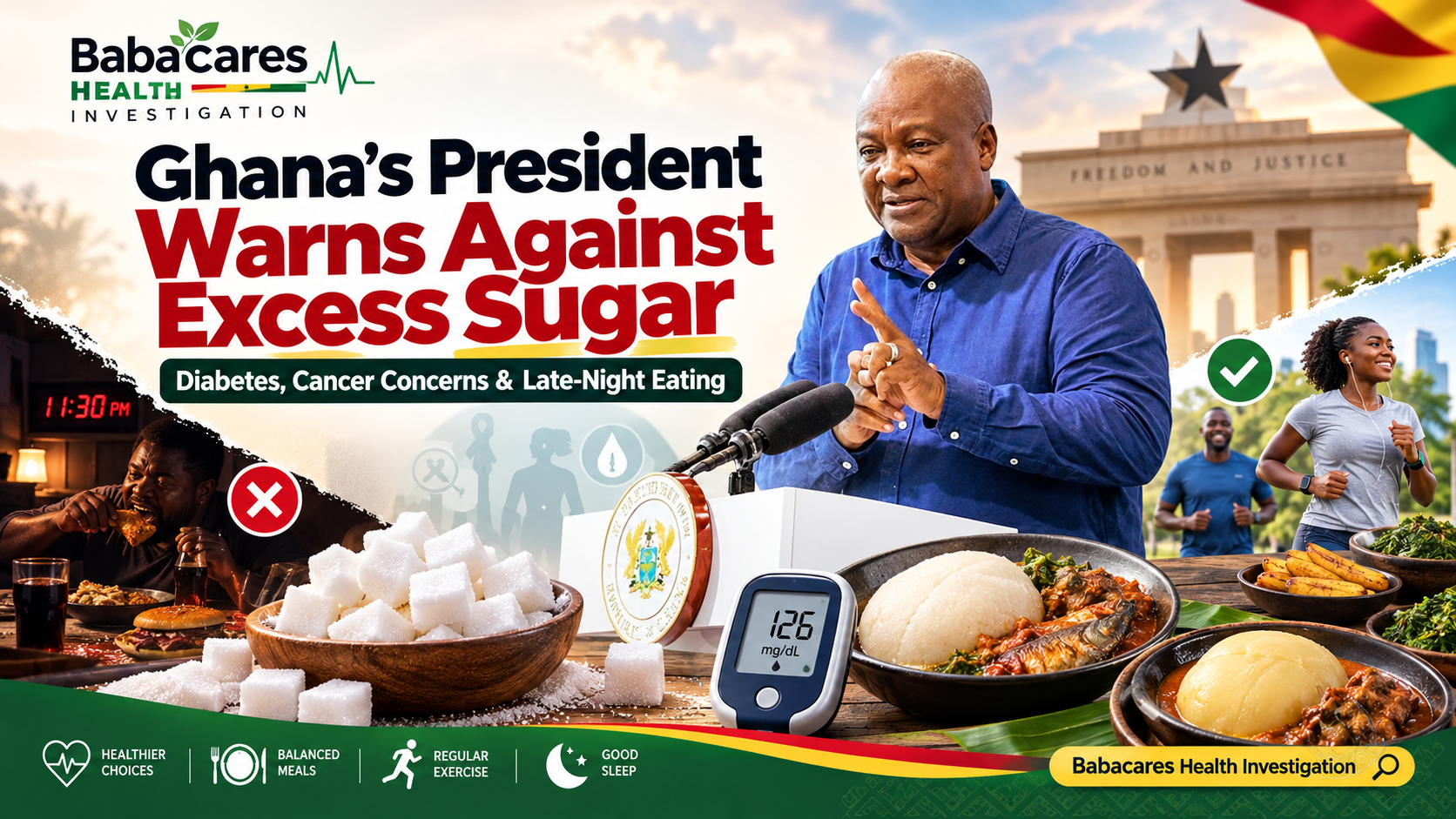
PRESIDENT OF GHANA WARNS AGAINST EXCESSIVE SUGAR: CAN YOUR DIET INCREASE DIABETES AND CANCER RISKS?
From sugar consumption to late-night banku and fufu, President John Mahama's health warning raises important questions about African diets, diabetes, cancer and the changing lifestyles of millions of people.
By Babajide Moronfolu | Babacares.com
Could the food we love, the sugar we consume, and the time we eat be contributing to some of the health challenges facing Africans today?
This is an important question arising from recent remarks by Ghana's President, John Dramani Mahama, who has urged citizens to reconsider their dietary habits, reduce excessive sugar consumption and become more physically active.
During his July 2026 Resetting Ghana tour of the Volta Region, President Mahama warned against excessive sugar intake, particularly among people who enjoy sweet foods and drinks.
He described excessive sugar consumption as a potential pathway to diabetes.
The President also spoke about cancer, drawing on his experience during a visit to the Sweden Ghana Medical Centre, a major cancer treatment facility in Accra.
He suggested that cancer cells thrive on sugar and warned that excessive consumption could encourage cancer.
His comments extended to traditional Ghanaian meals such as banku, akple and fufu, particularly when eaten in large quantities late at night.
But how much of this advice is supported by medical science?
And should Africans begin avoiding their traditional foods?
SUGAR AND DIABETES: WAS PRESIDENT MAHAMA RIGHT?
The President's concern about excessive sugar consumption is justified, although the relationship between sugar and diabetes requires explanation.
Type 2 diabetes develops when the body becomes resistant to insulin or cannot produce enough insulin to regulate blood glucose effectively.
Excess body weight, physical inactivity, genetic predisposition, age and several other factors can increase the risk of developing the condition.
Frequent consumption of sugar-sweetened beverages can contribute to excess calorie intake and weight gain, which may increase diabetes risk.
However, eating sugar does not automatically mean someone will develop diabetes.
A physically active person with a balanced diet can still develop the condition, particularly when genetic and other risk factors are present.
The World Health Organization recommends limiting free sugars to less than 10% of daily energy intake, ideally below 5% for additional health benefits.
For someone consuming approximately 2,000 calories daily, 5% represents about 25 grams, or six teaspoons, of free sugar.
These recommendations are particularly relevant in communities where sweetened drinks, sugary tea, pastries and heavily processed foods are becoming increasingly common.
DOES SUGAR REALLY FEED CANCER?
This is perhaps the most controversial aspect of President Mahama's remarks.
He reportedly described a conversation at the Sweden Ghana Medical Centre that led him to associate sugar with cancer growth.
There is some biological truth behind the broader observation: cancer cells frequently consume glucose rapidly.
But there is an important scientific distinction.
All cells in the human body need energy, and glucose is an important fuel for many normal cells as well as cancer cells.
According to the United States National Cancer Institute, there is no evidence that simply eating sugar directly causes cancer to grow faster, or that eliminating sugar will cause a tumour to shrink.
However, diets high in added sugars can contribute to excessive weight gain, and obesity is associated with an increased risk of several cancers.
Emerging laboratory research is also exploring how different sugars influence tumour metabolism, but these findings should not be confused with proof that ordinary sugar consumption directly causes cancer.
The lesson is straightforward: reducing excessive added sugar is sensible, but sugar avoidance is not a cancer treatment.
Patients undergoing cancer treatment should not eliminate essential nutrients or follow restrictive diets without guidance from their healthcare team.
BANKU, FUFU, AKPLE AND OTHER AFRICAN FOODS: ARE THEY THE PROBLEM?
President Mahama's warning about eating heavy traditional meals late at night has attracted considerable attention.
Banku, fufu, akple and similar African staples are rich in carbohydrates, which the body breaks down to provide energy.
But carbohydrates are not inherently harmful.
They remain an important part of a balanced diet.
The concern is often the quantity consumed, what accompanies the meal, individual health conditions and overall physical activity.
For example, a moderate portion of banku served with fish, vegetables and a nutritious soup may form part of a balanced meal.
The same principle applies to Nigerian foods such as eba, amala, pounded yam, semovita and rice.
Rather than declaring these traditional foods dangerous, public health education should focus on healthier portion sizes and meal combinations.
We do not necessarily need to abandon African foods. We need to understand how to eat them wisely.
WHY LATE-NIGHT EATING DESERVES ATTENTION
During an earlier address in April 2026, President Mahama advised citizens to finish dinner by approximately 7 p.m. rather than consume large meals shortly before bedtime.
His warning reflects a genuine concern about increasingly sedentary lifestyles.
Many people leave home early, sit at work for several hours, return late in the evening and consume their largest meal immediately before sleeping.
Research suggests that eating large meals close to bedtime can aggravate acid reflux, particularly among people already prone to the condition.
Meal timing may also influence glucose regulation and sleep, although individual responses vary.
However, there is no universal medical rule requiring everyone to stop eating precisely at 7 p.m.
Someone who works evening shifts or goes to bed much later may reasonably eat after that time.
For many adults, avoiding an unusually heavy meal within two to three hours of bedtime may be a more practical approach, especially when reflux is a concern.
EXERCISE: THE MISSING PART OF THE CONVERSATION
One of the President's strongest arguments concerns physical inactivity.
He compared earlier generations, who often engaged in demanding agricultural activities, with today's increasingly sedentary working population.
The comparison highlights an important shift.
Modern lifestyles frequently involve long hours sitting behind desks, driving and using electronic devices.
Regular physical activity helps improve insulin sensitivity, supports cardiovascular health, maintains muscle strength and contributes to healthy aging.
The World Health Organization recommends at least 150–300 minutes of moderate-intensity aerobic physical activity per week for adults, alongside muscle-strengthening exercises.
Walking, dancing, gardening, cycling and other everyday movements can contribute.
For older adults, physical activity should also include appropriate balance and strength exercises to help maintain independence and reduce falls.
WHAT AFRICANS CAN LEARN FROM MAHAMA'S WARNING
President Mahama has raised a conversation that deserves attention far beyond Ghana.
Nigeria, Ghana and other African countries are experiencing changes in diet, work patterns and physical activity.
Traditional diets now coexist with fast food, sweetened beverages, processed snacks and more sedentary routines.
Rather than frightening people away from familiar foods, governments and health professionals should encourage practical, culturally appropriate health education.
Simple actions can make a meaningful difference:
-
Reduce sugary drinks and unnecessary added sugar.
-
Eat balanced meals with appropriate portions.
-
Include vegetables, protein and fibre-rich foods.
-
Avoid routinely eating very heavy meals just before bedtime.
-
Engage in regular physical activity suited to your age and health.
-
Check blood pressure and blood glucose as advised by healthcare professionals.
-
Seek credible medical information rather than relying solely on viral health messages.
MY TAKE: A PRESIDENTIAL WARNING THAT DESERVES ATTENTION—AND SCIENTIFIC CLARITY
I commend President John Dramani Mahama for using his public platform to encourage healthier lifestyles and raise awareness about preventable non-communicable diseases.
African leaders should speak more frequently about public health, prevention and healthy aging.
However, public health communication must remain scientifically accurate.
Excessive sugar consumption is a legitimate concern, but the claim that sugar directly triggers cancer oversimplifies a complex disease.
Similarly, eating banku, fufu or other traditional carbohydrate-rich foods does not automatically make someone unhealthy.
What matters is the broader pattern of diet, physical activity, portion sizes, metabolic health and individual medical circumstances.
Public health messages should educate rather than create unnecessary fear.
FINAL THOUGHT
Perhaps the most valuable lesson from President Mahama's warning is that prevention deserves as much attention as treatment.
We must begin thinking seriously about the relationship between what we eat, how much we move, how well we sleep and how we age.
At Babacares, I have consistently emphasized that healthy aging is not simply about living longer.
It is about maintaining the physical strength, mental well-being and independence necessary to enjoy those additional years.
The goal is not to stop enjoying our traditional African meals. It is to make healthier decisions about how much we eat, what we eat with them and how we live.
So, the next time you sit down to enjoy your favourite banku, fufu, amala or pounded yam, remember that moderation and balance matter more than fear.
Your health tomorrow is influenced, in part, by the choices you make today.
Babajide Moronfolu | Babacares.com
Readers' Question: Do you agree with President Mahama's advice to avoid heavy carbohydrate-rich meals late at night, or do you believe traditional African foods are being unfairly blamed for modern health problems?









Comments