

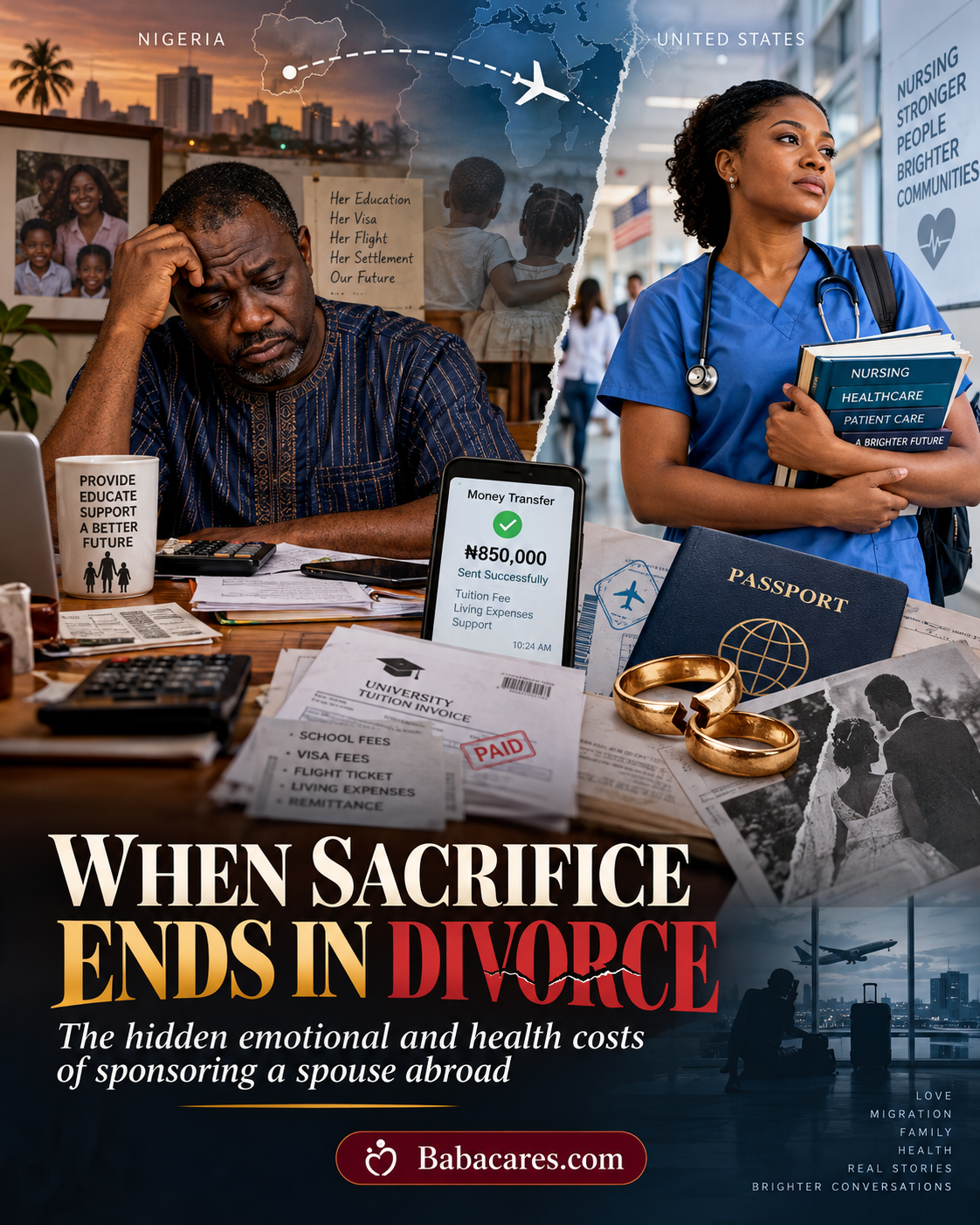
WHEN SACRIFICE ENDS IN DIVORCE: The Hidden Emotional and Health Costs of Sponsoring a Spouse Abroad.
After years of paying school fees, financing immigration, and enduring loneliness, what happens when the spouse you sacrificed everything for decides the marriage is over?
By Babajide Moronfolu | Babacares.com
When Love, Sacrifice, and Migration Collide
Imagine working tirelessly for ten or fifteen years, sending money abroad to support your spouse's education, paying bills, sacrificing your personal comfort, and looking forward to the day your family will finally reunite.
Then, one day, your spouse calls.
Instead of discussing reunion plans, you hear something you never imagined:
"I don't think this marriage is working anymore. I want a divorce."
For someone who has spent years investing financially and emotionally in a relationship, those words could be devastating.
Recently, I came across a social media story describing a Nigerian man who reportedly spent fifteen years supporting his wife and children abroad, only to face a request for divorce.
The authenticity of that particular account has not been independently established. Nevertheless, the discussion surrounding it raises a troubling question:
What happens to the emotional, psychological, financial, and physical health of people who sacrifice their own well-being to secure a better future for their spouses and families?
For Babacares, this is not simply another story about marriage or divorce. It is a conversation about mental health, relationships, migration, personal sacrifice, and the realities of growing older.
The African Dream of a Better Life Abroad
Across Nigeria and other African countries, families make enormous sacrifices to pursue opportunities in Canada, the United States, the United Kingdom, and elsewhere.
For some couples, the arrangement begins with a shared dream.
One spouse travels abroad to study nursing, medicine, technology, or another profession while the other remains behind to finance the education and support the family.
Sometimes, the children travel with the studying spouse.
The expectation is that after graduation, employment, and immigration stabilization, the family will reunite and enjoy the benefits of their collective sacrifice.
But migration can change family dynamics.
The spouse abroad may become financially independent, develop new social networks, and experience different cultural expectations.
Meanwhile, the spouse who remains behind may face rising living expenses, currency depreciation, loneliness, and the emotional burden of living without a partner.
Over time, two people who once shared the same vision may begin living very different lives.
The painful question is whether the marriage is growing alongside the opportunity or slowly disappearing behind it.
When Financial Sacrifice Becomes Emotional Exhaustion
Sending money overseas is not always an easy task.
For a spouse earning in Nigerian naira while paying expenses in American or Canadian dollars, financial responsibilities can become overwhelming.
School fees, accommodation, children's welfare, transportation, healthcare, and everyday expenses may require sacrifices far beyond the original family budget.
Some people borrow money, postpone retirement savings, work additional hours, or neglect their own health to keep their loved ones comfortable abroad.
The emotional consequences may be equally serious.
A spouse may begin to feel that their relationship has become defined primarily by money transfers rather than companionship, affection, and shared responsibilities.
When financial expectations are unclear or one partner feels unsupported, resentment may gradually develop.
Research into family economic strain has linked financial pressure with poorer marital quality and stability. However, financial hardship does not automatically lead to divorce, and supportive communication can help couples manage these pressures.
Marriage should be a partnership, not an endless financial obligation that leaves one person physically, emotionally, and financially depleted.
The Silent Health Crisis Behind Long-Distance Marriages
One aspect of these stories receives far too little attention: the health of the individuals involved.
Prolonged marital separation, financial uncertainty, and relationship conflict may contribute to:
-
Chronic stress, anxiety, and emotional exhaustion.
-
Loneliness and feelings of abandonment.
-
Sleep disturbances and difficulty concentrating.
-
Depression and reduced motivation.
-
Unhealthy coping behaviours.
-
Neglect of exercise, nutrition, medical appointments, and personal well-being.
A 2024 systematic review published in Social Science & Medicine examined the mental health effects of migration-related family separation. It identified links with anxiety, depression, psychological distress, and sleep difficulties among affected parents and children.
Although this research focused largely on separation associated with migration policies, its findings reinforce the importance of protecting family relationships and mental well-being during migration.
The World Health Organization's 2025 report on social connection also identifies loneliness and social isolation as significant public health concerns associated with poorer mental and physical health.
A broken relationship can hurt emotionally, but prolonged distress and isolation may also affect a person's overall health.
We must therefore begin asking not only how much an individual has spent supporting a spouse abroad, but also what that sacrifice has cost their own well-being.
When Education and Financial Independence Change a Marriage
Education and professional advancement should be celebrated.
A woman who becomes a nurse, doctor, engineer, or successful professional after immigrating has achieved something meaningful. The same applies to a man whose spouse supported him through years of education.
However, significant life changes can sometimes alter expectations within a marriage.
Financial independence may change how partners negotiate responsibilities, make decisions, and imagine their futures.
In some relationships, the spouse who provided financial support may expect continued influence over major decisions.
The spouse who completed the education may expect greater independence and a more equal partnership.
Without open communication, these changing expectations can become sources of conflict.
It is important to emphasize that education, nursing, immigration, and women's financial independence do not inherently destroy marriages.
Neither should we assume that every spouse who requests divorce has betrayed someone who supported them.
Some relationships break down because of prolonged separation, incompatibility, unresolved conflict, mistreatment, or changing personal circumstances.
Others survive and become stronger.
Every marriage has its own history, and responsible discussion requires hearing both sides.
What About the Children?
Children are sometimes the overlooked participants in international family separation.
A child who grows up abroad while one parent remains in another country may experience emotional distance, disrupted parental relationships, or uncertainty about family belonging.
Regular video calls and financial support can help maintain contact, but they do not always replace the experience of everyday parental involvement.
When a marriage eventually breaks down, children may face additional emotional and practical adjustments.
Parents should therefore prioritize their children's emotional security, avoid turning them against either parent, and seek professional support when necessary.
Migration should create opportunities for children without overlooking their need for stable and loving relationships.
The Impact on Men, Women, and Healthy Ageing
As a healthcare communicator and author passionate about healthy ageing, I am particularly concerned about individuals who spend their most productive years caring for everyone except themselves.
Imagine arriving at your late fifties or sixties after years of financial sacrifice, only to discover that your marriage has ended, your savings are depleted, and your retirement plans have been interrupted.
The emotional shock could be considerable.
But this concern is not limited to men.
Many women have also financed their husbands' education, supported immigration applications, raised children alone, and endured painful relationship breakdowns.
Both men and women deserve emotional support, financial security, dignity, and opportunities to rebuild their lives.
In my book, Ageless Living: Unlock the Secrets to Staying Young as You Grow, I explore the importance of emotional resilience, healthy relationships, spirituality, and maintaining purpose throughout life.
The message is relevant here.
Growing older successfully is not just about avoiding illness. It is also about protecting our emotional health, maintaining meaningful relationships, and making choices that preserve our dignity and peace of mind.
No one should have to sacrifice their entire future to demonstrate love.
Seven Lessons for Couples Planning Education or Immigration Abroad
Before embarking on a long-distance marriage arrangement, couples should consider the following:
1. Agree on a realistic reunion plan.
Discuss when and how the family intends to reunite. Avoid allowing temporary separation to become indefinite without mutual agreement.
2. Discuss financial expectations openly.
Determine who will pay tuition, living expenses, and other commitments, and review what each spouse can realistically afford.
3. Protect personal savings and retirement plans.
Supporting your partner should not require abandoning your own long-term financial security.
4. Maintain emotional intimacy.
Regular conversations should go beyond money, school fees, and bills. Discuss feelings, concerns, hopes, and relationship expectations.
5. Recognize changing roles.
Education and increased income may change family responsibilities. These changes should be negotiated with respect rather than control or resentment.
6. Seek counselling before problems become overwhelming.
Qualified marriage counsellors, therapists, and financial counsellors can help couples navigate disagreements and difficult transitions.
7. Never neglect your health.
Maintain medical appointments, physical activity, supportive friendships, adequate rest, and meaningful personal interests.
Most importantly, remember that financial contributions do not give one spouse ownership over another. Equally, mutual appreciation and fairness should remain central to a healthy relationship.
A Final Reflection: Love Should Not Cost You Your Health
There is something deeply admirable about a husband or wife who sacrifices personal comfort to support a partner's dreams.
Such sacrifices deserve recognition, gratitude, and respect.
But there is also an important lesson we must learn:
Love should not require us to destroy our health, financial security, or sense of self-worth.
Marriage is more than school fees, immigration documents, remittances, and professional success.
It is about companionship, mutual respect, trust, emotional connection, and shared responsibility.
When these foundations are neglected, even the most generous financial sacrifices may not be enough to sustain the relationship.
For couples preparing to migrate, the most important question may not be who will travel first or who will pay the bills.
It may be:
"How do we protect our marriage, our health, and our future while pursuing a better life?"
Because ultimately, what is the value of achieving financial success abroad if the emotional foundation of the family has collapsed?
A Question for Babacares Readers
Should a spouse who financed their partner's education abroad expect special consideration if the marriage ends? Or should financial sacrifice and marital commitment be treated as separate issues?
What lessons can African immigrant families learn from long-distance marriages?
I welcome your thoughts and experiences. Let us discuss this sensitive subject respectfully, without condemning either men or women.
Babajide Moronfolu
Author | Journalist | Healthcare Communicator
Babacares.com
https://www.babacares.com/blog-details?details=1055&title=WHEN+SACRIFICE+ENDS+IN+DIVORCE%3A+The+Hidden+Emotional+and+Health+Costs+of+Sponsoring+a+Spouse+Abroad









Comments