

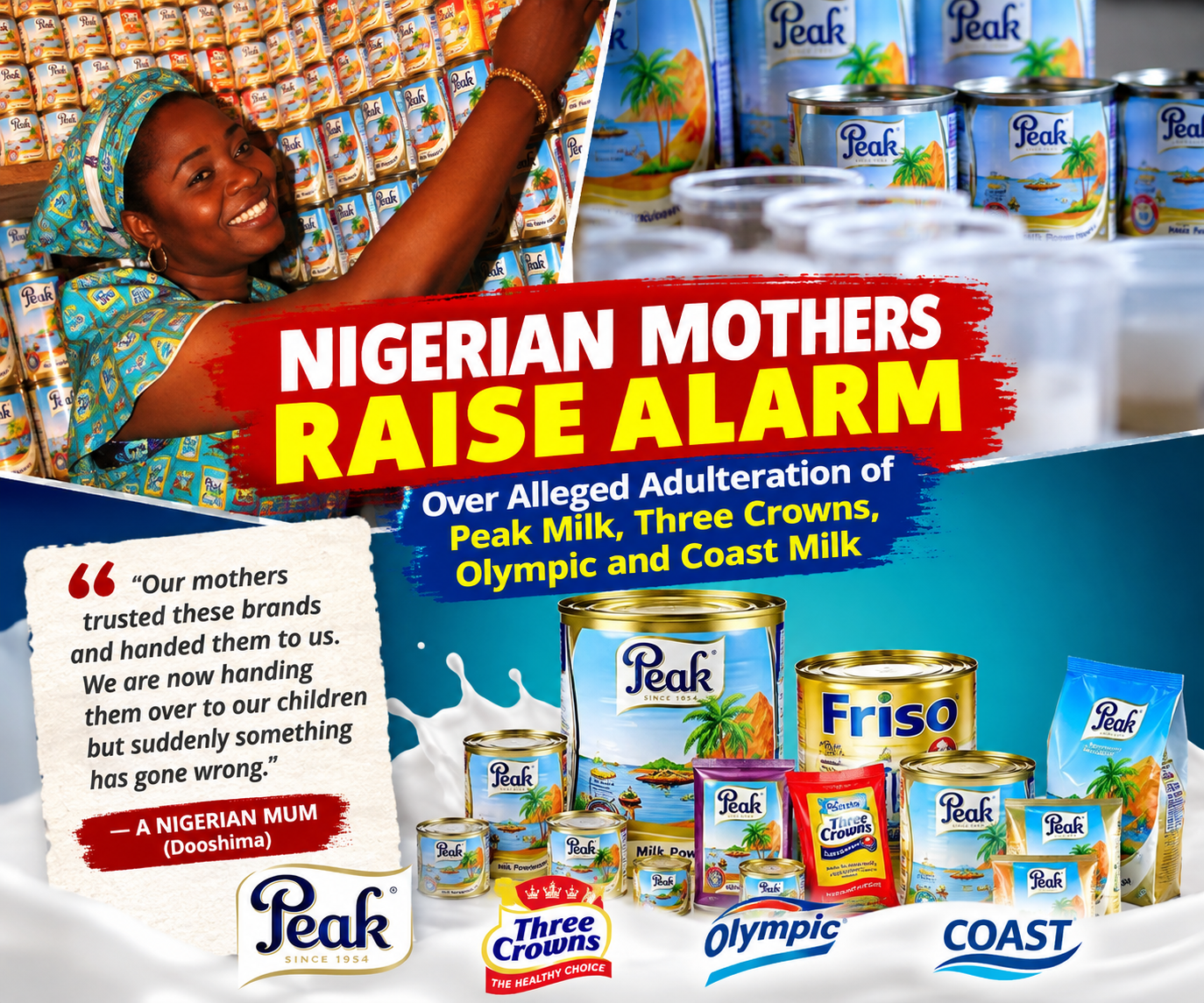
Peak Milk, Three Crowns, Olympic and Coast Milk: Nigerian Mothers Raise Alarm Over Alleged Adulteration and Food Safety Concerns.
BABACARES HEALTH & CONSUMER SAFETY | October 9, 2026
SEO Meta Description: Nigerian mother Dooshima raises concerns over allegedly spoiled Peak Milk, Three Crowns, Olympic and Coast Milk products. Babacares examines the potential health risks, consumer safety concerns, and calls for action from FrieslandCampina WAMCO and NAFDAC.
A Mother's Cry That Every Nigerian Parent Should Hear
For more than seven decades, Peak Milk has occupied a special place in Nigerian homes. From the breakfast tables of our grandparents to the kitchens of today's young families, the familiar milk brand has been more than just a household product. For many, it represents nourishment, childhood memories, and trust passed from one generation to another.
But what happens when that trust begins to shake?
A Nigerian food content creator identified as Ms. Dooshima has raised serious concerns in a widely circulated social media video, questioning the quality and safety of certain milk products associated with FrieslandCampina WAMCO Nigeria Plc.
Her emotional appeal, framed as an open letter on behalf of Nigerian mothers, mentions Peak Milk, Three Crowns, Olympic, and Coast Milk. She calls on the company to address reports of milk products allegedly becoming spoiled, thickened, or congealed, including products consumers believe to be genuine.
The video gained attention around September 21, 2026, prompting reports in Nigerian media.
The underlying question is simple but troubling: Can Nigerian mothers continue to trust the milk they give their children?
Importantly, the claims remain allegations. Babacares has not independently established that the named brands are adulterated or unsafe.
"Our Mothers Trusted These Brands and Handed Them Down to Us"
Dooshima's message draws its emotional strength from the relationship Nigerians have developed with these dairy products.
Peak Milk entered the Nigerian market in 1954, while Three Crowns was launched in 1988. Over the decades, these brands became familiar household names, and FrieslandCampina WAMCO expanded its dairy portfolio to include other products such as Olympic and Coast Milk.
In her video, Dooshima explained that families trusted these products for generations and were now preparing to pass that trust to their children.
Her concern was not merely about changes in taste or appearance. It was about the possibility that products trusted for decades might no longer meet consumers' expectations of safety and quality.
She questioned why reports of allegedly congealed or spoiled milk had not been adequately explained to worried consumers.
Particularly significant was her claim that some questionable products appeared to be genuine rather than counterfeit.
According to the reports, she wanted the manufacturer to explain whether the observed changes were normal, whether the affected milk was safe, and whether any product withdrawal was necessary.
Her message reflects a familiar concern among parents: children should not be exposed to avoidable health risks through everyday foods.
Is the Milk Really Adulterated? Understanding the Difference
There is an important scientific distinction between adulterated, counterfeit, spoiled, and naturally thickened milk.
Adulteration generally involves the deliberate addition, substitution, or removal of substances in a way that compromises a product's quality or safety.
Counterfeiting involves the unauthorized imitation of a legitimate product.
Spoilage, on the other hand, may result from microbial contamination, damaged packaging, inappropriate storage conditions, or other failures in the supply chain.
Milk may also change texture for reasons that do not necessarily establish contamination.
Therefore, congealed milk is not automatically proof of adulteration, just as authentic packaging does not automatically guarantee that a particular product has remained safe throughout storage and distribution.
Only appropriate investigation, examination of affected batches, and laboratory testing can establish the cause.
This distinction is essential because allegations of food adulteration can damage consumer confidence and business reputations, while genuine food safety problems require prompt action.
The Health Implications: Why Nigerian Mothers Are Worried
As a journalist with experience in healthcare, I find the potential public health implications particularly concerning.
Milk and dairy products provide nutrients such as protein, calcium, and certain vitamins. They are commonly consumed by families, including children and older adults.
However, if milk becomes contaminated with harmful microorganisms, consumption may result in foodborne illness.
Possible health effects include nausea, vomiting, diarrhoea, stomach cramps, fever, and dehydration.
The risks may be greater for young children, pregnant women, older adults, and individuals with weakened immune systems.
In some circumstances, severe foodborne infections can require hospitalization.
This does not mean that any of the milk brands mentioned in Dooshima's video have been proven to cause these illnesses. Rather, it explains why credible complaints concerning dairy product quality should be investigated quickly.
Food safety concerns are not simply public relations matters. They are potentially serious public health issues.
FrieslandCampina WAMCO: What Has the Company Said?
FrieslandCampina WAMCO is one of Nigeria's established dairy companies, with a history stretching back to the introduction of Peak Milk in 1954.
The company states on its official Peak Milk website that its products undergo quality assessments during production and distribution.
However, Dooshima's complaint raises questions that require a more specific response.
A September 22, 2026 news report stated that the company had not publicly responded to her appeal at that time. I could not verify a subsequent official response specifically addressing her September 2026 video. Therefore, it would be premature to conclude that the company has remained silent throughout the period.
For transparency and consumer reassurance, the following questions deserve answers:
-
Has FrieslandCampina WAMCO received complaints about unusually thickened or spoiled milk products?
-
If complaints were received, which products and batch numbers were involved?
-
Have samples been collected and subjected to independent laboratory testing?
-
Could packaging defects, storage conditions, or distribution practices explain any verified abnormalities?
-
Have regulators been informed of confirmed product-quality concerns?
-
If unsafe batches are identified, what procedures will be followed to notify consumers and remove them from circulation?
Clear answers supported by evidence would help protect both consumers and the integrity of legitimate manufacturers.
Where Is NAFDAC in All This?
Nigeria's National Agency for Food and Drug Administration and Control (NAFDAC) has an important responsibility to ensure that regulated food products meet applicable quality and safety standards.
In September 2026, NAFDAC Director-General Professor Mojisola Adeyeye emphasized that allegations circulating on social media should be scientifically verified before conclusions are drawn.
That position followed broader online allegations about fake and adulterated food products and was not necessarily a finding about the specific milk complaints raised by Dooshima
The agency's emphasis on evidence is appropriate.
However, scientific verification should be accompanied by accessible consumer reporting channels, timely investigations, and transparent communication.
Where credible complaints involve products consumed by children and families, public confidence depends on knowing that concerns are being taken seriously.
The Bigger Problem: When Nigerians Begin to Lose Trust in Everyday Food
The controversy also raises a broader issue about consumer protection in Nigeria.
Many Nigerians already worry about counterfeit medicines, unsafe packaged foods, misleading product labels, and poor storage conditions.
When concerns begin to involve brands that families have trusted for decades, uncertainty can spread quickly.
This is why manufacturers, distributors, retailers, and regulators must work together.
Companies should maintain effective quality-control systems and investigate complaints thoroughly.
Retailers must store and handle products appropriately.
Regulators must enforce standards and investigate suspected violations.
Consumers, meanwhile, deserve accurate information rather than rumours, panic, or unsupported assurances.
Trust takes decades to build. But a poorly handled food safety complaint can damage confidence much more quickly.
What Nigerian Parents Should Do
While investigations and clarification are important, families should take basic food safety precautions.
-
Examine milk packaging for damage, swelling, leaks, or broken seals.
-
Check expiry dates and follow the manufacturer's storage instructions.
-
Do not consume milk with unusual odours, visible mould, or unexpected changes in appearance.
-
Avoid tasting suspicious milk to determine whether it is safe.
-
Keep receipts, packaging, photographs, and batch numbers when reporting suspected defects.
-
Contact the manufacturer or NAFDAC if there is a credible safety concern.
-
Seek medical attention if a child or vulnerable person develops significant symptoms after consuming a suspected unsafe product.
FrieslandCampina WAMCO lists its consumer care telephone number as 0800 3292626 and email address as consumercare.wamco@frieslandcampina.com
These precautions apply generally to dairy products and should not be interpreted as evidence that the brands named in the video are unsafe.
My Perspective: Nigerian Mothers Deserve Answers, Not Speculation
There is something particularly powerful about Dooshima's appeal.
She is not presenting herself as a scientist or regulator. She is speaking as a concerned consumer and mother who wants reassurance about products associated with family nutrition.
Her message reflects the emotional relationship that exists between consumers and familiar brands.
And this is where I believe the responsibility of corporate organizations goes beyond selling products.
When a company earns the trust of several generations, it also assumes a responsibility to respond transparently when that trust is questioned.
This does not mean accepting every allegation as true.
It means respecting consumers enough to investigate their concerns and explain the findings.
Likewise, the Nigerian media must report such matters responsibly, neither dismissing legitimate complaints nor presenting unverified allegations as established facts.
Conclusion: Before We Reach for Our Peak, Let Us Be Sure Our Children Are Safe
For over 70 years, Peak Milk has been associated with nourishment and generations of Nigerian families.
The company's familiar slogan, Reach for Your Peak, communicates a message of aspiration, achievement, and vitality.
But Dooshima's appeal introduces a troubling question: What happens when parents begin to worry about the very products they associate with their children's nourishment?
The answer should not be fear, rumour, or premature condemnation.
It should be scientific investigation, transparent communication, and effective consumer protection.
FrieslandCampina WAMCO and relevant regulatory authorities have an opportunity to address these concerns with clarity and credible evidence.
Nigerian mothers are asking questions. Their concerns deserve to be heard, investigated, and answered.
Because when it comes to the safety of our children, trust must always be supported by evidence.
Babajide Moronfolu
Journalist | Author | Healthcare Communicator
Babacares — Informing Lives, Inspiring Change, Promoting Healthy Living.
References
-
Instagram — Dooshima's Open Letter to FrieslandCampina WAMCO.
-
Diaspora Digital Media — Woman Calls Out Peak Milk, September 21, 2026.
-
iExclusiveNews — Dooshima Demands Answers Over Spoiled Milk Reports, September 22, 2026.
-
Peak Milk — Official Quality Assurance Information.
-
Three Crowns Milk — Official Brand History.
-
Nigerian Television Authority — NAFDAC on Allegations of Adulterated Food, September 11, 2026.



Comments