

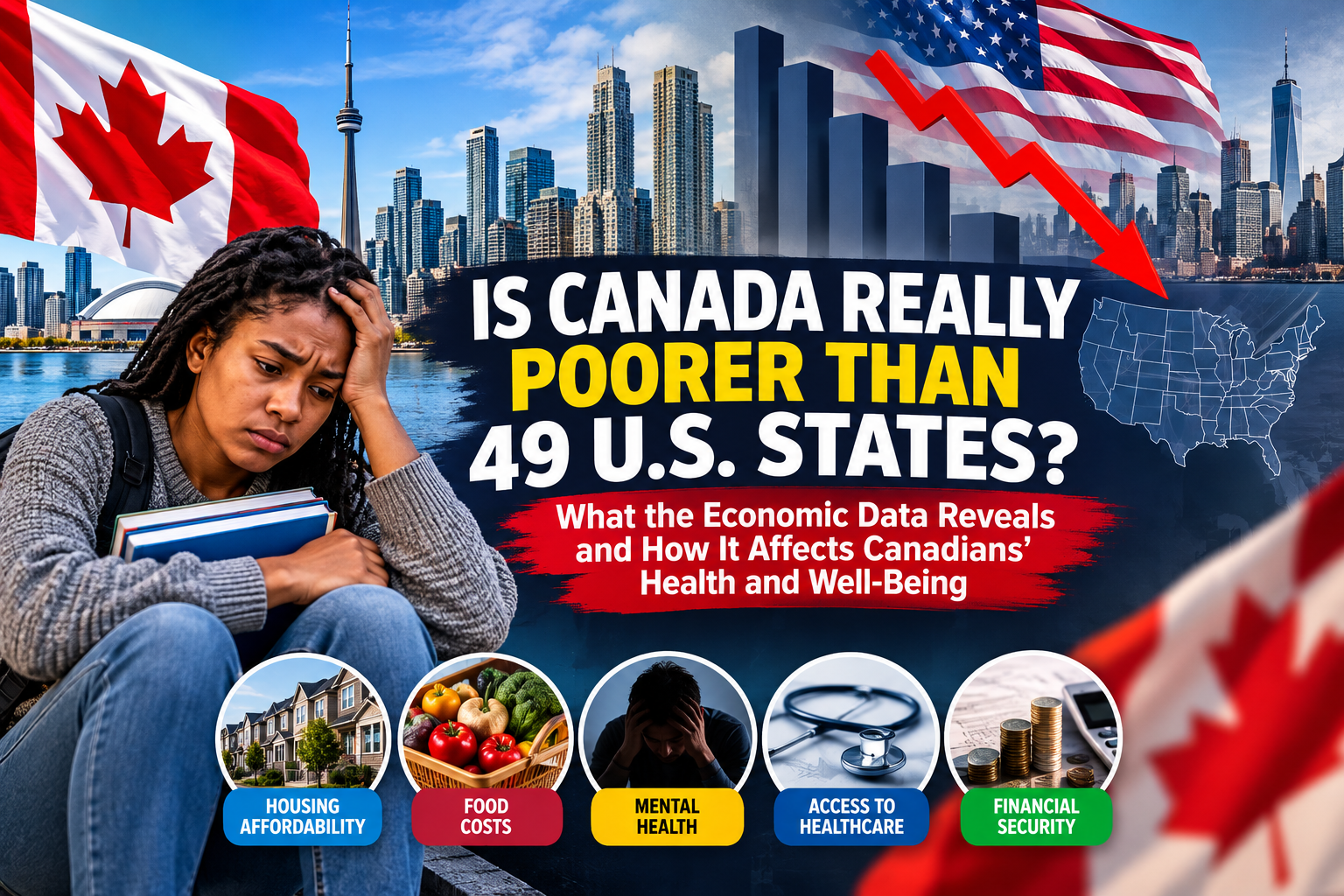
Is Canada Really Poorer Than 49 U.S. States? What the Economic Data Reveals About Canadians' Living Standards and Health.
An alarming social media headline has raised questions about Canada's economic future. But what do the figures actually mean, and how are financial pressures affecting the health and well-being of Canadian families?
By Babajide Moronfolu | Babacares.com
A few days ago, I came across a disturbing social media post carrying the headline:
"Canada Is Now Poorer Than 49 U.S. States": U.S. Media Reports.
The post, accompanied by an image of a homeless person sitting along a roadside, painted a troubling picture of Canada's economic situation.
For a country widely regarded as one of the world's desirable destinations for immigrants, education, employment, and improved living standards, such a headline naturally raises questions.
Is Canada truly becoming poorer than almost every state in the United States? Has the Canadian economy deteriorated so badly? And, perhaps more importantly, what does this mean for ordinary Canadians struggling with housing costs, groceries, transportation, healthcare, and mounting debts?
As a journalist and healthcare professional, I believe this discussion must go beyond sensational headlines.
The real question is not simply how Canada ranks economically against the United States, but whether Canadians are becoming healthier, financially secure, and better able to afford a reasonable standard of living.
Is the claim true? Understanding the figures
The social media claim contains an important element of truth, but it requires context.
A September 24, 2026, analysis published by To Do Canada, using World Bank data and U.S. Bureau of Economic Analysis figures, reported that Canada's nominal gross domestic product (GDP) per capita in 2025 was approximately US$55,698.
The estimated GDP per capita of Mississippi, one of the lowest-ranking U.S. states on this measure, was approximately US$55,877.
That would place Canada slightly below Mississippi and, consequently, below all 50 U.S. states when measured using those figures.
However, the difference between Canada and Mississippi was only about US$179 per person, or approximately 0.3%.
The social media headline referring to 49 states is therefore not an accurate description of this particular 2025 comparison. The precise ranking also depends on the year, exchange rate, and economic measure selected.
To Do Canada
+1
Crucially, this comparison does not mean that every Canadian is poorer than every American.
GDP per capita measures economic output divided by population. It does not directly measure how much money people earn, how much remains after taxes and expenses, or how comfortably families live.
Canada versus the United States: What the numbers show
Canada — 2025
US$66,783
GDP per capita, purchasing-power adjusted
United States — 2025
US$89,985
GDP per capita, purchasing-power adjusted
GDP per person, adjusted for purchasing power
2025 estimates, international dollars per person. Source: OECD.
$0$25,000$50,000$75,000$100,000CanadaUnited States
OECD 2025 GDP per capita estimates, expressed in purchasing-power-adjusted international dollars and rounded to the nearest dollar.
NAAG Chapter 1: GDP
Purchasing power parity (PPP) attempts to account for differences in price levels between countries.
This provides another perspective on the economic gap, rather than relying entirely on market exchange rates.
According to the OECD, Canada's GDP per person remains below that of the United States. However, Canada remains slightly above the OECD average on this purchasing-power-adjusted measure.
NAAG Chapter 1: GDP
+1
That distinction matters.
Canada faces genuine economic challenges, but describing the country as simply poorer than nearly every U.S. state overlooks the complexity of economic well-being.
Why is Canada falling behind economically?
Statistics Canada's March 2026 analysis provides evidence that Canada has struggled to keep pace with the United States in productivity and economic output per person.
Between 2015 and the third quarter of 2025, Canada's real GDP per capita grew at an annualized rate of approximately 0.82%, compared with 2.07% in the United States.
Over the same period, Canadian labour productivity grew at approximately 0.80% annually, compared with 1.96% in the United States.
Statistics Canada
Several structural challenges help explain the situation.
Canada has experienced weak business investment and productivity growth, high household debt, housing affordability problems, and pressure on infrastructure associated with rapid population growth.
The OECD has called for improvements in competition, innovation, digitalization, and productivity-enhancing investment.
OECD
+1
These are not problems that can be attributed solely to one government, political party, or immigration policy. They reflect economic trends that have developed over many years.
But economic statistics are only one part of the story.
For many households, the challenge is deeply personal.
The health consequences of economic hardship in Canada
When families struggle financially, the consequences can extend far beyond their bank accounts.
Economic insecurity may affect sleep, nutrition, mental health, relationships, and the ability to maintain a healthy lifestyle.
The Financial Consumer Agency of Canada reports that nearly half of Canadians have experienced sleep difficulties linked to financial worries.
It also identifies associations between financial stress and headaches, poor overall health, anxiety, depression, and other health concerns.
Canada
From a public health perspective, these findings are significant.
1. Financial stress and mental health
Imagine a family whose monthly income barely covers rent, groceries, insurance, utilities, and transportation.
One unexpected expense—a vehicle repair, job loss, or medical-related cost—could push the household into financial difficulty.
Persistent worries about money can contribute to anxiety, emotional exhaustion, sleep disturbances, and relationship problems.
Financial hardship is therefore not merely an economic concern. It is also a health and social welfare issue.
2. Housing affordability and family stability
Canada's housing affordability challenges have placed pressure on renters and prospective homeowners.
When a large proportion of household income goes towards rent or mortgage payments, families have less financial flexibility for healthy food, recreation, dental care, savings, and emergencies.
Housing insecurity may also increase emotional distress and family tensions.
For older adults, individuals living with disabilities, and families dependent on fixed incomes, such pressures may be particularly difficult to manage.
3. Food costs and nutritional health
Healthy living requires access to nutritious food.
But when grocery budgets become increasingly stretched, households may prioritize affordability over nutritional quality.
Some may reduce dietary variety, delay food purchases, or skip meals.
For children, older adults, and people managing chronic health conditions, inadequate nutrition can have significant consequences.
Canada's economic performance should therefore be evaluated partly by whether families can consistently afford balanced meals.
4. Employment insecurity and physical exhaustion
An economy can continue expanding while individual workers experience stagnant earnings or insufficient opportunities.
Some Canadians respond to financial pressures by working additional shifts, accepting multiple jobs, or postponing rest.
For workers in physically demanding occupations, including healthcare and caregiving, prolonged exhaustion may affect concentration, emotional well-being, and workplace safety.
No country should define economic success solely by the volume of work performed if people cannot enjoy a reasonable quality of life.
Is Canada still a good country in which to live?
Despite its economic challenges, Canada remains a country with important strengths.
These include a publicly funded healthcare system, established educational institutions, social protection programs, comparatively strong public institutions, and significant natural resources.
Nevertheless, these strengths should not prevent an honest examination of the country's weaknesses.
The OECD's 2025 Economic Survey acknowledged Canada's economic resilience and stable financial institutions while identifying weak productivity growth, household indebtedness, and housing affordability as serious challenges.
OECD
There is also an important difference between economic wealth and quality of life.
A country may generate higher economic output without necessarily providing more affordable housing, better access to healthcare, stronger family relationships, or improved mental health outcomes.
That is why the United States and Canada must be compared using several indicators—not GDP alone.
The objective should not simply be for Canada to become richer on paper, but for Canadians to experience meaningful improvements in their everyday lives.
What should Canada do to improve living standards?
Canada needs a coordinated approach that combines economic growth with social welfare and public health priorities.
First, improve productivity and employment opportunities. Investment in technology, infrastructure, business development, and workforce training can help improve economic output and potentially support higher wages.
Second, address housing affordability. Policies that increase housing supply, improve rental availability, and reduce barriers to construction deserve continued attention.
Third, strengthen financial security. Governments and employers should consider how wages, taxes, benefits, and the cost of essential services affect household disposable income.
Fourth, protect access to healthcare. Economic hardship should not prevent people from receiving necessary medical attention, mental health support, medications, or preventive care.
Fifth, invest in people. Education, skills development, support for older adults, and assistance for economically vulnerable households should remain important public policy priorities.
These measures will require cooperation between governments, businesses, communities, and individuals.
The bigger question: Are Canadians becoming poorer or simply feeling poorer?
The distinction is important.
GDP per capita can decline relative to another country even when overall economic output continues to grow.
Similarly, a household's income may increase while rising expenses leave it with little additional purchasing power.
Statistics Canada reported that Canada's real GDP per capita increased by 1.0% in the second quarter of 2026, demonstrating why it would be misleading to conclude that every economic indicator is consistently deteriorating.
Statistics Canada
However, one positive quarter does not erase longer-term productivity and affordability concerns.
What ultimately matters to ordinary Canadians is whether their incomes can support healthy and financially secure lives.
Can people afford decent housing?
Can families buy nutritious food without excessive financial anxiety?
Can workers earn enough to save for retirement?
Can young Canadians reasonably aspire to own homes?
Can older adults maintain their independence and dignity?
These are the questions that deserve national attention.
Conclusion: A country's true wealth lies in the well-being of its people
The claim that Canada is poorer than 49 U.S. states may attract attention on social media, but the underlying economic realities require careful interpretation.
Available 2025 nominal GDP-per-capita comparisons show Canada falling below even Mississippi by a narrow margin. Yet this statistical comparison does not establish that Canadians have a lower standard of living than residents of every American state.
What cannot be dismissed is the evidence that Canadian productivity and economic output per person have grown more slowly than in the United States.
These challenges deserve serious policy attention.
But at Babacares, we believe the conversation should go further.
A country's economic success should not be measured only by how much wealth it produces, but also by how effectively that wealth supports the health, dignity, and well-being of its people.
Canada does not need to win a statistical competition with the United States to justify its economic policies.
It needs to ensure that economic progress translates into affordable housing, nutritious food, decent employment, accessible healthcare, and a reasonable standard of living.
Because, ultimately, a wealthy country is not necessarily one in which everyone lives well.
And a strong economy should be one that allows its citizens to live not only longer, but healthier, happier, and more secure lives.
References
1. Statistics Canada (2026). Measuring Canada's Economic Performance Relative to the United States. March 25, 2026.
2. To Do Canada (2026). Canada's 2025 GDP Per Capita Sits Below Every U.S. State, but Here's What the Comparison Actually Means. September 24, 2026.
3. Organisation for Economic Co-operation and Development (2025). OECD Economic Surveys: Canada 2025.
4. OECD (2026). Canada Economic Snapshot: Foundations for Growth and Competitiveness.
5. Financial Consumer Agency of Canada (2025). Financial Stress and Its Impacts.
6. U.S. Bureau of Economic Analysis (2026). Gross Domestic Product by State.
7. Statistics Canada (2026). GDP Per Capita and Other Macroeconomic Indicators.









Comments