

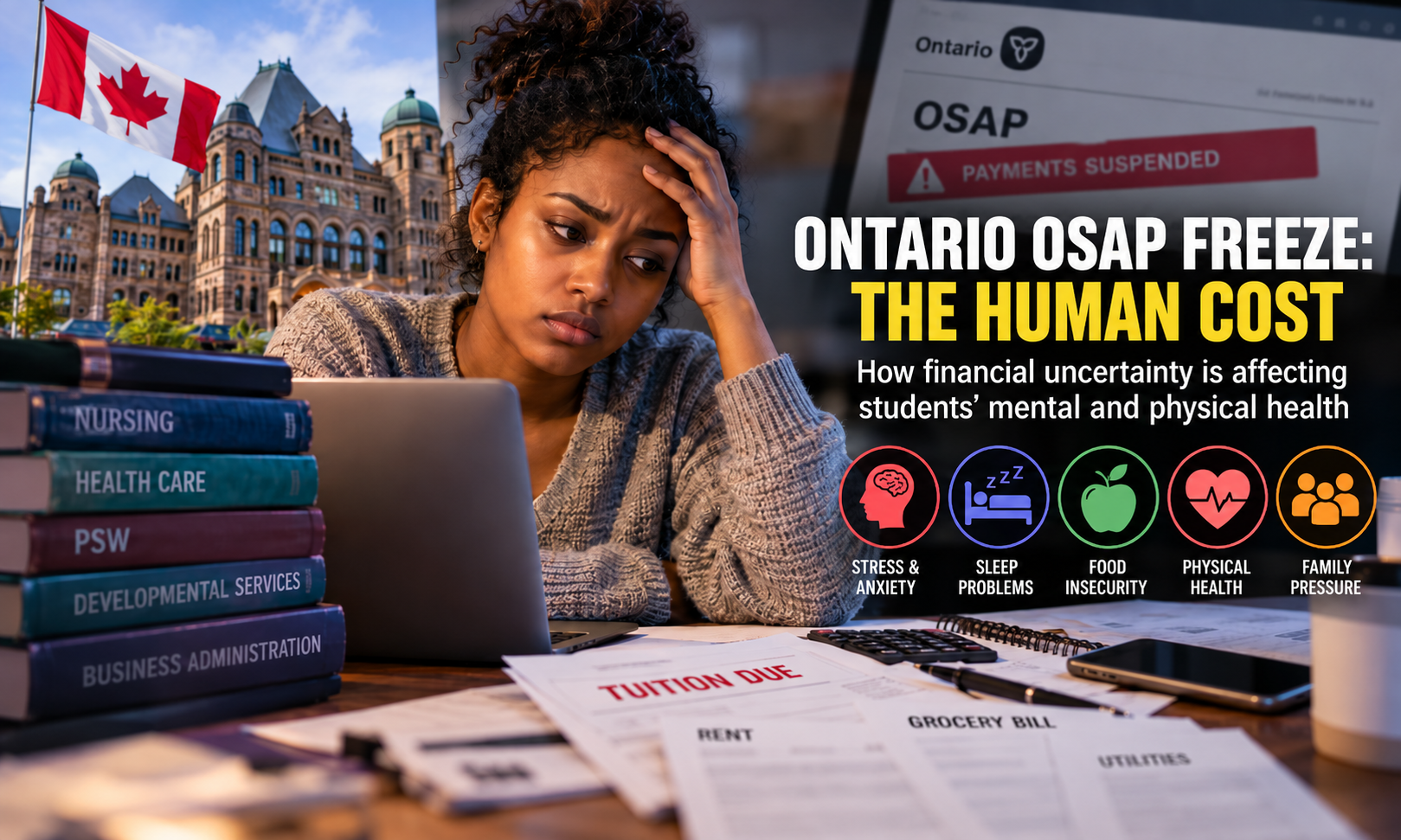
Ontario OSAP Funding Freeze: The Hidden Mental and Physical Health Crisis Facing Thousands of Students
BABACARES HEALTH & SOCIAL POLICY | October 8, 2026
As Ontario suspends student financial assistance to private postsecondary institutions amid investigations into alleged irregularities, concerns are growing about the financial security, mental health, and educational future of students who depend on the funding.
By Babajide Moronfolu | Babacares.com
Imagine being halfway through your college education, attending classes, completing assignments, preparing for examinations, and working towards a better future. Then, suddenly, you receive news that the financial assistance you were counting on has been suspended.
Your tuition remains unpaid. Your rent is due. Your grocery bills are mounting. Your family depends on you. And nobody can tell you exactly when the money will arrive.
For thousands of students attending private postsecondary institutions across Ontario, this is no longer an imaginary situation.
The Ontario government's decision to pause Ontario Student Assistance Program (OSAP) payments has created uncertainty for students who depend on government financial aid to continue their education.
While the government argues that the suspension is necessary to protect public funds and restore integrity to the student financial assistance system, another important question deserves attention:
Who is protecting the mental, emotional, and physical health of innocent students caught in the middle of this crisis?
What happened to OSAP funding?
On October 6, 2026, Ontario's Minister of Colleges, Universities, Research Excellence and Security, Nolan Quinn, announced that the provincial government was pausing OSAP payments associated with private postsecondary institutions.
The decision followed preliminary findings from an independent audit conducted with the support of KPMG.
According to the government's official statement, investigators identified serious concerns involving inadequate student verification, unusual concentrations of OSAP applications, connections between certain institutions and immigration-related businesses, and questions surrounding enrolment and academic outcomes.
The government referred the matter to the Ontario Provincial Police and notified the Auditor General. It also indicated that stricter conditions would apply before private institutions could regain OSAP eligibility.
The province says it is exploring low-interest loans through third-party financial institutions to assist affected students. However, its October 6 announcement provided no firm date for restoring payments.
Ontario News API
+2
Investigating suspected fraud is legitimate and necessary. Public money must be protected, and educational institutions should be held accountable.
But there is an important distinction between investigating institutions suspected of wrongdoing and disrupting the education of students who enrolled in good faith.
Students are already speaking out
The impact is becoming visible across Ontario.
In North Bay, a mother of four studying massage therapy reportedly faces the possibility of abandoning her education after planning her family finances around expected OSAP funding.
Another student, a laid-off steelworker retraining to become a paramedic, has expressed concern that the funding suspension could derail his efforts to enter a new career in healthcare.
These cases illustrate how an administrative decision can produce consequences extending well beyond the classroom.
OrilliaMatters.com
+1
CityNews Toronto also reported on October 8 that students at career colleges were experiencing confusion and distress over their educational futures.
CityNews Toronto
These reports do not establish the prevalence of medical or psychiatric conditions among affected students. They do, however, raise urgent questions about the potential health consequences of prolonged financial uncertainty.
When financial uncertainty becomes a health problem
At Babacares, we believe health must be understood beyond hospitals, medications, and medical appointments.
A person's health is also influenced by income, housing, nutrition, employment, education, social relationships, and psychological stability.
These are commonly described as the social determinants of health.
A student who suddenly loses expected educational funding may experience several overlapping pressures: fear of dropping out, unpaid tuition, growing debt, food insecurity, family conflict, and uncertainty about future employment.
According to the Centre for Addiction and Mental Health (CAMH), prolonged stress can contribute to anxiety, depression, sleep disturbances, headaches, digestive difficulties, and other physical and psychological symptoms.
CAMH
For some affected students, the financial crisis could become a health crisis if appropriate interventions are not available.
1. Anxiety, depression, and emotional distress
One of the most immediate potential consequences of the OSAP suspension is psychological distress.
Students may begin asking themselves difficult questions:
How will I complete my studies? What happens to the tuition I have already paid? Will I lose everything I have worked for? How will I explain this setback to my family?
When these questions remain unanswered, anxiety may intensify.
Students already managing work, childcare, academic demands, and household responsibilities may find their emotional resilience stretched further.
This risk is not merely theoretical. A September 2026 TD survey of Canadian postsecondary students reported that 76% of respondents said financial pressures negatively affected their well-being and academic performance. Forty-two per cent identified an impact on mental health.
That survey was not specifically about the OSAP freeze, but it demonstrates the wider relationship between financial difficulties and student well-being.
Newswire
2. Sleep deprivation and physical exhaustion
Financial worries do not disappear when students go to bed.
A student struggling to pay tuition and rent may spend sleepless nights calculating expenses, searching for additional employment, or worrying about an uncertain future.
Sleep deprivation can affect concentration, memory, emotional regulation, and general health.
The Financial Consumer Agency of Canada has reported associations between financial stress and sleep difficulties, headaches, poor overall health, and other medical concerns.
Canada
For students combining school with physically demanding jobs, including healthcare support work, persistent fatigue may also create additional safety concerns.
3. Food insecurity and poor nutrition
Many students use their financial assistance not only to pay tuition but also to cover essential living expenses.
When expected funds are delayed or suspended, some may struggle to afford adequate meals.
They may reduce food purchases, skip meals, or rely heavily on inexpensive foods that do not always provide balanced nutrition.
Insufficient nutrition can affect energy, concentration, and overall well-being.
Students who are parents or caregivers may face particularly difficult choices between meeting their own needs and providing for dependants.
A decision intended to protect the integrity of an educational funding program must therefore also consider the basic living conditions of students affected by its implementation.
4. Family pressures and relationship difficulties
For many mature students, education is not simply a personal ambition. It represents an opportunity to improve the economic future of an entire family.
Some students are single parents. Others are newcomers, caregivers, or workers returning to school after years of employment.
An unexpected funding suspension may create tensions between spouses, increase dependence on relatives, and undermine household financial stability.
In some cases, students may feel ashamed of circumstances beyond their control.
Such pressures can lead to social withdrawal, emotional exhaustion, and feelings of hopelessness.
These potential consequences deserve attention, particularly when students have complied with the requirements of their educational institutions and financial assistance programs.
5. The danger of abandoning education
Perhaps the most troubling potential long-term consequence is that financially vulnerable students may abandon their studies altogether.
Consider a student enrolled in a healthcare-related program, such as Personal Support Work, Developmental Services, or another career-training course.
After months of study, practical training, and personal sacrifice, the student suddenly discovers that the funding expected to cover tuition and living expenses is unavailable.
The student may face the difficult choice of taking on additional debt, working longer hours, or withdrawing from school.
For Ontario, such outcomes could also mean losing prospective workers in sectors where trained professionals are needed.
The government must therefore consider not only the financial integrity of OSAP but also the potential consequences for workforce development and public well-being.
Protecting taxpayers should not mean abandoning innocent students
There is a compelling argument for investigating institutions suspected of misusing public funds.
The government has a responsibility to protect taxpayers, prevent fraud, and ensure public funding supports legitimate education.
However, the principle of fairness requires that students who have acted honestly should not automatically bear the consequences of alleged misconduct by institutions or other individuals.
Students should not be presumed guilty simply because they attend a private career college.
Accountability and compassion are not competing principles. A responsible government should be capable of pursuing both.
What should the Ontario government do?
From a public health and social welfare perspective, Babacares recommends the following measures:
1. Protect existing students: Consider transitional exemptions or continued funding for verified students already enrolled and progressing satisfactorily, subject to appropriate safeguards.
2. Provide emergency financial support: Establish short-term assistance for students facing immediate tuition, housing, food, and transportation difficulties.
3. Offer accessible mental health services: Work with colleges and community healthcare organizations to provide counselling and crisis support.
4. Communicate clearly: Provide regular updates, transparent timelines where possible, and accessible explanations of students' funding status.
5. Investigate wrongdoing without unnecessary collective punishment: Apply appropriate oversight while distinguishing credible institutions and genuine students from suspected irregularities.
6. Explore alternatives to further indebtedness: Ensure students are not forced to depend solely on new private loans to replace previously expected assistance.
These measures would help protect educational continuity while allowing the government to investigate the serious concerns identified in the OSAP system.
Advice to students affected by the OSAP suspension
Students experiencing financial or emotional difficulties should take practical steps to protect their well-being.
Contact your college's financial aid office and request written clarification about your funding status, tuition obligations, and available payment arrangements. Preserve relevant OSAP correspondence and avoid making irreversible decisions to withdraw without first understanding the academic and financial consequences.
Students facing food insecurity or housing difficulties can contact 211 Ontario for information about community assistance programs.
Those experiencing persistent anxiety, depression, sleep disturbances, or difficulty coping should consider speaking with a healthcare professional or qualified counsellor.
Ontario also provides information about free and publicly funded mental health support services. Anyone experiencing a suicide crisis can call or text 988 in Canada, 24 hours a day.
Ontario
+1
Conclusion: Education should not become a threat to students' health
The Ontario OSAP controversy presents an important test of public policy, accountability, fairness, and compassion.
The government has every right—and indeed a responsibility—to investigate suspected financial irregularities and protect public resources.
But it must also recognize that behind every OSAP application is a human being.
A mother trying to build a career. A father hoping to provide a better life for his children. A laid-off worker seeking a fresh start. A newcomer working towards economic independence. A young person determined to acquire practical skills.
These students are more than application numbers or financial records.
They are individuals whose mental health, family stability, and futures may be affected by decisions taken at Queen's Park.
Ontario must restore integrity to OSAP without creating an avoidable crisis of financial insecurity, psychological distress, and educational disruption among innocent students.
At Babacares, our position is clear: education policy is also health policy. When financial decisions threaten people's ability to live, learn, eat, sleep, and plan for the future, the issue becomes a matter of public health.
Protecting public money is important. Protecting the people whose futures depend on that money is equally important.
References and further reading
-
Government of Ontario. (October 6, 2026). Statement by Minister Quinn on Pausing OSAP Payments.
-
CityNews Toronto. (October 8, 2026). OSAP freeze raises alarm bells for Ontario career college students.
-
Centre for Addiction and Mental Health. Stress: Health Effects and Coping Strategies.
-
Financial Consumer Agency of Canada. Financial Stress and Its Impacts.
-
TD survey, September 2026. Financial Pressures Affecting Canadian Postsecondary Students.
-
Government of Ontario. Find Mental Health Support.











Comments