

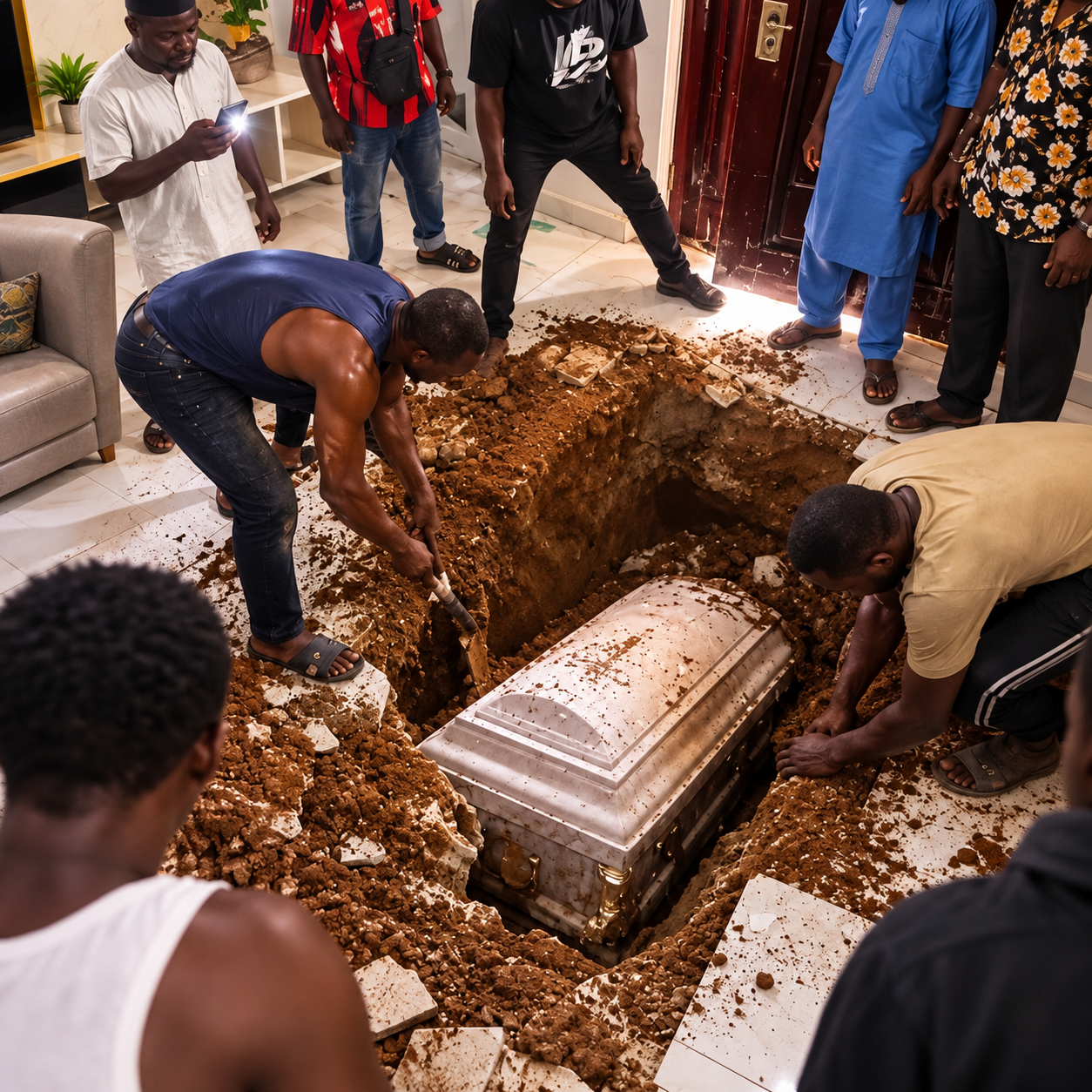
Buried Beneath the Living Room: The Health Risks of Burying a Corpse Inside a Residential Building.
Imagine renting a newly built apartment, moving in with your family and spending more than a year eating, relaxing and sleeping there—only to discover that a human body had been buried beneath your living room all along.
That disturbing scenario was recently shared on Facebook by Olalekan Opeyemi of ARISE News TV, who recounted the experience of a Nigerian tenant who reportedly discovered that his landlord's late father had been buried inside the house.
According to the account, the man said he was the first tenant of the property and had no idea that a grave was beneath his sitting room.
The situation reportedly came to light when members of the landlord's family arrived and informed him that they wanted to exhume the remains and rebury them elsewhere, promising to repair the living room afterward.
Whether viewed culturally, emotionally or from a housing perspective, the story is unsettling.
But it also raises an important health question:
Is it safe to bury a corpse underneath a residential apartment where people live every day?
The answer requires separating scientific evidence from fear.
Does Living Above a Grave Automatically Make You Sick?
Not necessarily.
One of the biggest misconceptions surrounding dead bodies is that every corpse automatically spreads dangerous diseases.
The World Health Organization (WHO) says that, in most circumstances, dead bodies do not create epidemics or pose a major infectious-disease threat to people simply because they are nearby.
Most microorganisms responsible for disease do not survive indefinitely after death.
There are, however, important exceptions—particularly when someone dies from certain highly infectious diseases such as cholera or viral haemorrhagic fevers including Ebola and Marburg.
So, if a body was properly buried and there was no direct contact with human remains or contaminated fluids, a tenant merely walking, sitting or sleeping on a floor above the burial site would not ordinarily be expected to contract an infection from the corpse.
That does not, however, mean burying people underneath residential living spaces should be regarded as good public-health practice.
1. Groundwater Contamination Can Be a Concern
One of the most important environmental considerations surrounding burial sites is water.
As a body decomposes, organic material and bodily fluids enter the surrounding soil.
The WHO acknowledges that buried human remains can potentially affect groundwater, depending on factors including:
-
the depth of burial;
-
the type of soil;
-
the height of the groundwater table;
-
the distance from wells and boreholes;
-
drainage conditions; and
-
the number and concentration of graves.
This is one reason established burial grounds are expected to be appropriately located in relation to sources of drinking water.
WHO guidance recommends keeping graves safely separated from drinking-water sources and ensuring burial occurs above the groundwater table.
For households that rely on wells or boreholes, therefore, the location of an undocumented grave may deserve particular environmental-health attention.
It does not automatically mean the water is contaminated, but it is a legitimate reason for assessment rather than assumption.
2. Decomposition Does Not Belong in an Ordinary Living Environment
Decomposition is a natural biological process.
After death, tissues begin breaking down through complex bacterial and chemical processes.
Proper cemeteries and burial locations are designed with factors such as soil depth, drainage and separation from human activity in mind.
An improvised grave beneath a sitting room may not have been designed according to comparable environmental standards.
If burial depth, drainage, construction or sealing were inadequate, potential problems could include:
-
moisture intrusion;
-
soil disturbance;
-
unpleasant odours;
-
contamination associated with leaking biological material; and
-
attraction of insects or other pests under certain conditions.
The mere presence of a grave does not prove that any of these problems are occurring. But such possibilities demonstrate why burial sites require proper planning rather than being treated simply as another part of a residential foundation.
3. Exhumation May Present a Greater Immediate Risk
Interestingly, the greatest potential exposure in a story like this may not necessarily come from having lived above the grave.
It may arise when the grave is opened.
Exhumation disturbs soil and human remains and may expose people directly to bodily material.
Those carrying out the process need appropriate precautions.
Public-health guidance recommends protective measures for people who directly handle human remains because blood, body fluids and other biological material can potentially expose workers to certain infections.
Depending on the circumstances surrounding the death and the condition of the remains, trained professionals should conduct an exhumation using appropriate protective equipment and infection-control procedures.
It should not simply become an informal family excavation in the middle of an occupied home.
4. What Did the Person Die From?
This is another question that should matter before human remains are disturbed.
For most ordinary deaths, the infectious risk from a buried corpse is low.
However, some infectious diseases require additional precautions.
For example, bodies of people who die from diseases such as Ebola, Marburg disease or cholera can require specific safe-burial procedures.
This is why the medical history and cause of death—where known—can be important when authorities or professionals plan an exhumation.
5. Structural Safety Should Not Be Ignored
There is also a non-medical safety issue.
Excavating a grave underneath or immediately beside an existing building can potentially disturb:
-
foundations;
-
floor slabs;
-
supporting soil;
-
plumbing systems; and
-
drainage infrastructure.
Removing soil beneath a building without proper engineering assessment may compromise structural stability.
Therefore, a grave discovered beneath an occupied residential room should not simply be dug open and filled back in without appropriate professional assessment.
6. The Psychological Impact Is Real
Perhaps one of the most immediate consequences for the tenant in this story is psychological.
Imagine discovering that for more than a year you had unknowingly been living directly above someone's grave.
Different people will react differently.
Some may regard it primarily as a cultural issue. Others may experience anxiety, fear, sleeplessness, disgust or a persistent feeling of being unsafe in their own home.
Those reactions should not automatically be dismissed as superstition.
A home is supposed to provide security and psychological comfort.
Discovering an undisclosed burial site beneath one's living space can fundamentally change how safe that home feels.
Mental wellbeing is part of health too.
7. Tenants Deserve Disclosure
The story raises another significant question:
Should someone be allowed to rent a property without being told that a human being is buried underneath the living room?
Quite apart from medical risk, this is a serious issue of transparency.
Cultural and religious attitudes toward burial differ, including within Nigeria. In some communities, burying relatives within family compounds is historically accepted.
But there is an important difference between knowingly living in a family compound containing ancestral graves and paying rent for accommodation without being told that a body is buried underneath the room where you live.
Prospective tenants deserve enough information to make an informed decision about the property they are being asked to occupy.
Nigerian Laws May Also Matter
Rules governing burial are not necessarily identical throughout Nigeria, so it would be wrong to suggest that one rule applies uniformly across every state.
However, some state burial laws demonstrate that authorities recognize the potential public-health relationship between graves and residential properties.
For example, Kaduna State's Burial Law 2019 provides mechanisms under which a court may intervene where a corpse has been buried in or near a dwelling house, including powers connected with determining whether a building remains fit for habitation.
That does not establish the legal position of the particular property described in the Facebook story, especially since its location and circumstances would need to be established.
But it illustrates an important principle:
Where people bury human remains is not merely a private family matter. It can also become a public-health, environmental and housing issue.
So, Was the Tenant in Danger for More Than a Year?
Based only on the account shared online, nobody can responsibly conclude that the tenant's health was harmed.
If the body was deeply and properly buried, the person did not die from a dangerous communicable disease, there was no contamination of the household water supply and the grave remained physically undisturbed, simply occupying the room above it would generally not be expected to cause infectious disease.
That distinction is important.
Fear should not replace science.
At the same time, an undocumented grave beneath an occupied residential building raises enough questions about water safety, sanitation, construction, exhumation procedures, psychological wellbeing and informed consent that it should not be casually dismissed.
What Should Someone Do If a Grave Is Discovered Inside Their Home?
If you unexpectedly discover human remains or a grave underneath or within your residential property:
Do not attempt to open or exhume it yourself.
The appropriate local authorities should first be contacted so that the identity and status of the burial can be established.
Environmental-health officials may need to assess sanitation and water sources, particularly if the household uses a nearby well or borehole.
Any exhumation should be conducted by authorized and appropriately protected personnel.
Where excavation could affect the building, a competent building professional or structural engineer should assess the property.
Residents who are severely distressed by the discovery should also recognize that psychological reactions are legitimate and seek support where necessary.
The Bigger Lesson
This unusual Nigerian story should not become another opportunity to spread the myth that every dead body automatically produces disease.
Science does not support that conclusion.
The World Health Organization has repeatedly stated that ordinary human remains generally do not pose an epidemic threat. Public-health concerns become more significant when infectious disease, contamination of water, direct handling of remains or unsafe burial and exhumation practices are involved.
But there is another principle worth defending:
Homes are meant for the living, and burial practices should respect public health, environmental safety, building standards and the rights of those who will occupy the property afterward.
If a person chooses to bury a loved one within private family property where local laws permit it, that is one conversation.
Building residential accommodation over the burial site and subsequently renting that property to an unsuspecting tenant is another.
The tenant deserves to know.
And when human remains are eventually removed, it should be done with dignity, professional supervision and appropriate health precautions.
At Babacares, our concern is not to create fear around death or burial.
It is to encourage informed choices about health, housing, sanitation and the environments in which we live.
Sometimes health risks are obvious.
Sometimes, as this remarkable story reminds us, they may be hidden right beneath our feet.
Sources
-
World Health Organization — Risks Posed by Dead Bodies After Disasters
-
World Health Organization/ICRC/IFRC — Guidance on health risks associated with human remains
-
World Health Organization — Guidance on safe burial sites and protection of drinking-water sources
-
U.S. Centers for Disease Control and Prevention — Infection-control considerations when handling human remains
-
Kaduna State Government — Burial Law, 2019
Babacares.com — Caring for your health, your family and your future.
https://www.babacares.com/blog-details?details=1045&title=Buried+Beneath+the+Living+Room%3A+The+Health+Risks+of+Burying+a+Corpse+Inside+a+Residential+Building.









Comments