

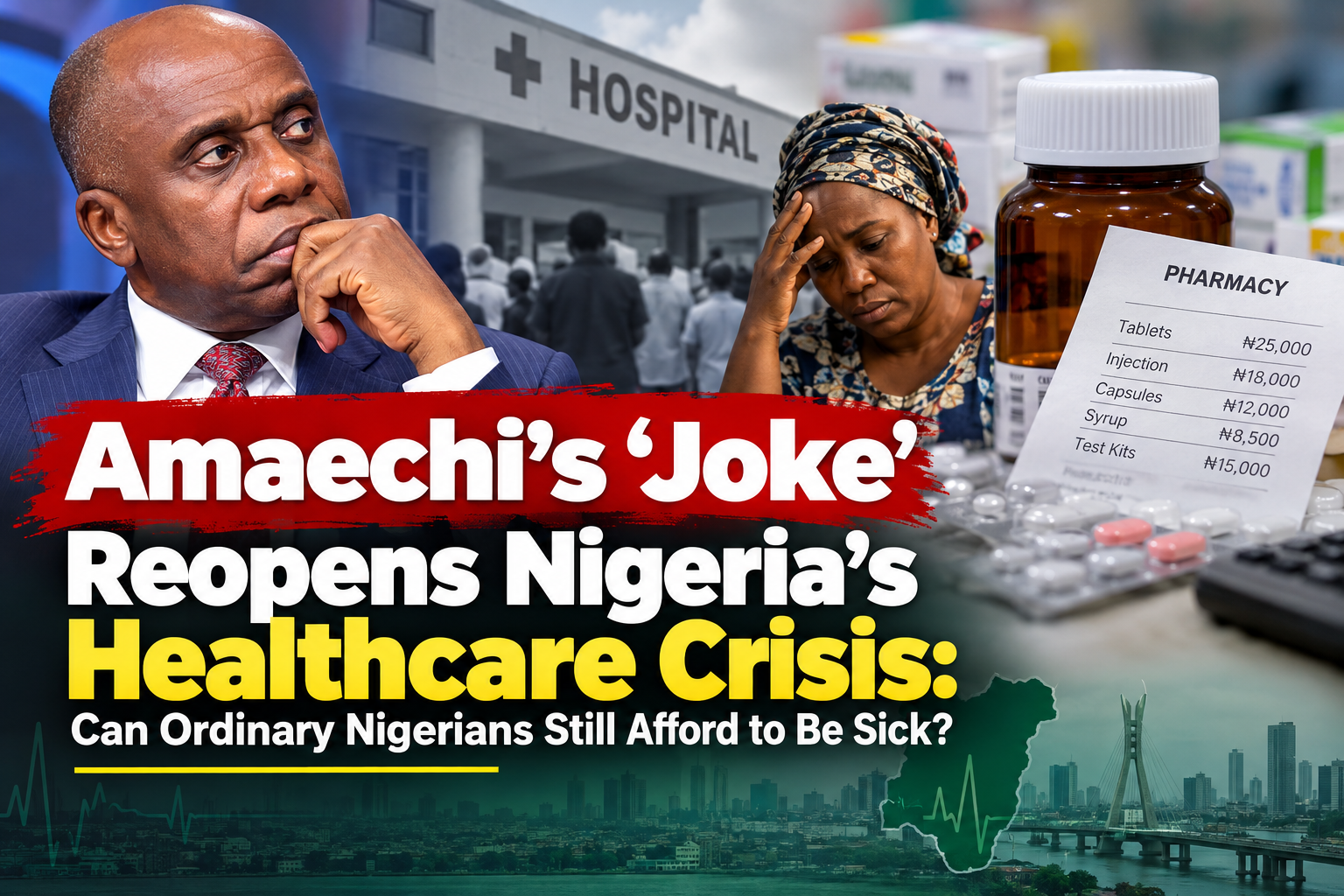
Rotimi Amaechi’s ‘Joke’ Reopens Nigeria’s Healthcare Crisis: Can Ordinary Nigerians Still Afford to Be Sick?
By Babajide Moronfolu | Babacares
It may have ended with Rotimi Amaechi describing his controversial statement as a joke, but the issue behind his words is anything but funny.
During an appearance on Channels Television’s Politics Today, former Rivers State Governor and former Minister of Transportation Rotimi Amaechi spoke about the growing economic hardship facing Nigerians and linked it to the difficulty of paying for medicines.
In one of the most striking moments of the interview, Amaechi suggested that President Bola Tinubu's economic policies contributed to his mother's death because medicines had become increasingly difficult to afford.
When host Seun Okinbaloye challenged him about his own ability and responsibility to provide healthcare for his mother, Amaechi defended himself before later reportedly making clear that the direct attribution of her death to the President was a joke.
But perhaps Nigerians should not allow the controversy surrounding the statement to bury the much bigger question it raised:
How many Nigerians are currently choosing between buying food and buying medicine?
Beyond Amaechi: The Real Healthcare Question
Amaechi is a former governor, former minister and prominent political figure.
That is precisely why his statement attracted scrutiny.
If a wealthy and influential Nigerian says the cost of medicines has become difficult to manage, many people will naturally ask how someone of his means could genuinely be unable to afford treatment.
That is a legitimate question.
But another question may be even more important:
If healthcare costs can become a political talking point for someone at that level of society, what is happening to Nigerians earning the minimum wage, pensioners, unemployed people and families living from one day's income to the next?
The conversation should therefore move beyond whether Amaechi was joking.
The real issue is healthcare affordability.
When Medicine Becomes a Luxury
For millions of families, falling sick does not begin with the question, “Which hospital should we use?”
It often begins with:
“How much is this going to cost?”
Consultation fees are only one part of the burden.
There are laboratory tests, diagnostic scans, transportation, hospital bills and perhaps most importantly, medicines that must sometimes be taken for months or years.
For people living with hypertension, diabetes, heart disease, kidney disease, arthritis, cancer and other chronic illnesses, medication is not optional.
When patients cannot afford their prescribed drugs, they may reduce doses, skip treatment or turn to unverified alternatives.
That can turn a manageable condition into an emergency.
Amaechi's Statement Should Not Be Treated as Medical Evidence
There is also an important distinction to make.
Amaechi's statement does not establish that government economic policies medically caused his mother's death.
His mother, Mary Amaechi, died in July 2026 at the age of 89.
The medical cause of an individual's death cannot be determined simply from a political interview.
Amaechi himself later reportedly characterised the direct attribution as a joke.
But the broader argument he was making — that rising living costs and medicine prices can affect people's ability to obtain healthcare — deserves serious examination.
That is where the public-health conversation should be focused.
Healthcare Does Not Exist Separately From the Economy
Economic policy and healthcare are closely connected.
When transportation becomes more expensive, getting to a hospital becomes more expensive.
When electricity and operating costs rise, hospitals and pharmacies may face higher expenses.
When imported medicines, equipment or raw materials become more expensive, patients may ultimately bear part of that cost.
And when household income fails to keep pace with everyday expenses, healthcare can quickly become one of the things families postpone.
This is why discussions about inflation, exchange rates, fuel prices and household income are also, indirectly, discussions about health.
A patient who cannot afford medication because food, rent and transportation have consumed the household income is experiencing both an economic problem and a health problem.
Nigeria's Healthcare Paradox
This debate comes at an interesting moment.
As Babacares recently highlighted, Nigeria is witnessing encouraging signs of reverse medical tourism, with some international patients travelling to the country for specialised care.
Nigeria has outstanding doctors, nurses, pharmacists and other healthcare professionals.
Some Nigerian medical facilities are demonstrating that world-class healthcare can be delivered within the country.
That progress deserves recognition.
But here lies the paradox:
What does it mean for Nigeria to attract foreign patients for sophisticated treatments while some Nigerians struggle to afford basic medicines?
Both realities can exist simultaneously.
Nigeria can possess centres of medical excellence while still having serious problems with affordability and access.
The Question Is Not Only Whether Hospitals Exist
A functioning healthcare system is not measured simply by the existence of beautiful hospitals or advanced equipment.
The more important questions are:
Can people reach those hospitals?
Can they afford the consultation?
Can they pay for diagnostic tests?
Can they buy the prescribed medicines?
Can they complete treatment without pushing their families into financial crisis?
Healthcare that technically exists but is financially unreachable remains inaccessible to the people who need it.
Chronic Illness Makes the Problem More Serious
The affordability issue becomes especially concerning for Nigerians living with chronic conditions.
A patient with hypertension may need medication every day.
A diabetic patient may require medication, monitoring and regular medical appointments.
Cancer, kidney disease and cardiovascular conditions can involve enormous recurring expenses.
Unlike treating a minor infection once, managing chronic illness often requires sustained spending.
Missing treatment because the family budget has collapsed can have serious consequences.
That is why access to affordable medicines must remain central to Nigeria's healthcare reform conversation.
Government Has a Role — But So Do Other Stakeholders
This should not become simply another political argument between government and opposition figures.
Nigeria needs a broader conversation involving government, pharmaceutical manufacturers, hospitals, health insurers, professional associations and patients.
Government has responsibilities in areas such as healthcare financing, regulation, primary healthcare, drug policy and creating conditions that encourage local pharmaceutical manufacturing.
The private sector also has a role in investment, innovation and expanding access.
Health insurance must become more meaningful for ordinary citizens.
Nigeria must also reduce excessive dependence on imported medical products by strengthening domestic pharmaceutical and medical-device manufacturing wherever feasible and safe.
From Political Joke to Public-Health Warning
Rotimi Amaechi may have called part of his statement a joke.
But Nigerians should not joke about the underlying issue.
The ability to afford medicine can determine whether someone manages a disease successfully or deteriorates unnecessarily.
This conversation therefore should not end with arguments over whether Amaechi could personally afford his mother's drugs.
Instead, Nigerians should ask:
Can the average pensioner afford his blood-pressure medication every month?
Can a minimum-wage worker afford treatment when a child suddenly becomes ill?
Can a diabetic Nigerian consistently afford prescribed medication and monitoring?
Can families seek hospital care without fearing financial ruin?
Those are the questions that matter.
Conclusion: Nigerians Should Not Have to Choose Between Food and Medicine
Healthcare should not become a luxury reserved for those who can afford it.
Neither should illness become a sentence to poverty.
Nigeria undoubtedly has excellent healthcare professionals and centres of medical excellence.
But the success of the health system must ultimately be measured by what happens to the ordinary citizen when sickness comes.
Amaechi's controversial statement may have generated political headlines.
His subsequent clarification may have changed how his personal claim should be interpreted.
But the question beneath the controversy remains:
Can ordinary Nigerians still afford to be sick?
Until the answer becomes a confident yes, Nigeria's healthcare conversation is far from over.
Babacares — Promoting healthier lives through information, awareness and conversation.
References
-
Channels Television, Politics Today, October 2, 2026.
-
TheCable, “Tinubu’s policies killed my mother… it was difficult to buy drugs for her, says Amaechi,” October 2, 2026.
-
Premium Times, “‘Tinubu’s policies killed my mother, I couldn’t afford her drugs’ – Amaechi,” October 3, 2026.
-
P.M. News, “‘Tinubu’s policies killed my mother’ — Amaechi jokes,” October 2, 2026.









Comments