

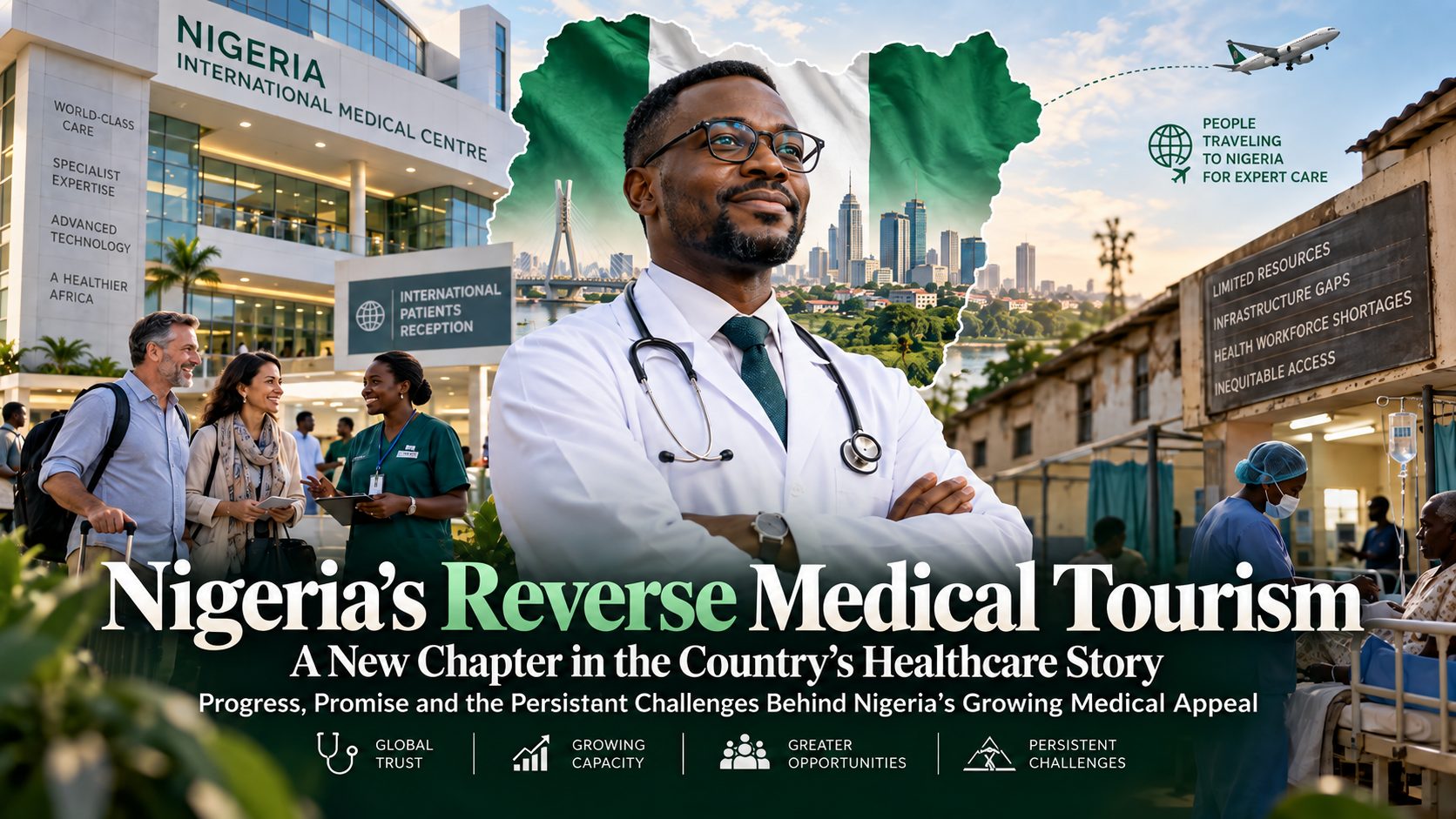
Nigeria’s Healthcare at 66: Is Reverse Medical Tourism a Sign of a Health System Turning the Corner?
By Babajide Moronfolu | Babacares
In my recent reflection on the state of Nigeria’s healthcare system at 66 years of independence, I examined a system that continues to struggle with inadequate funding, workforce shortages, unequal access to quality care, deteriorating infrastructure and the persistent movement of Nigerians abroad for medical treatment.
But there is another side of the story that deserves attention.
Nigeria may still have serious healthcare challenges, but there is growing evidence that some Nigerian hospitals and medical specialists are delivering services good enough to attract patients from outside the country.
This phenomenon has increasingly been described as “reverse medical tourism.”
The question, however, is this:
Is Nigeria genuinely becoming a medical tourism destination, or are we celebrating isolated centres of excellence within a healthcare system that still requires major reform?
The answer appears to be somewhere in between.
Signs That Something Positive Is Happening
In February 2025, Vice President Kashim Shettima publicly stated that Nigeria was witnessing an increase in reverse medical tourism.
According to the Federal Ministry of Information and National Orientation, Shettima revealed that 13 patients from the United States travelled to Nigeria for kidney transplants at Zenith Medical and Kidney Centre.
He attributed their decision partly to the relatively lower cost of treatment in Nigeria and the expertise available at specialised Nigerian facilities.
That is significant.
For many years, the dominant narrative has been that Nigerians travel to India, the United Kingdom, United States, Turkey, Germany, South Africa and other countries for specialist medical care.
Today, at least in certain specialties, the movement is beginning to occur in the opposite direction.
Nigeria Has Always Had Excellent Medical Professionals
One important distinction must be made.
Nigeria's healthcare challenge has never simply been a lack of competent doctors, nurses, pharmacists and other professionals.
Nigeria has produced highly skilled healthcare workers who practise successfully around the world.
The problem has often been whether the system surrounding those professionals gives them the equipment, staffing, funding, working conditions and organisational support necessary to perform at their best.
Recent developments show what can happen when expertise is matched with appropriate infrastructure.
Areas attracting increasing attention include kidney transplantation, fertility medicine, ophthalmology, orthopaedics, cardiac care, cancer treatment, advanced diagnostics and rehabilitation.
The Guardian reported in August 2026 that some private tertiary hospitals in Lagos, Abuja and Port Harcourt say between 10 and 15 per cent of their specialist patients come from outside Nigeria. However, there is currently no centralised national registry independently confirming that figure across the entire Nigerian healthcare system.
That distinction is important.
We can celebrate progress without exaggerating it.
The Isha Sesay Example
One of the better-documented examples of confidence in Nigerian healthcare involves journalist Isha Sesay.
When her mother became seriously ill in Sierra Leone, Sesay brought her to Nigeria.
Her mother spent approximately three months in intensive care at Lagoon Hospital in Apapa, Lagos.
Sesay subsequently publicly thanked Nigerian doctors and nurses, saying she was grateful for the medical options available in Nigeria and credited the medical team with saving her mother's life.
That testimony deserves recognition.
It shows that Nigerian institutions can provide highly sophisticated care capable of attracting patients from neighbouring countries.
Former Sierra Leone President Ernest Bai Koroma
Another notable example involves former Sierra Leonean President Ernest Bai Koroma.
In January 2024, Sierra Leone's judicial authorities permitted Koroma to travel to Nigeria for medical treatment.
He subsequently arrived in Abuja.
Koroma remained in Nigeria for more than two years before returning to Sierra Leone in September 2026 after the legal case that had surrounded his departure was dropped.
His presence in Nigeria further illustrates that the country possesses medical facilities capable of attracting prominent patients from elsewhere in Africa.
But We Must Be Careful With Viral Claims
The excitement surrounding reverse medical tourism has also produced claims that should be treated carefully.
For example, viral social-media posts have claimed that 15 per cent of patients in Nigerian private hospitals are foreigners from Europe and America.
Available reporting suggests that some specialist hospitals have estimated international patient numbers within the 10–15 per cent range, but Nigeria does not presently have a comprehensive national database establishing that percentage for the private healthcare sector as a whole.
There are also stories about foreign celebrities allegedly being cured in Nigeria after doctors in Western countries were unable to treat them.
Such stories may be genuine personal experiences, but unless supported by direct statements, medical institutions or credible independent reporting, they should be presented as personal testimony rather than established medical evidence.
Nigeria's healthcare achievements are impressive enough without embellishment.
A Centre of Excellence Is Not Yet a Strong National Health System
This may be the most important point.
A foreigner receiving excellent treatment in a well-equipped private hospital in Lagos or Abuja does not necessarily mean that an ordinary Nigerian living in a rural community has access to similar care.
Nigeria effectively operates several healthcare realities simultaneously.
There are world-class private centres and highly competent specialists.
There are also overstretched government hospitals, under-equipped primary healthcare centres and communities where basic health services remain difficult to access.
According to the World Health Organization-supported Nigeria Health Systems and Services Profile, essential health-service coverage remains limited, with primary healthcare particularly weak.
The report also identifies inadequate infrastructure, limited funding and workforce shortages as major constraints on healthcare delivery.
So while reverse medical tourism is encouraging, it should not become a convenient excuse for ignoring broader systemic problems.
The Funding Problem Remains
Healthcare cannot become sustainable through isolated private-sector success alone.
WHO-linked health financing data indicate that Nigeria's health expenditure remains low relative to need.
The Nigeria Health Systems and Services Profile reports that government health expenditure remains below the 15 per cent Abuja Declaration target, while out-of-pocket payments account for more than 75 per cent of total health expenditure.
It also reports that only a relatively small proportion of Nigerians are protected through health insurance or other pooled financing mechanisms.
This means that even when quality treatment exists, affordability remains a major barrier.
A healthcare system cannot be considered successful merely because excellent treatment is available.
It must also be accessible.
The Human Resources Crisis
Nigeria also continues to lose healthcare professionals to other countries.
The WHO-linked health workforce profile identifies poor remuneration, difficult working conditions, uneven workforce distribution and outward migration as significant challenges.
Nigeria has one of Africa's largest healthcare workforces, yet the number of doctors, nurses and midwives available remains below what is required to meet demand adequately.
Ironically, Nigerian-trained professionals are helping sustain healthcare systems in the United Kingdom, United States, Canada, Australia and several other countries.
This tells us something important:
Nigeria's fundamental problem is not absence of talent.
It is building a system capable of retaining, equipping and rewarding that talent.
Nigerians Are Still Spending Heavily Abroad
The reverse medical tourism narrative must also be balanced against continued outbound medical tourism.
In November 2025, the Nigerian Medical Association estimated that Nigeria still loses approximately US$2 billion annually to Nigerians seeking medical treatment abroad.
That is an important reality check.
Nigeria may now be receiving some international patients while simultaneously losing far more money through Nigerians travelling overseas for healthcare.
Both realities can exist at the same time.
So, Is Reverse Medical Tourism Real?
Yes — but it is still emerging.
There is credible evidence that patients are coming to Nigeria for kidney transplants, fertility treatment, specialised surgery, eye care, rehabilitation and other services.
There is also evidence of significant investment in specialised facilities.
Nigeria should be proud of these achievements.
But we should distinguish between centres of excellence and a national healthcare system that works reliably for everyone.
Nigeria has already demonstrated that it possesses the doctors, nurses, specialists, entrepreneurs and medical expertise necessary to compete internationally.
The next challenge is to make that level of healthcare available not merely to wealthy Nigerians and international patients, but also to the market woman in Ibadan, the farmer in Benue, the pensioner in Kano, the child in Bayelsa and the struggling family in Lagos.
From Reverse Medical Tourism to Healthcare Transformation
Rather than asking only how Nigeria can attract more foreign patients, policymakers should ask:
How can the quality attracting foreigners become the standard available to Nigerians themselves?
Nigeria needs continued investment in primary healthcare, teaching hospitals and specialised centres.
Government must improve health insurance coverage, strengthen regulation, retain health professionals, support public-private partnerships and ensure that sophisticated medical equipment remains functional after commissioning.
Nigeria should also create a credible national database for medical tourism so that claims about international patient numbers can be measured objectively.
Most importantly, healthcare must be regarded as a national development priority rather than merely another sector competing for government attention.
Conclusion: Celebrate the Progress, But Continue the Work
Nigeria's emerging reverse medical tourism deserves celebration.
The country has talented professionals and medical institutions capable of producing outcomes that command international confidence.
Stories such as that of Isha Sesay's mother and international patients travelling to Nigeria for kidney transplantation demonstrate that Nigerian medicine can compete at a very high level.
But celebrating these successes should not silence discussion about poor primary healthcare, unaffordable treatment, workforce migration, inadequate infrastructure and the millions of Nigerians who still struggle to obtain basic healthcare.
At 66, perhaps the most accurate assessment of Nigerian healthcare is neither hopelessness nor triumphalism.
It is potential increasingly becoming visible, but not yet evenly distributed.
Nigeria does not need to prove that one hospital can compete with London, Toronto or New York.
The greater achievement will come when Nigerians, regardless of income or location, can confidently say:
“If I become sick, my country has a healthcare system that will take care of me.”
That should be the real meaning of healthcare progress.
References
-
Federal Ministry of Information and National Orientation. Nigeria Now Witnessing Surge in Reverse Medical Tourism – VP Shettima, February 6, 2025.
-
The Guardian Nigeria. Medical tourism reversal masks crisis in Nigeria's health sector, August 30, 2025.
-
The Guardian Nigeria. How Nigeria Is Turning the Tide on Medical Tourism, August 29, 2026.
-
TheCable. CNN journalist thanks Nigerian medics for saving mother's life, July 2, 2017.
-
Channels Television. Indicted Ex-Sierra Leone President Arrives In Nigeria For Medical Care, January 19, 2024.
-
WHO Regional Office for Africa/African Health Observatory Platform. Nigeria Health Systems and Services Profile, 2025–2026.
-
The Guardian Nigeria. Africa loses $10bn to medical tourism, NMA urges investment in healthcare, November 2025.










Comments