

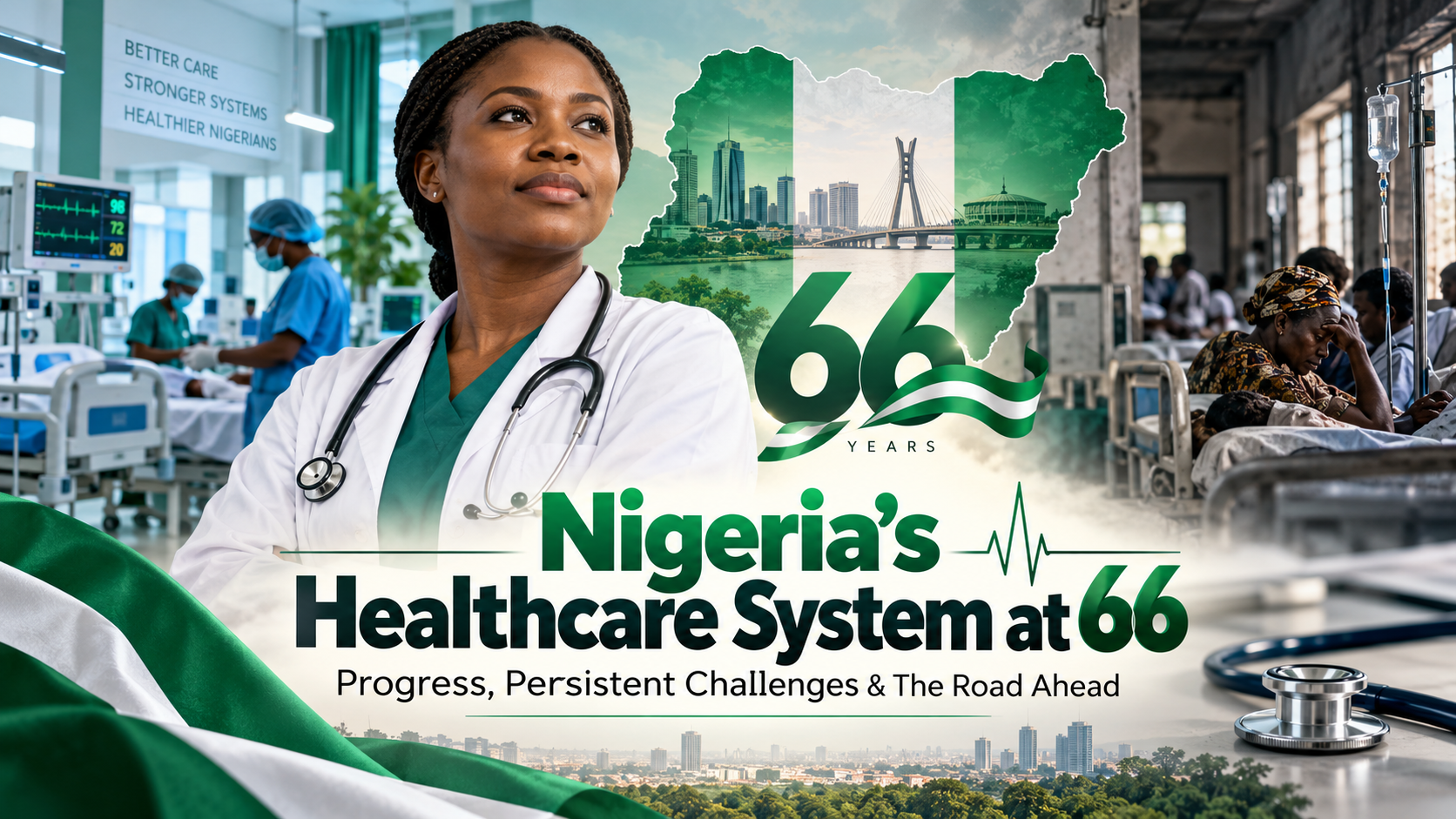
Nigeria’s Healthcare System at 66: Progress, Persistent Failures and the Urgent Road to Universal Health Coverage.
Nigeria at 66: How Healthy Is the Nation?
As Nigeria marked its 66th Independence Anniversary on October 1, 2026, the occasion naturally invited reflection not only on politics, the economy and national unity, but also on something even more fundamental: the health of Nigerians and the condition of the healthcare system meant to protect them.
This reflection is partly inspired by the recent healthcare reporting of Victoria Longjohn of Channels Television, whose reports have continued to draw attention to developments within Nigeria's health sector — from the welfare of health workers to government interventions, primary healthcare and improvements in health infrastructure.
The question at 66 is therefore simple but important:
After more than six decades of independence, how well is Nigeria's healthcare system serving its people?
The answer is mixed. Nigeria has made measurable progress, and significant reforms are underway. Yet for millions of Nigerians, quality healthcare remains too expensive, too distant or simply unavailable when it is most needed.
A Healthcare System With Enormous Potential
Nigeria possesses some of Africa's finest doctors, nurses, pharmacists, laboratory scientists and other health professionals. Nigerian-trained healthcare workers are contributing to health systems in the United Kingdom, Canada(I am one) , United States, Saudi Arabia and many other countries.
The paradox is that while Nigerian professionals help strengthen health systems abroad, the health system at home continues to struggle with shortages of manpower, inadequate equipment, uneven infrastructure and poor financing.
This is not to say that nothing has changed.
The Federal Government says its health-sector reform programme has produced more than 21 strategic health policies, supported more than 500 major health infrastructure projects, established 17 new federal tertiary health institutions and created six Centres of Excellence for cancer care. It also reports that more than 8,300 Primary Healthcare Centres have recently received performance-linked funding. Federal Ministry of Health
These are important developments. But hospitals and policies must ultimately be judged by what happens to the ordinary Nigerian who becomes sick.
Healthcare Financing Remains Nigeria's Achilles Heel
One of the biggest weaknesses of Nigeria's health system remains how healthcare is paid for.
The African Health Observatory Platform on Health Systems and Policies reports that out-of-pocket payments have historically accounted for around three-quarters of Nigeria's total health expenditure. In practical terms, this means that many Nigerians must find money themselves before they can receive treatment. AHOP
Recent government figures put out-of-pocket spending at approximately 71 percent, still extraordinarily high. Federal Ministry of Health
That figure tells a painful story.
A family dealing with cancer, kidney disease, emergency surgery or complications during childbirth may face not only a health crisis but also a financial crisis.
For too many Nigerians, illness can empty savings, force the sale of property, lead families into debt or delay treatment until a condition becomes life-threatening.
Health insurance coverage is expanding, which is encouraging. The Federal Ministry of Health reported in 2026 that enrolment had risen to more than 22 million Nigerians, representing a significant increase since 2023. Federal Ministry of Health
But in a country of well over 200 million people, the majority of Nigerians still lack adequate financial protection when sickness strikes.
The Abuja Declaration Is Still Relevant
There is also the long-standing question of government funding.
In 2001, African Union countries meeting in Abuja committed themselves to allocating at least 15 percent of annual government expenditure to health.
Nigeria has historically remained far below that aspiration.
There has recently been some movement. According to the Federal Ministry of Health and Social Welfare, health's share of the federal budget has risen to around 5.2 percent, while the Basic Health Care Provision Fund increased substantially, reaching almost ₦299 billion in the 2026 fiscal framework. Federal Ministry of Health
The increase should be acknowledged.
But 5.2 percent remains far from 15 percent.
Nigeria cannot build a world-class health system on inadequate and unpredictable financing.
Primary Healthcare: The Foundation Must Work
An effective healthcare system does not begin with teaching hospitals.
It begins with the Primary Healthcare Centre in the community.
This is where hypertension should be detected before it causes a stroke.
It is where pregnant women should receive antenatal care.
It is where babies should receive vaccines.
It is where malaria, diarrhoea and respiratory infections should be treated before complications develop.
Nigeria has tens of thousands of primary healthcare facilities, yet government officials themselves acknowledge that many are still not optimally functional. Federal Ministry of Health
A health centre without sufficient nurses, medicines, electricity, laboratory services, water or functioning equipment may exist on paper but offer little protection to the community it is supposed to serve.
There are encouraging signs of investment. In the Federal Capital Territory, for example, authorities recently approved the renovation and upgrading of all 14 general hospitals, including medical equipment, diagnostic facilities and theatre upgrades, as reported by Victoria Longjohn for Channels Television. Channels Television
Similar seriousness is required nationwide.
The Health Workforce Crisis
Nigeria's healthcare workers remain among the strongest assets of the system — but also among its most endangered.
Poor remuneration, delayed allowances, inadequate equipment, insecurity, stressful working environments and better opportunities overseas have encouraged thousands of healthcare professionals to leave the country.
The result is commonly described as the "Japa" crisis in healthcare.
According to the Federal Ministry of Health, Nigeria's doctor-to-population ratio has been estimated at around one doctor to 5,000 people, with many healthcare professionals disproportionately concentrated in urban centres. Federal Ministry of Health
Even within major cities, remaining doctors and nurses may face overwhelming workloads.
Channels Television has documented some of these pressures. Resident doctors in the FCT previously raised concerns including manpower shortages, long working hours, unpaid salaries and deductions. Channels Television
Government has subsequently announced interventions addressing outstanding payments and recruitment of health workers. Channels Television
But Nigeria needs more than emergency responses whenever doctors threaten industrial action.
It needs a deliberate health-worker retention strategy covering salaries, housing, training opportunities, occupational safety, professional development and reasonable working conditions.
Maternal and Child Health: Progress, But the Numbers Remain Troubling
Perhaps no indicator reveals the strength of a healthcare system better than whether mothers and children survive conditions that modern medicine knows how to manage.
There has been progress.
Government figures based on recent demographic data indicate that maternal mortality has declined compared with previous surveys, while skilled birth attendance, immunisation and child-survival indicators have improved. Federal Ministry of Health
The 2023–24 Nigeria Demographic and Health Survey found that 110 children out of every 1,000 live births die before their fifth birthday. Infant mortality stood at 63 per 1,000 live births, while neonatal mortality was 41 per 1,000. DHS Program
That is progress compared with previous decades.
But it is still unacceptable that approximately one in nine Nigerian children does not live to celebrate a fifth birthday.
Even more striking are the regional inequalities.
The same survey shows enormous differences between parts of Nigeria. Under-five mortality was much lower in the South-West than in several North-Western states, illustrating that where a child is born within Nigeria can significantly influence the child's chances of survival. DHS Program
That is not merely a medical problem.
It is an issue of equity.
Medicines, Equipment and Local Production
Another major weakness remains Nigeria's dependence on imported medicines, medical consumables and equipment.
When the naira depreciates or global supply chains are disrupted, hospitals and patients immediately feel the consequences through higher prices.
Government's renewed emphasis on local pharmaceutical and medical manufacturing is therefore welcome.
In August 2026, for example, the Federal Government announced plans to promote local production of family-planning commodities as part of a broader effort to strengthen health-sector self-reliance. Channels Television
Nigeria should extend this philosophy aggressively to essential drugs, vaccines, diagnostics, medical devices and hospital consumables.
A nation of Nigeria's size should increasingly be a producer of healthcare products, not simply a consumer of imported ones.
Public Health Threats Remain Real
Nigeria also continues to battle infectious diseases alongside a rapidly growing burden of non-communicable diseases.
Malaria, tuberculosis, meningitis, Lassa fever and other infectious diseases remain significant challenges.
At the same time, hypertension, diabetes, stroke, cancer, kidney disease and cardiovascular illnesses are placing growing pressure on families and hospitals.
Recent events illustrate how quickly public-health emergencies can emerge. Channels Television reported that a methanol poisoning outbreak in Ondo State in September 2026 resulted in 182 reported cases and 48 deaths, according to NAFDAC. Channels Television
Nigeria therefore needs a health system capable of doing two things simultaneously: controlling infectious outbreaks and preventing the growing epidemic of chronic diseases.
What Nigeria Has Gotten Right
At 66, criticism should not prevent acknowledgement of progress.
Health insurance is expanding.
More resources are being directed toward primary healthcare.
Cancer-care infrastructure is receiving investment.
Government is pursuing local manufacturing.
Digital health is receiving greater attention.
More PHCs are receiving funding.
Nigeria has also demonstrated considerable capacity in disease surveillance and outbreak response.
Those gains matter.
But reforms should not ultimately be measured by the number of policies announced, facilities commissioned or billions of naira allocated.
They should be measured by human outcomes:
Is a pregnant woman safer today?
Can a poor child receive treatment without the parents first searching for money?
Can an accident victim receive emergency care immediately?
Can a cancer patient receive treatment without becoming bankrupt?
Can a nurse or doctor build a respectable life in Nigeria without feeling compelled to leave the country?
Those are the real indicators of healthcare progress.
Nigeria at 66: The Next Health Revolution Must Be About Access
President Bola Tinubu told Nigerians during his 66th Independence Anniversary address that the country is moving "from reform to prosperity" and pledged continued strengthening of primary healthcare alongside states and local governments. Channels Television
In healthcare, however, prosperity will mean very little unless Nigerians can feel it when they are sick.
The next phase of health reform should therefore concentrate on universal access.
Nigeria needs to progressively increase health funding, strengthen primary healthcare, dramatically expand health insurance, improve emergency medical services, retain its healthcare workforce, invest in maternal and child health and build a domestic pharmaceutical and medical-manufacturing industry.
Accountability must accompany every naira allocated.
Conclusion: A Healthy Nigeria Must Become a National Project
At 66, Nigeria has travelled a long road.
There is progress worth celebrating. There are reforms worth supporting. And there are Nigerian healthcare professionals performing extraordinary work, frequently under extraordinarily difficult circumstances.
But we cannot allow resilience to become an excuse for dysfunction.
A Nigerian should not have to be wealthy before receiving excellent healthcare.
A pregnant woman should not die because there is no blood.
A child should not die because the nearest functional health centre is kilometres away.
A family should not fall into poverty simply because someone developed cancer or kidney disease.
And Nigeria should not continue training some of Africa's finest medical professionals primarily for other countries to benefit from their expertise.
At 66, Nigeria's greatest healthcare challenge is no longer identifying what is wrong. We largely know what is wrong. The challenge is turning policies, budgets and reforms into reliable healthcare at the bedside, in the maternity ward, in the village clinic and in every Nigerian community.
The true measure of Nigeria's progress at 66 will therefore not be how many years of independence have passed.
It will be how many Nigerian lives the country is able to protect, improve and save.
References
- Federal Ministry of Health and Social Welfare — 2025 NHSW-JAR: Tinubu's Health Renewal Compact Records 84% Implementation. Federal Ministry of Health
- Federal Ministry of Health and Social Welfare — FG Reaffirms Commitment to Building an Inclusive, Digital and Resilient Health System. Federal Ministry of Health
- Federal Ministry of Health and Social Welfare — Healthcare Financing and NHIA Expansion, 2026. Federal Ministry of Health
- Nigeria Demographic and Health Survey 2023–24 — DHS Program. DHS Program
- African Health Observatory Platform/WHO — Nigeria Health System and Services Profile: Health Financing. AHOP
- Channels Television/Victoria Longjohn — FCT Exco Approves Completion of Utako General Hospital, Upgrade of Health Facilities, September 29, 2026. Channels Television
- Channels Television/Victoria Longjohn — reporting on health workforce welfare, recruitment and resident doctors. Channels Television
- Channels Television — President Bola Tinubu's 66th Independence Anniversary Address, October 1, 2026.









Comments