

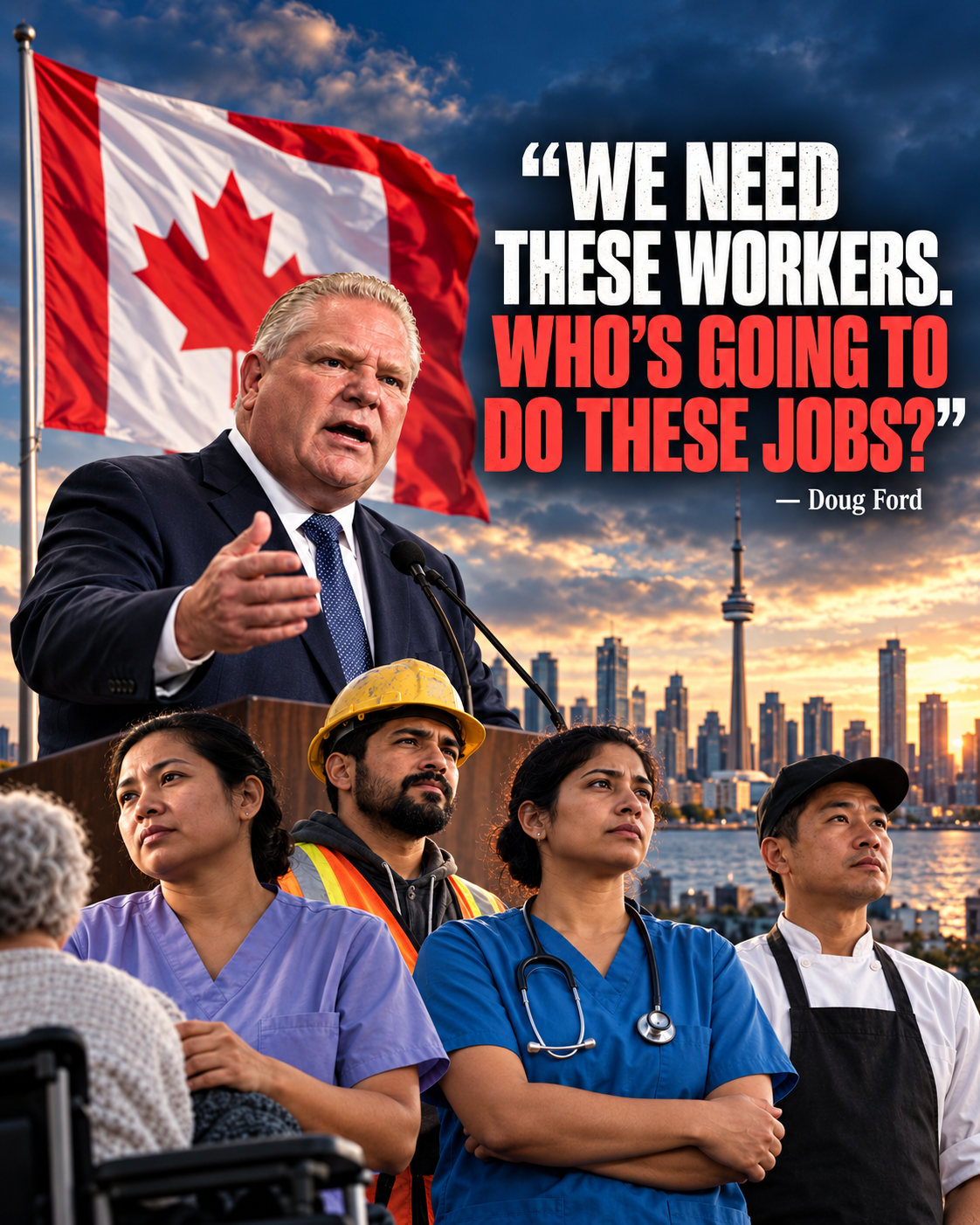
“We Need These Workers. Who’s Going to Do These Jobs?” — Doug Ford’s Question Exposes the Mental Health Toll of Canada’s Immigration Uncertainty.
“We need these workers. Who’s going to do these jobs?”
Those words, attributed to Ontario Premier Doug Ford in a video circulating online on October 3, 2026, have reopened a difficult conversation about immigration, labour shortages and the uncertain future facing thousands of temporary residents already living and working in Canada. The wording can be heard and is being widely discussed online, although I have not located an official Ontario government transcript of the remarks at the time of writing.
Ford’s question deserves attention because it comes at a time when Canada is trying to reduce its temporary-resident population while simultaneously acknowledging that foreign workers remain important to several parts of the economy.
And somewhere between those two policy realities are human beings experiencing fear, anxiety and uncertainty about whether they will be allowed to continue the lives they have built in Canada.
For some, immigration uncertainty is no longer simply about paperwork.
It has become a mental-health issue.
“We Need These Workers” — Yet Many Workers Are Unsure Whether They Can Stay
Consider the contradiction.
Governments and employers continue to speak about labour needs, yet some temporary workers and international graduates who are already in Canada are approaching the end of their authorized stay without obtaining permanent residence.
Canada's federal government openly recognizes that temporary residents contribute to the economy. IRCC says temporary residents play an important role in supporting Canada's economy and that the immigration system must continue meeting labour-market needs while also protecting housing, health-care capacity and opportunities for Canadian workers.
But Canada is also intentionally reducing the temporary-resident population.
Under the 2026–2028 Immigration Levels Plan, the federal government intends to bring temporary residents to less than 5 per cent of Canada's population by the end of 2027. The target for new temporary-resident arrivals is 385,000 in 2026, falling to 370,000 in 2027 and 2028.
Those are policy numbers.
But behind those numbers are people.
A Personal Support Worker may be caring for seniors today while wondering whether she will still be legally allowed to work in Canada next year.
A construction worker may be helping build Canadian homes while uncertain whether his own family will remain in the country.
An international graduate may have studied, worked and paid taxes in Canada for several years, only to discover that obtaining permanent residence has become far more difficult than expected.
That uncertainty can have a psychological cost.
Imagine Building a Life and Then Being Told You May Have to Leave
Imagine coming to Canada legally.
You pay international tuition.
You complete your education.
You obtain a work permit.
You find a job.
You develop Canadian work experience.
Your employer begins depending on you.
You rent an apartment.
You make friends.
You become involved in your church, mosque, community association or neighbourhood.
Perhaps your spouse joins you.
Perhaps your children begin attending Canadian schools.
Four or five years pass.
Canada no longer feels like a foreign country.
It feels like home.
Then your work permit begins approaching its expiry date.
Your permanent-residence score is not competitive enough.
A program changes.
Your application is refused.
Or you simply discover that the immigration pathway you expected to use is no longer realistically available.
Suddenly, years of planning become uncertain.
For people who no longer maintain valid temporary status, Canadian immigration law is clear. IRCC states that foreign nationals who fail to maintain their temporary status or remain after the end of their authorized stay may face enforcement action, including removal by the Canada Border Services Agency.
Legally, Canada is entitled to enforce its immigration laws.
But the human consequences should not be ignored.
What Immigration Uncertainty Can Do to Mental Health
Immigration is already one of life's major transitions.
When that transition is combined with uncertainty about legal status, employment, income, housing and family stability, the emotional strain can become substantial.
Canadian research on recent immigrants has identified settlement difficulties, unemployment, family separation, discrimination, financial pressures, limited social support and other post-migration challenges as factors affecting emotional wellbeing.
A federal study using the Longitudinal Survey of Immigrants to Canada found that about 29 per cent of immigrants surveyed reported emotional problems at one stage of the study, while approximately 16 per cent reported high levels of stress. Lower income and dissatisfaction with the settlement experience were also associated with poorer emotional outcomes.
This does not mean that immigration uncertainty automatically causes mental illness.
Nor should every temporary resident facing an expiring permit be described as mentally unwell.
But prolonged uncertainty can create conditions in which anxiety, fear, hopelessness and stress become harder to manage.
And immigration status can affect almost every major part of a person's life.
Can I continue working?
Can I renew my permit?
Can my spouse remain employed?
Can my children stay in their school?
Should I sign another lease?
Should I buy a car?
Should I continue building my career?
Should we have another child?
Should I send money home or save everything for legal and immigration expenses?
Will Canada still be my home next year?
For some immigrants, these questions are not occasional worries.
They become daily realities.
The Fear of an Email From IRCC
For people living with immigration uncertainty, an ordinary email notification can trigger intense fear.
Some repeatedly refresh their IRCC accounts hoping for an update.
Some struggle to sleep.
Some become withdrawn from friends and family.
Some are afraid to make long-term plans.
Their employers may ask:
“When does your work permit expire?”
Parents overseas may ask:
“Have you received your permanent residence?”
Children may ask:
“Are we going back?”
And sometimes the person in the middle has no answer.
There can also be enormous financial pressure.
Many international students have paid substantially higher tuition than domestic students.
Families may have sold property, borrowed money or spent years of savings to finance their Canadian education.
After graduation, some then spend additional money on immigration applications, examinations, credential assessments, language testing and professional advice.
Returning home can therefore feel, psychologically, not simply like moving countries again but like abandoning years of investment and expectation.
That is why Canada's immigration discussion should include mental wellbeing alongside economics, housing and enforcement.
Canada Is Intentionally Reducing Temporary Immigration
It is important to be fair to the federal government's position.
Canada is not reducing temporary immigration without stated reasons.
Ottawa says immigration growth needs to become more sustainable and better aligned with housing supply, health-care capacity, infrastructure and labour-market conditions.
IRCC says the 2026–2028 plan is intended to meet economic and labour needs while putting the Canadian workforce first and reducing pressure on housing and public services.
These concerns are legitimate.
Housing affordability remains a major problem.
Health-care systems are under strain.
Infrastructure must keep pace with population growth.
And Canadian workers, especially younger Canadians searching for entry-level employment, must also have fair access to jobs.
Immigration policy therefore cannot simply be reduced to the argument that everyone already in Canada should automatically receive permanent residence.
Temporary status is temporary.
A study permit, work permit or post-graduation work permit is not a guarantee of permanent residence.
Canada has the right to determine who qualifies to stay permanently.
But recognizing that legal reality does not eliminate another important question:
What should Canada do with temporary residents who are already filling genuine and continuing labour shortages?
That is where Doug Ford's question becomes particularly relevant.
“Who’s Going to Do These Jobs?”
Ford's remark—
“We need these workers. Who's going to do these jobs?”
—raises a practical question about the relationship between immigration policy and labour demand.
If workers are genuinely required in particular sectors, then Canada should carefully examine whether it makes economic sense to lose trained and experienced workers who are already established here.
Consider a Personal Support Worker.
She may already have Canadian training.
She understands the Canadian health-care system.
She has experience caring for seniors.
Her employer trusts her.
Her clients know her.
She pays taxes.
She pays rent.
She shops in her local community.
Yet she may reach the end of her temporary status without securing permanent residence.
If she leaves Canada and the same employer later reports a shortage of caregivers, Canada may eventually have to recruit another worker from overseas and start the process again.
That raises a reasonable question:
Why lose experienced workers only to search internationally for replacements in sectors where genuine shortages continue?
Interestingly, the federal government appears to recognize part of this problem.
Its current immigration plan includes an initiative to accelerate permanent residence for up to 33,000 temporary workers in 2026 and 2027, targeting people who have established roots in their communities, pay taxes and contribute to Canada's economy.
That approach suggests there is room for a system that reduces overall temporary-resident numbers while still identifying workers whose skills Canada genuinely needs.
Canada Must Also Listen to Canadian Workers
There is another side to this debate, and it must not be ignored.
Some Canadians are asking a different question:
Why bring in foreign workers when Canadians themselves are looking for jobs?
That concern deserves serious consideration.
Immigration should not become a mechanism through which employers avoid improving wages, benefits or working conditions.
Canadian teenagers, young adults, unemployed workers and newcomers with permanent status should have genuine opportunities to compete for jobs.
Employers claiming labour shortages should be expected to demonstrate that those shortages are real.
Where Canadians are available and qualified, they should not be displaced simply because employers prefer a more vulnerable or cheaper workforce.
This is why the answer cannot simply be “more immigration” or “send everyone home.”
The issue is more complicated.
Canada needs a labour-market strategy that distinguishes between genuine shortages and employers who simply do not want to pay enough to attract workers.
The Human Beings Behind the Statistics
One of the greatest dangers in immigration debates is that people become numbers.
385,000 temporary arrivals.
380,000 permanent residents.
5 per cent of the population.
230,000 workers.
155,000 students.
These statistics matter.
But each number represents a life.
A mother.
A father.
A caregiver.
A graduate.
A truck driver.
A construction worker.
A nurse.
A farm worker.
A restaurant employee.
A skilled tradesperson.
Someone paying rent.
Someone paying taxes.
Someone supporting relatives abroad.
Someone who may already regard Canada as home.
Government must manage immigration responsibly.
But responsible immigration management should also recognize psychological wellbeing.
Do Not Create Hope Without Clarity
One lesson Canada should take from the present situation is the need for much greater transparency.
People should understand from the beginning that studying or working temporarily in Canada does not automatically lead to permanent residence.
Schools, recruiters, employers and immigration intermediaries should not sell temporary pathways as if permanent residence were guaranteed.
At the same time, governments should try to make immigration pathways more predictable.
If Canada genuinely needs health-care workers, caregivers, skilled tradespeople or workers in rural and remote communities, those priorities should translate into transparent immigration pathways.
If Canada's needs change, people should know as early as possible.
An individual should not spend several years structuring an entire life around a pathway only to discover very late that it has effectively disappeared.
Policy can change.
But predictability matters.
And where major changes affect people already deeply established in Canada, governments should carefully consider transitional measures.
Canada Cannot Want Labour While Ignoring the Worker
Perhaps that is the bigger message behind Doug Ford's comment.
A society cannot view immigrants only as workers when labour is required and then forget the human being when immigration status becomes inconvenient.
People are more than labour units.
They develop relationships.
Their children form friendships.
They become members of churches, mosques and community organizations.
They volunteer.
They develop careers.
They build professional networks.
They care for Canadian seniors.
They serve Canadian customers.
They build Canadian homes.
They become part of Canadian communities.
That does not automatically create a legal entitlement to permanent residence.
But it should encourage policymakers to think carefully about how immigration rules affect people who have become economically and socially established.
Canada Needs Balance, Not Extremes
Canada does not need an immigration policy based entirely on emotion.
But neither should it have one that ignores emotion completely.
There must be balance.
Canada should continue controlling immigration levels.
Housing and infrastructure must be considered.
Canadian workers must be protected.
Employers must not be permitted to use immigration to suppress wages.
Temporary status must retain meaning.
But Canada should also create clearer pathways for workers filling genuine shortages.
It should recognize established workers who have demonstrated their contribution.
It should improve transparency.
It should reduce unnecessary immigration uncertainty.
And mental-health and settlement supports should be accessible to people struggling under prolonged immigration insecurity.
Doug Ford Asked the Question. Canada Must Now Answer It.
“We need these workers. Who's going to do these jobs?”
It is a simple question.
But the answer is complicated.
Sometimes the answer should be Canadians.
Sometimes employers should raise wages and improve working conditions so Canadians are willing to take available jobs.
Sometimes technology and productivity improvements may reduce labour requirements.
And sometimes Canada will genuinely need immigrant workers.
When that happens, another question must follow:
What happens to the experienced immigrant workers who are already here?
If Canada truly needs some of them, should there not be clearer pathways allowing those workers to remain?
And if Canada decides it no longer needs them, how can that transition be handled in a way that respects the law while recognizing the enormous psychological and human consequences involved?
Because immigration policy is about more than numbers.
It is about people.
Canada should protect its borders.
Canada should protect Canadian workers.
Canada should manage population growth responsibly.
But Canada should also protect human dignity and mental wellbeing.
When a worker has spent years caring for Canadian seniors, constructing Canadian buildings, serving Canadian customers, paying Canadian taxes and becoming part of a Canadian community, the question should not only be:
“Who's going to do these jobs?”
Canada should also ask:
“What happens to the people who have already been doing them?”
That is the immigration conversation Canada urgently needs to have.
Babacares — Promoting Health, Wellness and a Better Society.
References
-
Immigration, Refugees and Citizenship Canada. Supplementary Information for the 2026–2028 Immigration Levels Plan. Government of Canada. The plan sets temporary-resident arrival targets of 385,000 for 2026 and 370,000 for 2027 and 2028 and commits to reducing temporary residents to below 5% of Canada's population by the end of 2027.
-
Immigration, Refugees and Citizenship Canada. Immigration Levels Plan – March 23, 2026. Government of Canada. Includes information about temporary-status compliance, potential enforcement and removal, labour-market considerations and Canada's immigration targets.
-
Immigration, Refugees and Citizenship Canada. Temporary Resident Targets – March 23, 2026. Government of Canada. Describes the economic role of temporary residents and Canada's objective of balancing labour needs with housing, health care and opportunities for Canadian workers.
-
Robert, Anne-Marie & Gilkinson, Tara. Mental Health and Well-Being of Recent Immigrants in Canada: Evidence from the Longitudinal Survey of Immigrants to Canada. Citizenship and Immigration Canada, 2012. The research examined emotional problems, stress and settlement-related factors among recent immigrants.
-
Immigration, Refugees and Citizenship Canada. Understanding Student and Temporary Worker Numbers in Canada. Data updated to July 31, 2026. Government of Canada.
-
Online video discussion concerning comments attributed to Ontario Premier Doug Ford, October 3, 2026. The circulated clip contains the statement, “We need these workers. Who's going to do these jobs?” At the time of writing, an official Ontario government transcript of the specific remarks had not been located, so the quotation should be understood in that context.
Disclaimer: This article is commentary on immigration policy, labour needs and mental wellbeing. It is not legal or immigration advice. Individuals facing loss of immigration status or a removal process should seek advice from a qualified Canadian immigration lawyer or licensed immigration consultant.











Comments