

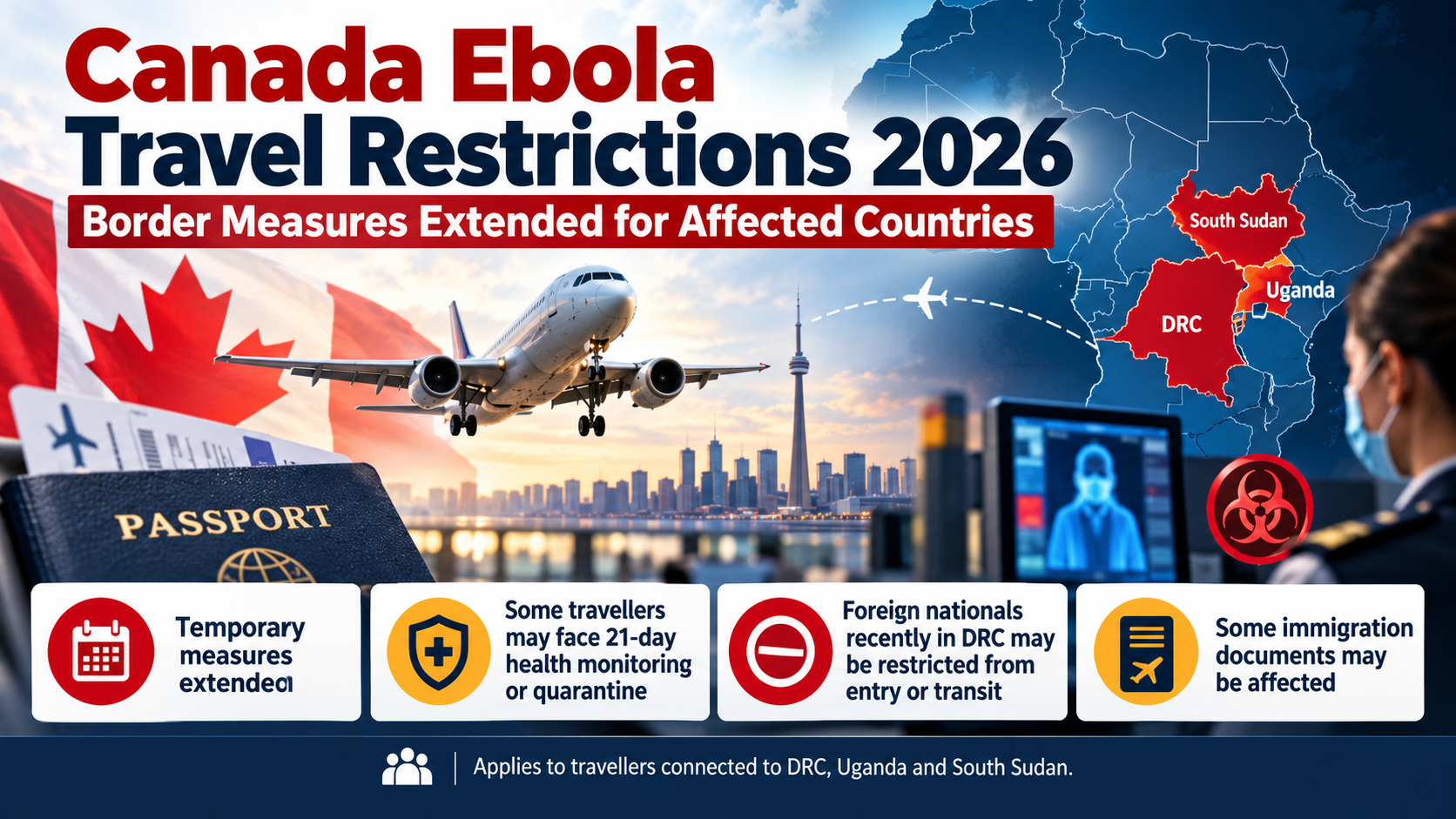
Canada Ebola Travel Restrictions 2026: Border Measures Extended for Republic of the Congo, Uganda or South Sudan.
The Government of Canada has extended temporary border and immigration measures introduced in response to the ongoing Ebola disease outbreak in the Democratic Republic of the Congo (DRC).
The measures, which also affect travellers connected to Uganda and South Sudan, have been extended until September 28, 2026, at 11:59 p.m. EDT. Canada says the restrictions are precautionary and that the overall risk of Ebola to people in Canada remains low.
Why Canada Extended the Ebola Border Measures
Canada first introduced temporary measures in May 2026 after an Ebola outbreak in the DRC and concerns about possible spread to neighbouring countries.
The Public Health Agency of Canada says the measures are intended to reduce the risk of Ebola being introduced and spreading within Canada while allowing authorities to safely assess returning travellers and humanitarian workers. Canada
The current measures apply to people who have recently been in the Democratic Republic of the Congo, Uganda or South Sudan. Even travellers who only transit through these countries may be affected. Canada
What Happens to Canadian Citizens and Permanent Residents?
Canadian citizens, permanent residents and people registered under the Indian Act are still permitted to return to Canada after travelling to the DRC, Uganda or South Sudan.
However, if they have been in one of the affected countries during the 21 days before arriving in Canada, they may be required to undergo a health assessment.
Travellers without Ebola symptoms are generally required to quarantine for 21 days, unless they qualify for an exemption. Those showing symptoms consistent with Ebola may be isolated at a medical facility for further assessment. Canada
Stricter Rules for Some Foreign Nationals
The restrictions are more severe for foreign nationals who have recently been in the Democratic Republic of the Congo.
Foreign nationals from other countries who have been in the DRC during the previous 21 days are generally prohibited from:
- entering Canada;
- boarding a flight to Canada; or
- transiting through Canada.
Certain exemptions exist, including for some crew members and other specified categories. Canada
Foreign nationals who have recently been in Uganda or South Sudan, but are otherwise eligible to enter Canada, may still be permitted to travel but can be subject to the 21-day quarantine requirement. Canada
Immigration Documents Also Affected
Canada has also temporarily suspended certain immigration documents for foreign nationals whose last country of residence listed on their immigration application was the DRC, Uganda or South Sudan.
According to Immigration, Refugees and Citizenship Canada, affected people may be unable to travel to Canada even if they already hold an approved:
- temporary resident visa;
- permanent resident visa;
- electronic travel authorization (eTA); or
- certain other immigration documents.
IRCC says it will continue processing affected applications, but some applications will not be finalized while the temporary measures remain in place. Canada
People already inside Canada are not automatically losing their immigration status because of these temporary measures. Canada
How Serious Is the Ebola Situation?
Canada's July 2026 risk assessment reported Ebola cases in the Democratic Republic of the Congo and Uganda.
As of July 2, Uganda had reported 20 confirmed cases, including two deaths, with no evidence at that time of sustained transmission within Uganda. The same Canadian assessment reported no cases in South Sudan as of that date. Canada
Canada continues to describe the overall public-health risk domestically as low, but authorities say the border measures are being maintained as a precaution. Canada
What Travellers Should Do Before Flying to Canada
Anyone planning travel involving the DRC, Uganda or South Sudan should check Canada's latest rules before booking or boarding a flight.
A valid visa, eTA, permit or other travel document does not necessarily mean a person can currently travel to Canada if the Ebola measures apply to them.
Canadian authorities also recommend checking destination-specific travel advisories and speaking with a healthcare provider or travel-health clinic before travelling to an Ebola-affected area. Canada
Official Canada Ebola border measures for travellers
What This Means for Families and International Travellers
For families, students, workers and visitors with connections to the affected countries, the restrictions could lead to disrupted travel plans, postponed entry to Canada or mandatory quarantine.
People planning to reunite with relatives in Canada should therefore verify their eligibility before purchasing non-refundable tickets.
The restrictions are temporary, but the Government of Canada has indicated that measures may change depending on how the outbreak develops.
No Ebola Outbreak in Canada
It is important to put the announcement in context.
The extension of these border measures does not mean Canada is experiencing an Ebola outbreak. Rather, the government says the measures are designed to reduce the possibility of imported cases and protect public health while the international outbreak continues. Canada
Travellers should rely on official health and immigration information rather than rumours circulating on social media.
Babacares will continue to monitor developments concerning Ebola, public health and international travel.
Read more health and wellness news:
Babacares.com











Comments