

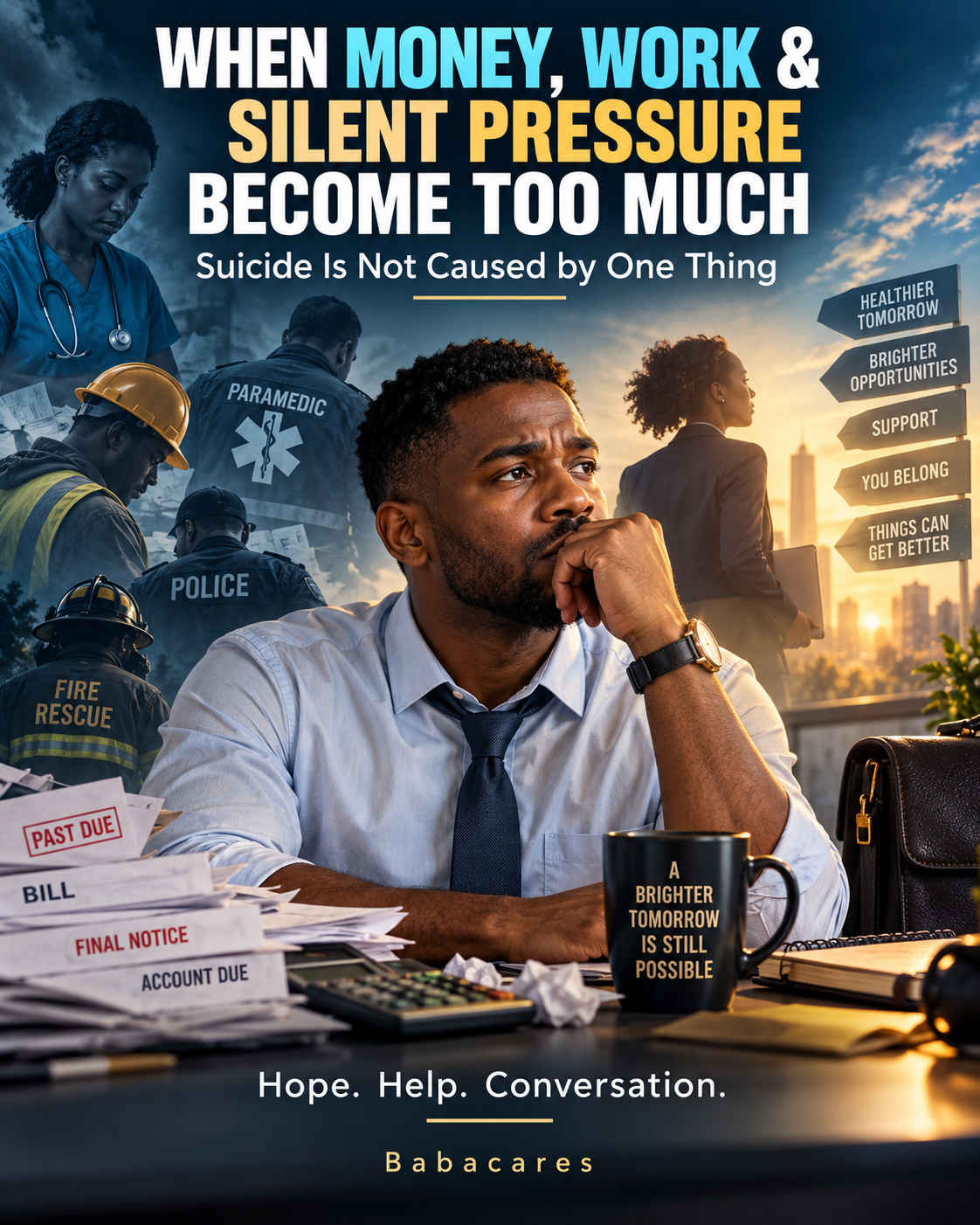
WHEN MONEY, WORK AND SILENT PRESSURE BECOME TOO MUCH: SUICIDE IS NOT CAUSED BY ONE THING.
A thoughtful LinkedIn post by Opunimi Akinkugbe, former Nigerian Ambassador to Greece and financial-literacy advocate, recently drew attention to an issue we do not discuss enough: the connection between financial pressure and mental wellbeing.
She wrote about the emotional weight of unpaid bills, mounting debt, school fees, business failure, job loss and the pressure to maintain appearances. Her central message was powerful: financial problems can be addressed; a life cannot be replaced.
I believe that conversation needs to go even further.
Money problems are certainly important, but suicide is rarely the result of a single issue. The World Health Organization says suicidal behaviour can be associated with a combination of factors including financial problems, relationship conflict, loss, loneliness, chronic pain or illness, violence, abuse, alcohol or other mental-health problems, discrimination and social isolation. World Health Organization
In other words, sometimes the person we see functioning normally at work is carrying a burden nobody around them understands.
WHAT ABOUT PEOPLE WHOSE JOBS EXPOSE THEM TO TRAUMA EVERY DAY?
This is where I believe professionals such as paramedics, EMTs, police officers, firefighters, nurses and other frontline workers deserve particular attention.
Paramedics and EMTs repeatedly encounter death, serious injuries, accidents, violence and families experiencing some of the worst moments of their lives. Research has found significant mental-health and suicide concerns among first responders, linked to repeated trauma exposure, PTSD, depression, occupational stress and barriers to seeking help. PubMed
But paramedics should not be described as universally having the highest suicide rate. Occupational risk differs by country, sex, age and dataset.
For example, U.S. CDC data for 2021 found particularly elevated suicide rates among people working in construction and extraction; farming, fishing and forestry; personal care and service; installation, maintenance and repair; and arts, design, entertainment, sports and media. Certain transportation, protective-service and healthcare occupations also showed elevated rates. CDC
This tells us something important:
The person at risk may not look distressed.
It could be the paramedic who just attended a fatal collision.
It could be the nurse who has watched several patients die.
It could be the farmer facing a failed harvest.
It could be the construction worker facing job insecurity.
It could be the business owner drowning in debt.
It could be the artist whose career has collapsed.
It could be the immigrant working three jobs while supporting relatives in two countries.
It could even be the successful executive everyone assumes has everything under control.
WORKPLACES MUST DO MORE THAN OFFER A PAYCHEQUE
Mental health cannot remain something employers address only after a tragedy.
Managers and organizational leaders should be asking:
Are employees working excessive hours?
Are people regularly exposed to traumatic events?
Can workers admit that they are struggling without fearing that their careers will suffer?
Is confidential counselling genuinely accessible?
Do supervisors recognize signs of severe stress, burnout or withdrawal?
Are employees returning to work immediately after traumatic incidents without meaningful psychological support?
WHO emphasizes that suicide prevention requires action across many parts of society—not only healthcare, but also education, employment, business, government and the media. World Health Organization
FINANCIAL WELLNESS IS ALSO MENTAL-HEALTH PREVENTION
Opunimi Akinkugbe's original point deserves repeating.
Debt and financial crisis can generate enormous psychological pressure.
Sometimes the first intervention someone needs is not simply “be strong.”
It may be:
a conversation with a financial adviser;
a realistic debt-repayment arrangement;
help negotiating with creditors;
temporary family support;
selling an asset;
reducing expenses;
professional counselling;
or simply admitting to someone trusted that things have become overwhelming.
Shame often makes financial problems more dangerous because people begin suffering privately while maintaining the appearance that everything is fine.
CHECK ON THE STRONG PERSON TOO
We often check on people who visibly appear vulnerable.
We should also check on the person who is always helping everybody else.
Ask your doctor.
Ask your paramedic friend.
Ask the nurse.
Ask the police officer.
Ask the caregiver.
Ask the entrepreneur.
Ask the unemployed graduate.
Ask the friend whose business just collapsed.
Ask the person going through divorce.
Ask the person who suddenly became unusually quiet.
And sometimes go beyond:
“How are you?”
Ask:
“How are you really coping?”
Then give them time to answer.
HELP IS AVAILABLE
If you or someone you know is thinking about suicide or feels unable to stay safe, seek immediate professional help.
Canada: Call or text 9-8-8, Canada's national Suicide Crisis Helpline, available 24/7. In an immediate emergency, call 9-1-1 or go to the nearest emergency department. 9-8-8: Suicide Crisis Helpline
Canada 9-8-8 Suicide Crisis Helpline
United States: Call or text 988 for the Suicide & Crisis Lifeline.
U.S. 988 Suicide & Crisis Lifeline
United Kingdom and Ireland: Samaritans — 116 123, available for emotional support.
Samaritans
Australia: Lifeline — 13 11 14, with phone, text and online crisis support available around the clock. Lifeline
Lifeline Australia
Nigeria: In the LinkedIn post that inspired this article, Opunimi Akinkugbe listed Lagos Lifeline: 070 0000 6463 or 020 1410 6463; WhatsApp 090 9000 6463. Because crisis-service details can change, people should also verify current local services or use a global helpline directory.
Anywhere in the world: The International Association for Suicide Prevention (IASP) links to verified crisis services in more than 150 countries through Find A Helpline. IASP
Find a Helpline Worldwide
For broader global suicide-prevention information, the World Health Organization's LIVE LIFE initiative provides evidence-based guidance to governments and communities. Suicide reduction is also part of the United Nations Sustainable Development Goals, including the global target of reducing premature mortality from noncommunicable diseases and promoting mental health and wellbeing. World Health Organization
WHO Suicide Prevention Resources
WHO LIVE LIFE Initiative
United Nations Sustainable Development Goals
THE MESSAGE IS SIMPLE
Money trouble deserves attention.
Workplace trauma deserves attention.
Depression deserves attention.
Loneliness deserves attention.
Burnout deserves attention.
But above all, people deserve attention before a crisis becomes a tragedy.
A financial problem can change.
A job can change.
A business can be rebuilt.
Debt can be renegotiated.
A career can begin again.
But a life lost cannot be replaced.
Credit: This reflection was inspired by a LinkedIn post by Opunimi Akinkugbe on financial stress, mental wellbeing and suicide prevention. I have expanded the discussion here to include occupational stress and suicide risk among first responders, healthcare workers and other professions.
What do you think employers, families and communities should be doing differently to recognize people who are silently struggling?
https://www.babacares.com/blog-details?details=1033&title=WHEN+MONEY%2C+WORK+AND+SILENT+PRESSURE+BECOME+TOO+MUCH%3A+SUICIDE+IS+NOT+CAUSED+BY+ONE+THING.











Comments