

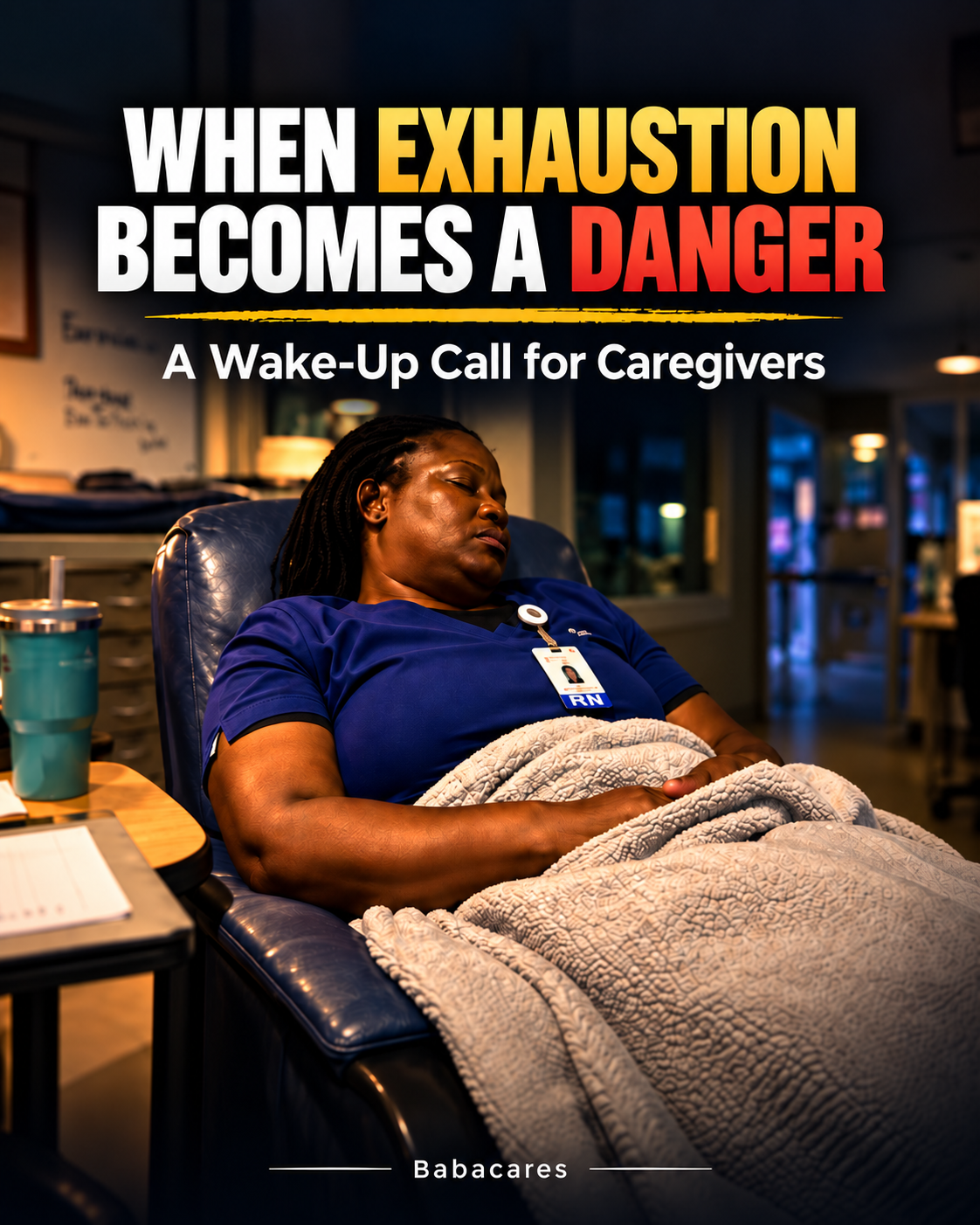
WHEN EXHAUSTION BECOMES A DANGER: A WAKE-UP CALL FOR CAREGIVERS WORKING MULTIPLE JOBS.
A disturbing story currently circulating among Nigerians in the caregiving community should make every Personal Support Worker, caregiver, nurse and healthcare assistant stop and reflect.
According to the viral account, a Nigerian woman working a night shift as a caregiver allegedly fell asleep while on duty. During the period she was sleeping, the client she was assigned to care for reportedly got up to use the washroom, fell and sustained serious injuries, including broken ribs.
The story alleges that a supervisor and other managers arrived at the workplace and found the caregiver still asleep. Instead of immediately waking her, they reportedly took photographs documenting what they found before eventually waking her.
Confused and frightened after waking up, the caregiver allegedly said she was not feeling well.
The matter reportedly became even more complicated when management learned from another worker, described in the viral account as her colleague and friend, that she was working two additional jobs.
Management allegedly concluded that excessive work and inadequate rest may have contributed to her falling asleep during the night shift.
She was subsequently reportedly dismissed from her employment.
Whether every detail of this viral account is ultimately confirmed or not, the story raises an extremely important issue for thousands of caregivers working long hours:
How much work is too much when another person's safety is in your hands?
CAREGIVING IS NOT JUST ANOTHER JOB
Caregiving carries enormous responsibility.
A caregiver may be responsible for a client who is elderly, cognitively impaired, physically weak, at high risk of falling, or unable to call for help independently.
During a night shift, the workplace may become quiet, but responsibility does not disappear.
A client may suddenly need assistance to use the washroom, reposition in bed, take medication, respond to pain, or deal with an emergency.
That means a caregiver who is assigned to remain awake cannot treat a night shift as an opportunity to sleep unless the employer specifically permits sleep as part of that particular shift arrangement.
WORKING MULTIPLE JOBS CAN BECOME A SAFETY ISSUE
Many caregivers work more than one job.
The reasons are understandable.
The cost of housing is high. Groceries are expensive. Many immigrants are supporting relatives abroad, paying school fees, sending money home, repaying debts and trying to establish themselves financially.
There is nothing inherently wrong with working for more than one employer.
The danger begins when the amount of work leaves a person so exhausted that he or she can no longer perform safely.
A worker may believe:
“I can handle another eight-hour shift.”
The body may say otherwise.
Extreme fatigue can reduce alertness, concentration, reaction time and judgment. A caregiver may miss a call bell, forget an instruction, fail to notice a change in a client's condition or, as alleged in this viral story, fall asleep when the client requires supervision.
At that point, working extra hours is no longer only a personal financial decision. It becomes a client-safety issue.
DO NOT HIDE ILLNESS OR EXTREME FATIGUE
Another lesson from this story concerns what happens after something goes wrong.
If you are genuinely sick, say so.
If you are dangerously exhausted, report it.
If an incident occurs, provide an accurate account of what happened.
Trying to invent an explanation because you are frightened can create a second and potentially more serious problem.
Employers may investigate incident reports, staffing records, access logs, documentation, witness statements, security footage and other evidence.
A false explanation can damage a worker's credibility even when the original mistake might otherwise have been dealt with differently.
YOUR CO-WORKER IS NOT YOUR CONFIDENTIAL DIARY
The reported allegation that a colleague disclosed the caregiver's other employment also carries another lesson.
Be professional about what you share at work.
Co-workers can become good friends, but the workplace remains the workplace.
Discussing how many jobs you work, how little sleep you have had, how you intend to sleep during a quiet shift, or how exhausted you are may later become relevant if an incident occurs.
This does not mean caregivers should become suspicious of everyone.
It simply means workers should maintain appropriate professional boundaries.
Never tell colleagues anything that you would be embarrassed to repeat in front of your supervisor, manager or professional regulator.
DOCUMENTATION CAN PROTECT YOU
Caregivers should document important events accurately and promptly.
If a client refuses assistance, document it according to workplace policy.
If a client is repeatedly trying to get out of bed and is at risk of falling, report it.
If you notice a change in behaviour, mobility or mental status, report it.
If your assignment is unsafe or you believe you cannot safely continue your shift because of illness or exhaustion, notify the appropriate supervisor.
Good documentation cannot prevent every problem, but poor or missing documentation can make an already difficult situation much worse.
NEVER LEAVE A HIGH-RISK CLIENT UNSUPERVISED CONTRARY TO THE CARE PLAN
Caregivers must understand the client's care plan.
Some clients are independent.
Others require standby assistance.
Some require one-person assistance, while others require two workers or mechanical equipment for transfers.
A client with a history of falls may require particularly close monitoring.
Never assume that because a client walked independently yesterday, the same client is automatically safe today.
Care needs can change rapidly.
NIGHT SHIFT REQUIRES A DIFFERENT KIND OF DISCIPLINE
Night work is difficult because it conflicts with the body's natural sleep cycle.
Caregivers working nights should take fatigue seriously.
Before a night shift, get adequate sleep whenever possible. Avoid accepting consecutive shifts that leave virtually no recovery time. Eat appropriately, remain hydrated, move around when safe to do so, and follow workplace break policies.
Most importantly, if you are becoming so sleepy that you are struggling to remain awake while responsible for vulnerable people, treat that as a safety problem rather than something to hide.
MONEY IS IMPORTANT — BUT SO IS YOUR CAREER
One extra shift can provide additional income.
But a serious workplace incident can cost far more.
A caregiver could lose employment, damage professional references, face an internal investigation, become involved in litigation or, depending on the profession and jurisdiction, face regulatory consequences.
A recent Australian case illustrates the seriousness of sleeping while responsible for residents: a tribunal cancelled the registration of a Nigerian nurse following findings of professional misconduct related to sleeping during night shifts at an aged-care facility. The Guardian Nigeria
No overtime payment is worth destroying a career that took years to build.
EMPLOYERS ALSO HAVE RESPONSIBILITIES
The conversation should not focus only on blaming individual caregivers.
Employers also need adequate staffing, reasonable scheduling, proper supervision, clear fatigue-management policies and an environment where workers can honestly report that they are unwell or unsafe to continue working.
Healthcare systems depend heavily on workers who routinely perform physically and emotionally demanding duties.
Fatigue should therefore be treated as both a worker-wellness issue and a patient-safety issue.
THE BIG LESSON
The reported story should serve as a warning to every caregiver:
Know your limits.
Work hard, but do not work yourself into a condition where you become a danger to the very person you are employed to protect.
Your client needs you alert.
Your employer expects you to be fit for duty.
Your family needs you healthy.
And your career deserves protection.
There is nothing wrong with wanting additional income. But when your body is telling you that it desperately needs rest, sometimes the wisest financial decision is to say no to the next shift.
Because one exhausted night can undo years of hard work.
To caregivers reading this: have you ever felt pressured to accept a shift even when you knew you were too exhausted to work safely? What do you think employers and workers should do differently?
— Babacares
https://www.babacares.com/blog-details?details=1032&title=WHEN+EXHAUSTION+BECOMES+A+DANGER%3A+A+WAKE-UP+CALL+FOR+CAREGIVERS+WORKING+MULTIPLE+JOBS.








Comments