

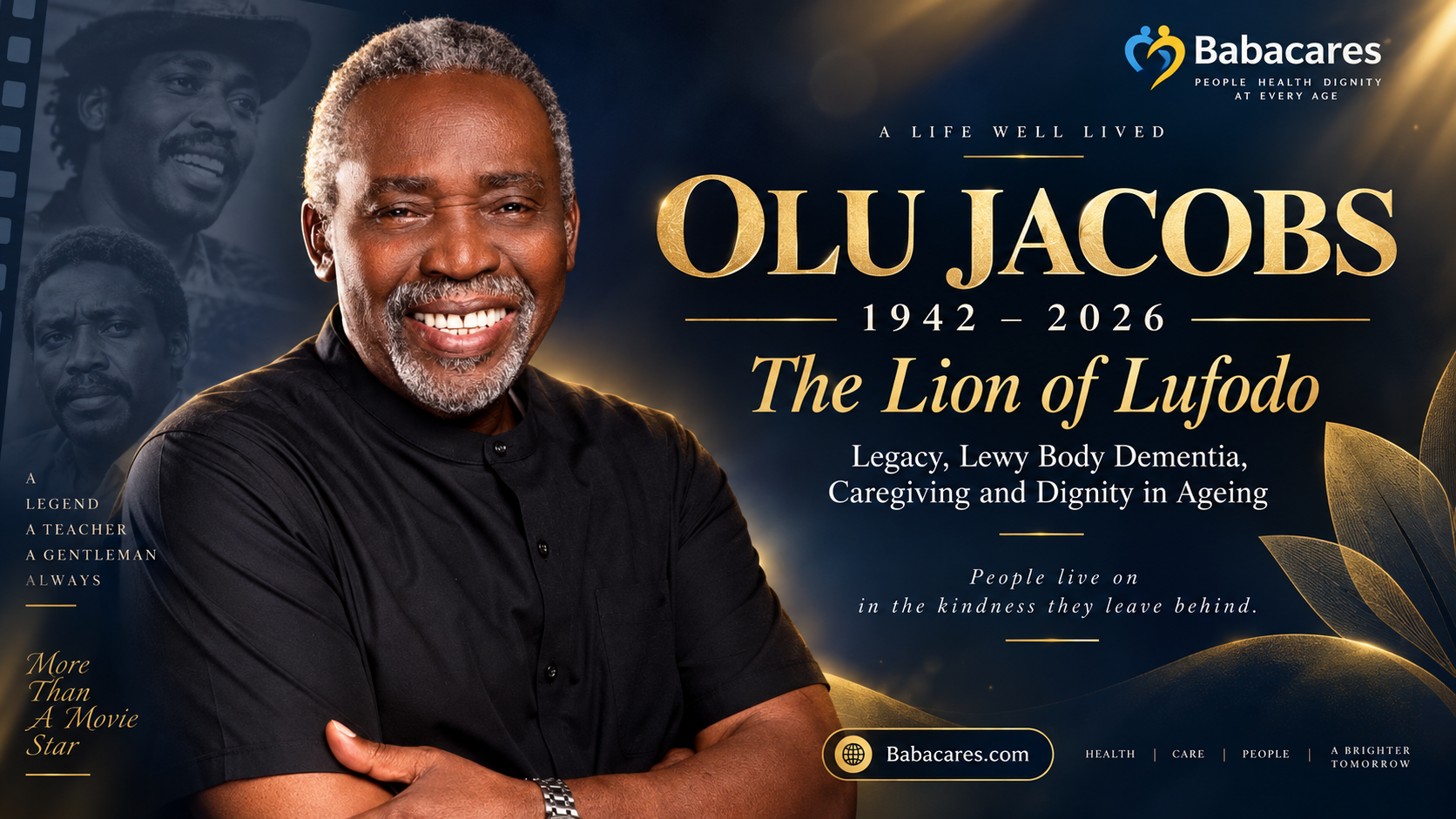
Olu Jacobs Dies at 84: “The Lion of Lufodo,” His Battle With Lewy Body Dementia, Legendary Career and the Health Lessons He Leaves Behind.
The death of legendary Nigerian actor Oludotun Baiyewu Jacobs, MFR, popularly known as Olu Jacobs, marks the end of one of the most remarkable careers in African theatre and cinema.
But beyond the movies, awards and commanding roles for which he will forever be remembered, the final years of Olu Jacobs’ life also told another important story — one about ageing, dementia, caregiving, love, dignity and the enormous responsibility families often carry when a loved one develops a progressive neurological illness.
Olu Jacobs died on Wednesday, September 16, 2026, at the age of 84. His wife, veteran actress Joke Silva, and their son announced his passing.
In perhaps the most touching description of the man millions admired, his family called him:
“The Lion of Lufodo.”
The family said they were announcing the passing of their husband, father, grandfather and uncle with gratitude to God “for a life well lived and fought.” They also appealed for privacy as they mourn.
That phrase — “a life well lived and fought” — is particularly meaningful when one considers the difficult health journey that characterised the legendary actor’s later years.
From Kano to the World
Olu Jacobs was born on July 11, 1942.
Long before Nollywood became an internationally recognised film industry, Jacobs had established himself as a professionally trained actor with international experience.
After developing an interest in acting as a young man, he travelled to Britain and studied at the prestigious Royal Academy of Dramatic Art in London.
He subsequently worked in British repertory theatre and appeared in several British television productions, including The Goodies, Till Death Us Do Part, Barlow at Large, The Venturers, Angels, The Tomorrow People and The Professionals.
His international film credits included The Dogs of War, Baby: Secret of the Lost Legend and Pirates.
When he returned to Nigeria, Jacobs became one of the towering figures who helped define what would eventually become modern Nollywood.
His deep voice, impeccable diction, commanding presence and remarkable ability to portray kings, chiefs, fathers and men of authority made him instantly recognisable.
His career lasted more than five decades.
Awards Befitting a Legend
Olu Jacobs received numerous honours for his contribution to African cinema.
He won the Africa Movie Academy Award for Best Actor in a Leading Role in 2007.
He received an Industry Merit Award at the Africa Magic Viewers’ Choice Awards in 2013 and a Lifetime Achievement Award in 2016.
In 2011, the Nigerian government conferred on him the national honour of Member of the Order of the Federal Republic, MFR.
Together with Joke Silva, he also helped establish the Lufodo Group and Lufodo Academy of Performing Arts, contributing to the development of younger generations of actors and theatre professionals.
It is therefore fitting that the family referred to him at death as “The Lion of Lufodo.”
But perhaps one of the most important chapters of his life unfolded away from movie sets.
The Diagnosis That Changed Everything
In November 2021, Joke Silva publicly revealed for the first time that her husband had been living with dementia with Lewy bodies, often abbreviated as DLB.
She explained that the illness had already been affecting him for several years.
Speaking about the diagnosis, Silva described it as a degenerative condition affecting the brain and acknowledged how difficult the experience had been both for Jacobs and for members of the family.
Her disclosure was significant.
Millions of people knew Olu Jacobs as the powerful man whose voice could dominate a movie scene.
Suddenly, the public was confronted with another reality:
even our strongest heroes can become vulnerable to disease.
What Is Lewy Body Dementia?
Lewy body dementia is a progressive brain disorder associated with abnormal deposits of a protein called alpha-synuclein in the brain.
These deposits are known as Lewy bodies.
According to the U.S. National Institute of Neurological Disorders and Stroke, these changes can interfere with brain function and affect thinking, movement, behaviour, mood, sleep and functions of the autonomic nervous system.
Lewy body dementia generally refers to two related conditions:
dementia with Lewy bodies and Parkinson’s disease dementia.
The symptoms can overlap with both Alzheimer’s disease and Parkinson’s disease, which is one reason diagnosis can sometimes be challenging.
People living with the condition may experience problems with:
- attention and concentration;
- thinking and judgement;
- visual perception;
- episodes of confusion or fluctuating alertness;
- hallucinations;
- slow or stiff movement;
- tremors;
- difficulty walking;
- sleep disturbances;
- falls and balance problems;
- swallowing difficulties;
- depression or anxiety.
Symptoms differ considerably from one person to another.
The disease is progressive, meaning that symptoms generally worsen over time.
At present, there is no cure for Lewy body dementia, although treatments and supportive care can help manage some symptoms and improve quality of life.
When a Spouse Becomes a Caregiver
Perhaps one of the most moving aspects of Olu Jacobs’ health journey was the role played by Joke Silva.
Theirs had long been regarded as one of Nigeria's most enduring entertainment marriages.
But dementia changed the nature of that relationship.
In later interviews, Silva spoke openly about having to accept a new reality.
She explained that there came a point when she realised that the husband she had known was often no longer present in the same way because of the illness.
Yet she continued loving and caring for him.
She described the experience as being almost like caring for a father and said she had learned to “meet” her husband where he was rather than continually fighting against the changes brought by dementia.
That experience will be familiar to many families caring for people with dementia.
A spouse may gradually become a caregiver.
Children may begin making decisions for parents who once made decisions for them.
Roles can reverse.
Communication may change.
Personalities may change.
The person with dementia may eventually need help with dressing, bathing, eating, mobility, medication and virtually every aspect of daily living.
According to the U.S. National Institute on Aging, people with advanced Lewy body dementia can eventually become completely dependent on others for care.
Caregivers Need Care Too
Olu Jacobs’ story should therefore also remind society to pay attention to the health of caregivers.
Family caregiving can be a beautiful expression of love.
But it can also be physically exhausting, emotionally draining and financially demanding.
The U.S. Centers for Disease Control and Prevention notes that caregivers of people with Alzheimer’s disease and related dementias can face increased risks of anxiety, depression and poorer quality of life.
Caregivers may neglect their own medical appointments.
They may sleep poorly.
They may become socially isolated.
Some experience chronic stress while simultaneously trying to maintain employment and care for other family members.
This is why respite care, extended family assistance, professional home-care support, caregiver education and emotional support are so important.
No caregiver should be expected to carry the entire burden alone.
Early Evaluation Matters
Another lesson from Lewy body dementia is the importance of seeking medical evaluation when noticeable changes appear in an older adult.
Families should not simply dismiss persistent confusion, hallucinations, unusual sleep behaviour, repeated falls, movement difficulties or major changes in thinking as “ordinary old age.”
Dementia is not simply another name for getting older.
An accurate diagnosis helps health professionals decide on appropriate treatment and enables families to understand what may lie ahead.
The National Institute on Aging says early diagnosis can also give patients and families time to organise medical care, legal matters, financial arrangements and a broader support network.
Ageing With Dignity
Olu Jacobs’ final years also invite an important conversation about how society treats people whose appearance or abilities change because of ageing or illness.
As his health declined and photographs of him appeared online, there was sometimes insensitive discussion about his physical appearance.
This is precisely when compassion matters most.
Ageing changes the human body.
Neurological diseases can change speech, movement, memory, facial expression, weight and independence.
None of those changes erase a person's achievements or humanity.
A person with dementia remains deserving of respect, privacy, companionship and dignity.
We must learn to see the person before the disease.
The Cruelty of False Death Reports
There is another lesson from the later years of Olu Jacobs’ life.
For years before his actual death, false reports repeatedly circulated online claiming that he had died.
His family had to deny those reports on several occasions.
In 2021, Joke Silva publicly dismissed one such rumour while confirming that her husband was alive.
Again in later years, the family was forced to respond to similar misinformation.
For families already dealing with serious illness, such rumours can create additional emotional distress.
Health journalism and social-media reporting should therefore observe a basic principle:
Never declare someone dead without reliable confirmation.
On September 16, 2026, confirmation finally came from the family itself.
Love Through Sickness and Health
Perhaps one of the most enduring dimensions of Olu Jacobs' story will be his relationship with Joke Silva.
They met decades ago through theatre.
Their relationship grew alongside their careers.
They performed, trained others, raised a family and built institutions together.
And when illness changed their lives, Silva remained publicly committed to caring for the man she had loved for decades.
Her experience also illustrates something medicine cannot easily quantify:
the emotional cost of watching someone you love gradually change because of dementia.
Dementia affects more than one brain.
In many ways, it affects an entire family.
Remembering “The Lion of Lufodo”
Olu Jacobs should not be remembered primarily for his illness.
Dementia was something that happened to him.
It was not who he was.
He was an actor.
A husband.
A father.
A grandfather.
A mentor.
A pioneer.
A man who left Nigeria to train professionally at a time when acting was still regarded by many as an uncertain career, succeeded on international stages and screens, and returned to become one of the foundations upon which Nollywood's global reputation was built.
His health journey, however, leaves us with lessons that deserve to survive alongside his films.
Take changes in memory, movement, sleep and behaviour seriously.
Seek medical evaluation early.
Support families living with dementia.
Remember the health and wellbeing of caregivers.
Respect the dignity and privacy of older adults.
And perhaps most importantly:
never allow illness to erase the identity of the person who existed before the diagnosis.
For decades, Olu Jacobs gave audiences unforgettable performances.
During his final years, his family gave society something equally important — a glimpse into the realities of ageing, dementia and caregiving.
The booming voice may now be silent.
The cameras may have stopped rolling.
But the legacy remains.
Oludotun Baiyewu Jacobs, MFR
July 11, 1942 – September 16, 2026
Actor. Mentor. Husband. Father. Pioneer.
And, in the loving words chosen by his wife and son:
“The Lion of Lufodo.”
May his soul rest in peace.
References
- Premium Times. Veteran Nollywood actor Olu Jacobs dies at 84, September 16, 2026.
- Channels Television. Tributes Pour In As Nollywood Mourns Olu Jacobs, September 16, 2026.
- Punch Newspapers. Veteran actor Olu Jacobs dies at 84, September 16, 2026.
- Punch Newspapers. Olu Jacobs had degenerative brain disease — Joke Silva, September 16, 2026, revisiting her 2021 disclosure.
- The Guardian Nigeria. Joke Silva Opens Up About Husband Olu Jacobs’ Dementia, July 3, 2023.
- National Institute of Neurological Disorders and Stroke. Lewy Body Dementia.
- National Institute on Aging. Lewy Body Dementia: Causes, Symptoms, and Diagnosis.
- NHS. Dementia with Lewy bodies – Symptoms.
- Centers for Disease Control and Prevention. Caregivers of a Person with Alzheimer’s Disease or a Related Dementia.










Comments