

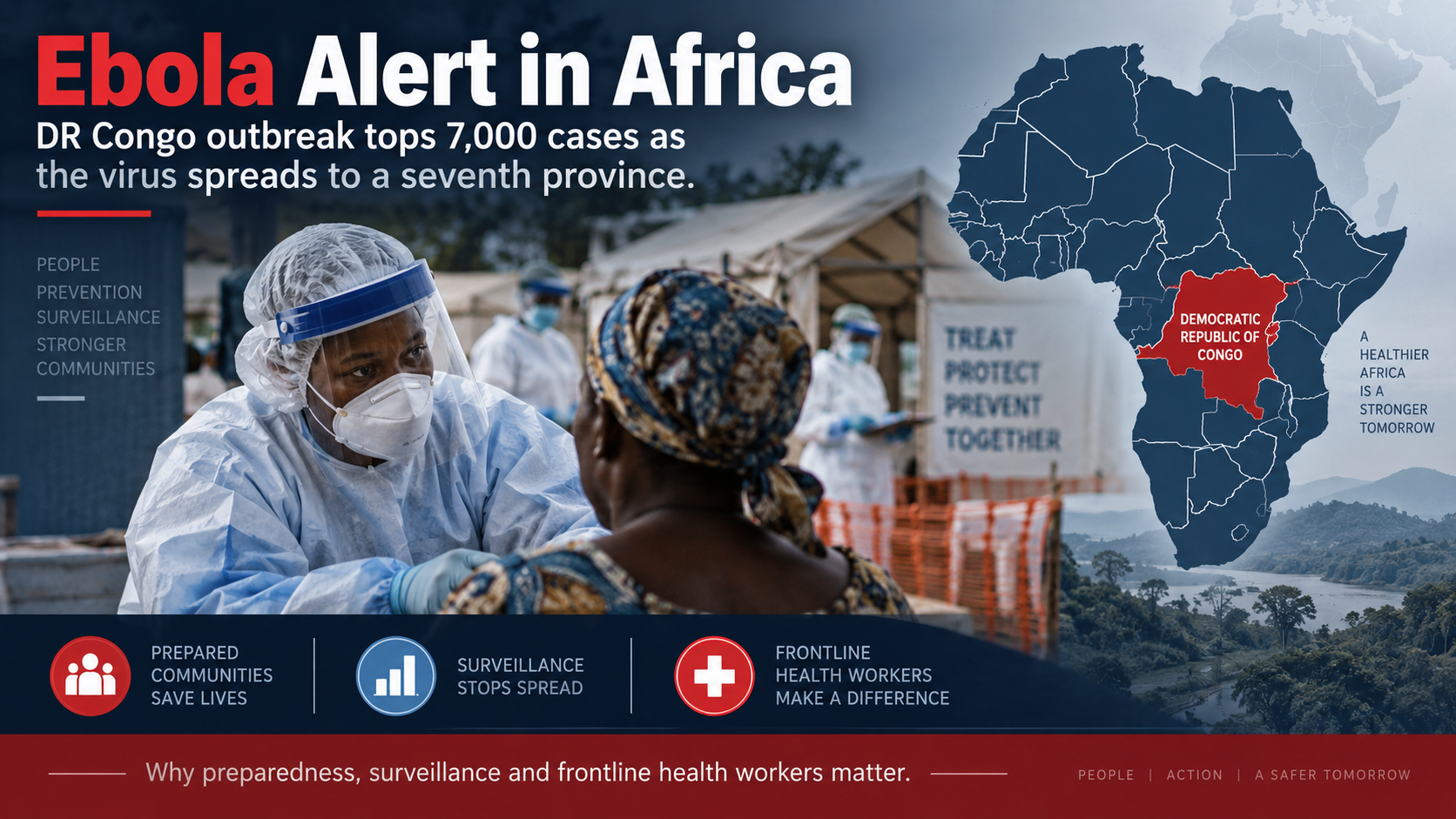
Ebola Alarm in Africa: Congo Outbreak Tops 7,000 Cases as Virus Spreads to Seventh Province.
Africa is facing a serious public-health challenge as a rapidly expanding Ebola outbreak in the Democratic Republic of Congo continues to spread beyond its original epicentre.
Official government data reported by Reuters showed that confirmed infections had exceeded 7,000 cases by September 11, 2026, while the virus had spread into a seventh province.
The development is raising concern among health authorities because Ebola is one of the world’s most dangerous infectious diseases, and the current outbreak is unfolding in areas already affected by conflict, displacement, shortages of healthcare workers and weak health infrastructure.
The Outbreak Is Spreading
The outbreak has expanded from eastern Congo into additional regions, including South Ubangi in the northwest, according to recent reports.
A case identified there involved a young man who had travelled through several provinces before becoming ill, highlighting one of the biggest challenges in controlling infectious diseases: human movement can carry an outbreak far beyond its original location before authorities realise what is happening.
Africa’s leading public-health authorities have warned that the outbreak is spreading quickly beyond the original epicentre.
The situation has been complicated by insecurity, displacement, health-worker strikes and large movements of people between affected communities.
More Than 3,000 Deaths Reported
Recent reports indicate that the outbreak has caused thousands of deaths.
The Associated Press reported more than 3,300 deaths as the number of cases continued to rise, making the outbreak one of the most serious Ebola emergencies in recent African history.
The scale of the crisis is particularly worrying because health systems in affected areas are struggling to keep pace.
The World Health Organization has warned about shortages of trained healthcare workers, treatment capacity and funding.
According to Reuters, approximately 5,000 additional healthcare workers may be needed to strengthen the response, while treatment centres require major financial support to operate effectively.
Why Ebola Is So Dangerous
Ebola virus disease is a severe illness transmitted through direct contact with the blood or bodily fluids of an infected person or contaminated materials.
Early symptoms may resemble other common illnesses and can include:
- fever;
- severe weakness;
- muscle pain;
- headache;
- sore throat;
- vomiting;
- diarrhoea; and
- abdominal pain.
Some patients later develop serious bleeding and organ complications.
The disease can spread rapidly in families and healthcare settings when infection-control procedures are inadequate.
This is why early detection, isolation, protective equipment and contact tracing are essential.
Healthcare Workers Are on the Front Line
One of the most worrying aspects of any Ebola outbreak is the danger faced by healthcare professionals.
Doctors, nurses, laboratory workers, ambulance teams and burial workers may come into direct contact with infected patients.
When healthcare systems are understaffed or lack adequate protective equipment, the risk becomes even greater.
The current Congo outbreak illustrates an important lesson for African governments:
Public-health preparedness cannot begin only after an outbreak becomes an emergency.
Countries need trained epidemiologists, laboratory capacity, protective equipment, isolation facilities, emergency transport and strong disease-surveillance systems before an epidemic occurs.
Vaccination Has Begun
Vaccination is also part of the response.
Authorities have begun vaccinating frontline health workers in affected areas, while clinical trials are underway for vaccines targeting the specific Bundibugyo strain involved in the outbreak.
However, vaccine supply remains limited compared with the scale of the outbreak.
Health authorities therefore continue to rely heavily on traditional outbreak-control measures, including identifying cases quickly, tracing contacts, isolating infected people and educating communities.
Should Nigerians Be Worried?
At present, the outbreak being reported is in the Democratic Republic of Congo, not Nigeria.
There is no reason for Nigerians to panic simply because Ebola is circulating elsewhere in Africa.
However, the outbreak deserves attention.
Modern travel means infectious diseases can cross borders quickly, particularly when infected people travel before symptoms are recognised.
Nigeria has previous experience managing Ebola effectively. During the 2014 West African epidemic, the country successfully contained imported cases through rapid identification, contact tracing, isolation and coordinated public-health action.
That experience demonstrated that preparedness can make an enormous difference.
The lesson today is not panic.
The lesson is vigilance.
What African Countries Should Be Doing
African governments should treat the Congo outbreak as another reminder that health security is a regional responsibility.
Surveillance at airports, land borders and healthcare facilities should remain strong.
Health professionals should also receive updated information about symptoms and travel histories so that unusual cases can be identified early.
Governments need to maintain:
- emergency-response teams;
- laboratory capacity;
- infection-control supplies;
- trained healthcare workers;
- public information systems;
- contact-tracing capacity; and
- regional cooperation.
Public-health authorities must also combat misinformation.
Fear and rumours can cause people to hide symptoms, avoid hospitals or reject healthcare workers, making outbreaks even harder to contain.
A Bigger Lesson About Africa’s Health Systems
This Ebola outbreak is not only a story about one virus.
It exposes a larger problem.
When outbreaks occur in regions where hospitals are understaffed, healthcare workers are on strike, communities are displaced and funding is inadequate, infectious diseases have an opportunity to spread.
Africa cannot continue waiting for emergencies before investing in healthcare.
Strong health systems save lives during normal times — and become even more important during crises.
Investment in healthcare workers, laboratories, primary healthcare, disease surveillance and emergency preparedness should therefore be seen as a national-security priority, not merely another government expense.
No Need for Panic — But No Room for Complacency
The current Ebola situation in Congo deserves serious attention.
More than 7,000 infections and thousands of deaths represent real human suffering.
But fear alone will not stop Ebola.
Preparedness will.
Early detection will.
Vaccination will.
Contact tracing will.
Trusted public information will.
And adequately equipped healthcare workers will.
For Nigerians and other Africans watching the situation, the message should be simple:
Stay informed, trust credible health authorities and avoid spreading unverified information.
Ebola is dangerous, but outbreaks can be contained when governments, healthcare professionals and communities act quickly and work together.
References
Reuters — Ebola infections top 7,000 in Democratic Republic of Congo, government data show, September 11, 2026.
Associated Press — Ebola outbreak in Congo spreads to a seventh province, September 11, 2026.
Associated Press — Africa’s top health body warns Congo Ebola outbreak is rapidly spreading beyond epicentre, September 2026.
Reuters — WHO says staff shortage, funding challenges hamper Congo Ebola response, September 8, 2026.
https://www.babacares.com/blog-details?details=1026&title=Ebola+Alarm+in+Africa%3A+Congo+Outbreak+Tops+7%2C000+Cases+as+Virus+Spreads+to+Seventh+Province.







Comments