

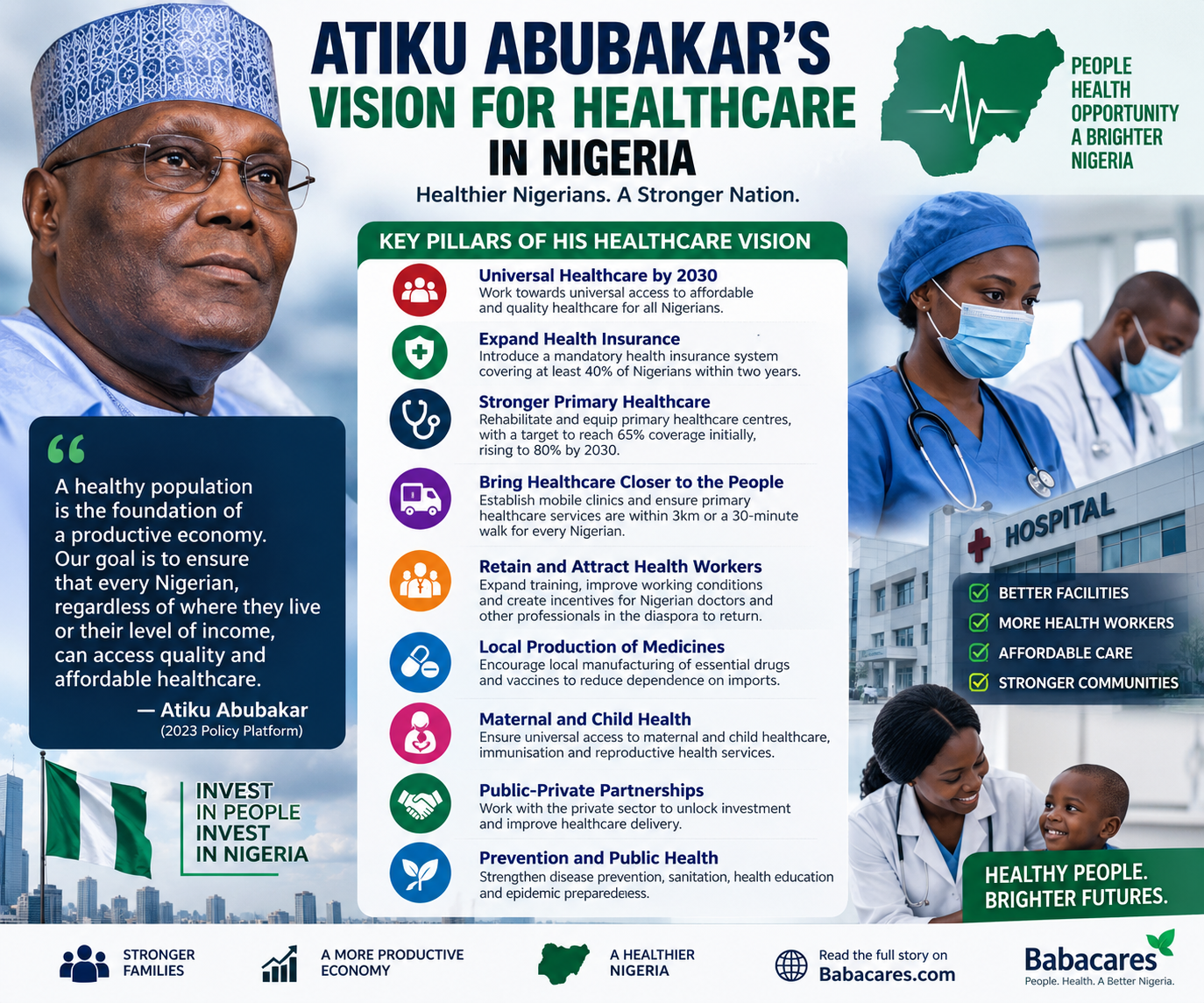
Atiku Abubakar’s Vision for Nigeria’s Healthcare: Universal Coverage, Better Hospitals and Reversing Brain Drain
Nigeria’s healthcare system continues to face serious challenges: inadequate primary healthcare, poorly equipped facilities, low insurance coverage, high out-of-pocket spending, shortages of health workers and the continuing migration of doctors, nurses and other professionals abroad.
Against this background, former Vice President Atiku Abubakar has consistently argued that Nigeria needs a healthcare system built around universal access, stronger primary healthcare, better health insurance, greater private-sector participation, local pharmaceutical production and improved conditions for healthcare professionals.
Although many of the detailed proposals currently available come from his 2023 presidential policy platform, they remain relevant to the national conversation about how Nigeria can build a stronger and more accessible healthcare system.
Healthcare as a Foundation for National Development
Atiku’s healthcare philosophy begins with the belief that improving the health of Nigerians is directly connected to national productivity, job creation, poverty reduction and economic development.
His policy proposals identified several broad objectives, including increasing life expectancy, ensuring access to basic and reproductive healthcare, improving maternal and child health and strengthening immunisation.
This approach reflects an important principle: healthcare should not simply be seen as expenditure.
A healthier population is more productive.
Children who receive timely healthcare are more likely to stay in school and develop properly. Adults who can obtain treatment early are less likely to lose income because of prolonged illness. Families protected by health insurance are less likely to be pushed into poverty by medical bills.
For Atiku, healthcare therefore forms part of Nigeria’s wider human-capital and economic-development strategy.
Universal Healthcare by 2030
One of the central elements of Atiku’s healthcare vision is the goal of moving Nigeria toward universal access to affordable and quality healthcare by 2030.
His policy platform proposed comprehensive reform of the Federal Ministry of Health and its agencies, with greater emphasis on policy formulation, standardisation, monitoring and evaluation. It also proposed greater engagement with the private sector as part of expanding healthcare delivery.
During the 2023 campaign, Atiku’s programme also proposed a mandatory health-insurance system covering at least 40 percent of Nigerians within two years.
This is particularly important because Nigeria continues to struggle with low insurance coverage and heavy reliance on direct household payments.
The National Health Insurance Authority Act of 2022 made health insurance mandatory for citizens and legal residents, with the broader national objective of achieving universal health coverage. Yet significant gaps in insurance, infrastructure and financing remain.
The challenge for any future government will not simply be announcing wider insurance coverage, but ensuring that enrolled Nigerians can actually obtain good-quality care when they need it.
Strengthening Primary Healthcare
Atiku has placed strong emphasis on primary healthcare, which should be the first point of contact between Nigerians and the health system.
His proposals included working with state and local governments to expand access to basic primary healthcare services.
One analysis of the 2023 manifestos noted that Atiku’s programme targeted access to a defined basic primary healthcare package for at least 65 percent of Nigerians initially, rising toward 80 percent coverage by 2030.
His wider policy proposals also included rehabilitation or construction of standard healthcare centres at ward level and better-equipped general hospitals at local-government level.
This focus is crucial because a functioning health system cannot depend entirely on teaching hospitals and major urban medical centres.
Primary healthcare should provide:
- antenatal and postnatal care;
- immunisation;
- family planning;
- treatment for common illnesses;
- hypertension and diabetes screening;
- maternal and child health services;
- prevention and treatment of infectious diseases; and
- early referral of serious cases.
When primary healthcare fails, patients either overcrowd secondary and tertiary facilities or delay treatment until their conditions become much more serious.
Bringing Healthcare Closer to the People
Atiku’s 2023 programme also proposed working with state and local governments to establish mobile clinics, with the aim of ensuring that people could reach primary healthcare services within approximately three kilometres or a 30-minute walk.
For rural and underserved communities, geographical access can be just as important as affordability.
A health centre may technically exist, but if a pregnant woman must travel for hours before reaching it—or if there is no reliable transport in an emergency—that facility cannot truly be described as accessible.
Mobile clinics and community-based healthcare can therefore help bridge the gap, although they must complement permanent, properly staffed facilities rather than replace them.
Reversing Nigeria’s Medical Brain Drain
One of Atiku’s most significant healthcare concerns has been the continuing exodus of Nigerian health professionals.
His policy platform proposed expanding the number and skills of frontline healthcare workers while creating incentives to attract Nigerian doctors in the diaspora back home.
This problem has become even more serious in recent years.
Nigerian doctors, nurses, pharmacists, laboratory scientists and other professionals continue to migrate to countries where they can obtain better pay, equipment, security, professional development and working conditions.
The medical profession itself has warned ahead of Nigeria’s 2027 elections that political leaders must address healthcare-worker welfare, brain drain, health financing and primary-care infrastructure if meaningful reform is to occur.
The question is not simply how many healthcare professionals Nigeria trains.
The deeper question is: How many can Nigeria retain?
Training more doctors and nurses while thousands leave each year will not solve the workforce shortage.
Retention requires competitive salaries, decent accommodation, safe working environments, modern diagnostic equipment, opportunities for postgraduate training, manageable workloads and respect for professionals.
Turning Brain Drain Into Brain Gain
Atiku’s proposal to attract doctors in the diaspora is also significant because Nigeria has a large pool of highly experienced healthcare professionals working internationally.
Many Nigerian doctors abroad have indicated that they would consider returning or contributing more substantially to Nigerian healthcare if the right conditions existed.
Diaspora medical professionals can contribute through specialist missions, telemedicine, training, investment, research collaborations and, where conditions permit, permanent return.
But patriotism alone will not bring them home.
Nigeria must create a healthcare environment in which professionals believe they can work effectively and build sustainable careers.
Expanding Local Production of Medicines and Vaccines
Another pillar of Atiku’s healthcare vision is reducing Nigeria’s dependence on imported medicines and medical supplies.
His programme proposed encouraging medium- and large-scale pharmaceutical companies to increase the local production of essential medicines, while also promoting vaccine production and improving reliable drug supply to healthcare facilities.
This has both healthcare and economic implications.
Greater domestic pharmaceutical production could:
- reduce dependence on imports;
- improve medicine availability;
- create skilled jobs;
- strengthen national health security;
- reduce exposure to foreign-exchange shortages; and
- potentially lower costs for patients.
Nigeria’s experience during global health emergencies has shown the importance of domestic capacity to produce essential medicines, vaccines and medical supplies.
Maternal and Child Health
Atiku’s proposals also give attention to women and children.
His policy platform called for universal access to maternal and child healthcare, reproductive health, immunisation and related essential services.
Earlier policy proposals also included free medical services for pregnant women and children under five as a minimum objective for state and local governments.
This remains highly relevant because Nigeria continues to face major challenges in maternal and child health.
No healthcare reform can be considered successful if pregnant women continue to die from preventable causes or if children cannot receive basic vaccines and early treatment.
The Role of the Private Sector
Atiku has repeatedly advocated stronger private-sector participation in healthcare.
In a 2022 interview, he argued that Nigeria needs greater private-sector involvement in both health and education, noting the substantial role private providers already play in cities such as Lagos.
His formal healthcare programme similarly proposed unlocking the market potential of the health sector by engaging private investors.
Private investment can bring capital, innovation, specialised services and modern management practices.
But strong regulation remains essential.
Healthcare cannot become a system where only Nigerians with high incomes can obtain quality treatment.
Public-private partnerships should therefore strengthen universal access rather than widen inequality.
Prevention, Not Just Treatment
Another important part of Atiku’s policy approach is preventive healthcare.
His policy document proposed improving environmental sanitation, promoting healthy living, expanding public-health education and strengthening preparedness for epidemics such as Ebola, Lassa fever and COVID-19.
Prevention is often less expensive than treating advanced disease.
Clean water, vaccination, sanitation, nutrition, early screening and public-health education can prevent enormous numbers of illnesses before hospital treatment becomes necessary.
A strong healthcare system therefore needs both hospitals capable of treating serious disease and community systems capable of preventing disease in the first place.
Where Atiku’s Vision Still Needs Greater Detail
Atiku’s healthcare proposals contain several important goals, but independent assessments have also identified weaknesses.
A policy assessment of the 2023 presidential candidates noted that Atiku’s programme contained commitments to affordability, access and improved healthcare facilities but lacked sufficient budgetary and statistical benchmarks in some areas to allow voters to measure progress easily.
This is important.
Healthcare promises become much more meaningful when accompanied by clear answers to questions such as:
How much money will be allocated?
Where will the funding come from?
How many healthcare workers will be recruited?
How many facilities will be rehabilitated?
What percentage of Nigerians will actually receive insurance?
How quickly will these targets be achieved?
Future healthcare plans should therefore combine ambition with measurable timelines and public accountability.
Nigeria Needs More Than Political Promises
Nigeria’s healthcare problems are too serious to become merely campaign slogans.
Doctors and other health professionals have already challenged political candidates preparing for 2027 to publish clear, time-bound healthcare commitments that citizens can monitor.
Whether the proposal comes from Atiku Abubakar, Peter Obi, the current government or another political leader, Nigerians should demand the same things:
clear targets, transparent financing, accountability and measurable results.
Atiku’s vision contains important themes—universal healthcare, stronger primary care, wider insurance, local drug manufacturing, public-private partnerships and reversing brain drain.
These are all areas Nigeria urgently needs to address.
The real test, however, would be implementation.
The Bigger Leadership Question
Nigeria does not lack medical talent.
Nigerian doctors and nurses are making important contributions to health systems around the world.
Nigeria also does not lack policy documents.
What the country has often lacked is consistent implementation, adequate financing and accountability.
Atiku Abubakar’s healthcare vision recognizes many of these challenges and presents universal access and human-capital development as important national priorities.
But whoever seeks to lead Nigeria must go beyond identifying the problems.
Leadership must ensure that the pregnant woman in a rural community can reach a skilled professional.
That the child with a fever can receive treatment.
That a family is not pushed into poverty by one hospital admission.
That a Nigerian doctor does not believe leaving the country is the only way to practise medicine with dignity.
And that healthcare facilities are places where Nigerians can confidently expect competent, affordable and humane care.
That should be the standard by which every healthcare vision is ultimately judged.
References
- Atiku Abubakar – Roadmap to 2023, CivicHive — healthcare reforms, universal access, pharmaceutical production and reversing brain drain.
- Manifesto.NG – Atiku Abubakar Health Policy — maternal and child health, primary healthcare, general hospitals, drug production and health-sector reform.
- BBC comparison of Nigeria’s 2023 presidential policy platforms — Atiku proposals on mandatory health insurance, mobile clinics, healthcare workers and local pharmaceutical production.
- Atiku Abubakar Policy Document — universal healthcare by 2030, preventive care, maternal and child health, private-sector participation and diaspora doctors.
- Punch – Party Manifestoes and the Right to Health — Atiku’s primary healthcare coverage targets and universal health coverage proposals.
- Commonwealth Fund – Nigeria Health System Profile, 2026 — Nigeria’s continuing challenges with health financing, workforce shortages, insurance and primary healthcare.
- Punch Healthwise – Doctors’ Demands Ahead of the 2027 Elections, May 2026 — calls for improved funding, health-worker welfare, primary healthcare, insurance and measures against brain drain.
- Policy and Schematic Assessments of Candidates in the 2023 Presidential Election — independent assessment of Atiku’s healthcare proposals and need for measurable commitments.











Comments