

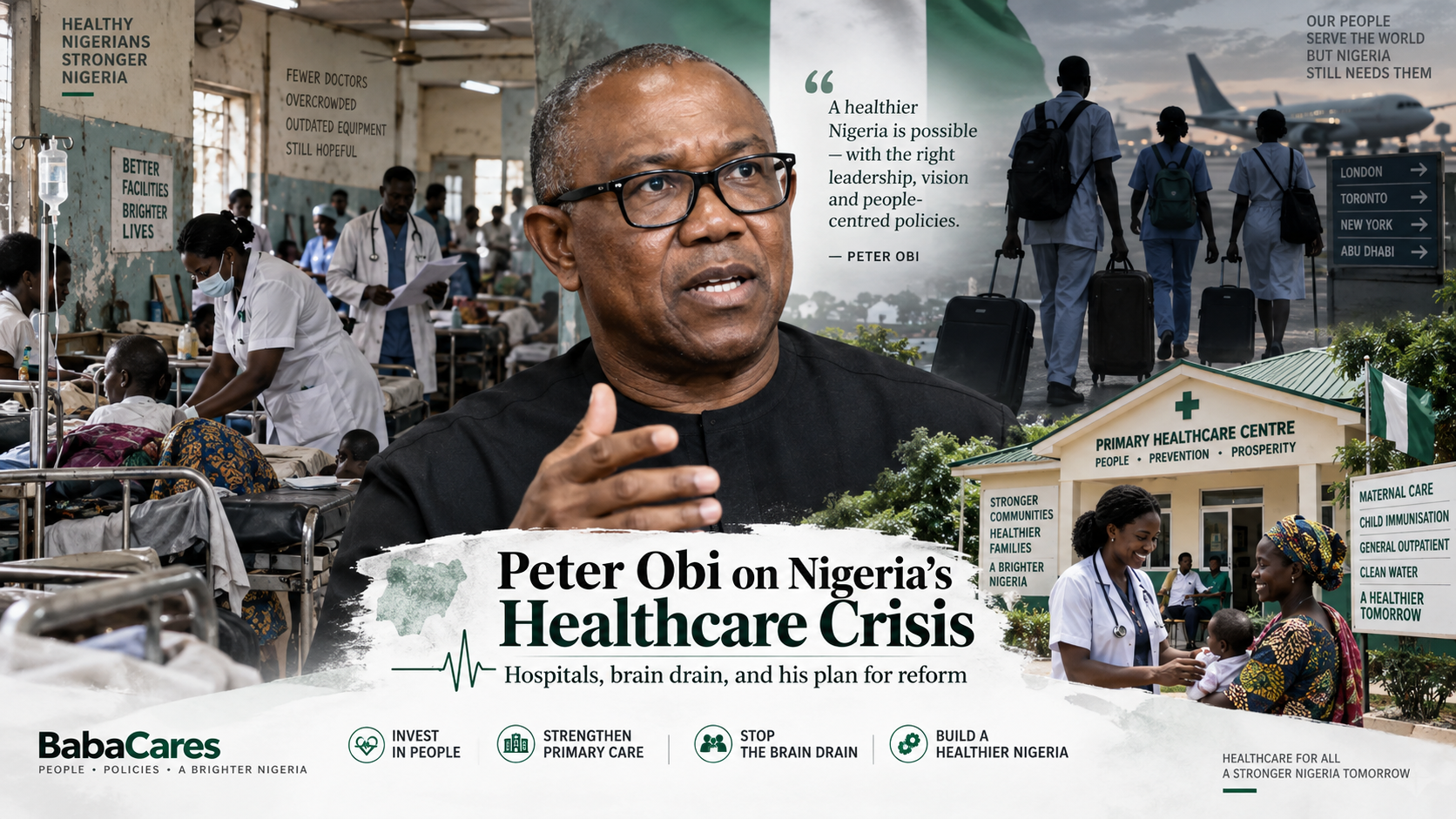
Peter Obi on Nigeria’s Healthcare Crisis: Decaying Hospitals, Brain Drain and His Plan for Reform.
Nigeria’s healthcare system has once again come under sharp scrutiny following comments by Peter Obi, who has described the state of healthcare in the country as deeply troubling and has outlined what he says he would do differently if given the opportunity to lead Nigeria.
For Obi, the crisis is not simply about inadequate hospitals. It is about a system weakened by poor investment, underperforming primary healthcare centres, inadequate health insurance, deteriorating infrastructure and the continued migration of Nigerian doctors, nurses and other health professionals to countries where they believe they will be better equipped, better paid and better respected.
His message is straightforward: a country cannot become productive if its people are unhealthy.
A Healthcare System in Serious Difficulty
In his 2026 political programme, Obi described Nigeria’s primary healthcare system as severely underperforming.
According to figures he cited, Nigeria has approximately 30,000 primary healthcare centres, but only about 10 to 20 percent are operational or functioning adequately.
This is consistent with independent assessments that Nigeria has roughly 30,000 primary healthcare facilities but that only about one-fifth are fully functional, largely because of inadequate funding, staff shortages and poorly maintained facilities.
Primary healthcare centres are supposed to be the first point of contact for millions of Nigerians.
They should provide services such as antenatal care, immunisation, family planning, treatment of common illnesses, maternal and child healthcare and early diagnosis.
When these facilities fail, patients are pushed toward already overcrowded secondary and tertiary hospitals—or simply go without care.
Obi has argued that this state of affairs contributes to Nigeria’s poor health indicators, including high maternal and infant mortality. In his August 2026 campaign address, he described Nigeria’s maternal and infant mortality indicators as among the most concerning globally and said healthcare must be treated as part of the country’s human-capital development.
Hospitals That Have Been Allowed to Deteriorate
The larger problem extends beyond the number of health facilities.
Many Nigerians have become familiar with hospitals struggling with inadequate equipment, overcrowded wards, unreliable power and water supplies, shortages of medicines, overworked staff and long waiting times.
Obi has repeatedly argued that Nigeria must stop treating healthcare as an afterthought.
In an April 2025 address to an event organised by ANAP Doctors in North America and the University of Nigeria alumni, he called for national priorities to be redirected toward health, education and poverty reduction, arguing that development should be measured by improvements in people's lives rather than simply the construction of physical projects.
His concern about deterioration in the health system is also part of a wider debate among Nigerian medical professionals.
Doctors themselves have repeatedly complained about deteriorating facilities, inadequate equipment, poor remuneration, insecurity and extremely difficult working conditions.
The result has been a vicious cycle: facilities deteriorate, professionals become frustrated, more professionals leave, and the remaining staff face even heavier workloads.
Nigeria Trains Them—Other Countries Benefit
Perhaps one of the most painful dimensions of Nigeria’s healthcare crisis is the migration of highly trained medical professionals.
Nigeria spends years and substantial resources training doctors, nurses, midwives, pharmacists, laboratory scientists and other health professionals, only for many of them to leave for the United Kingdom, Canada, the United States, Australia, the Middle East and other destinations.
Obi has spoken bluntly about the reasons.
His healthcare policy platform recalls his earlier observation:
“Our doctors leave because we don't pay them, don't equip them, and don't respect them.”
His proposed approach therefore includes better remuneration, improved working conditions and investment in healthcare infrastructure as measures to retain health professionals.
The scale of the migration is substantial.
Official figures reported in 2026 indicated that 20,966 Nigerian healthcare workers relocated abroad within one year, including 3,919 doctors, 7,487 nurses and midwives, thousands of laboratory professionals, pharmacists and physiotherapists.
The Federal Government has itself acknowledged that Nigeria is experiencing serious health-workforce shortages as doctors, nurses and midwives migrate, with the United Kingdom, United States and Canada among their major destinations.
The consequences are felt most severely by ordinary Nigerians.
When experienced physicians, specialist nurses, surgeons, anaesthetists, midwives and other professionals leave, the problem cannot be solved simply by replacing one worker with another.
Years of clinical knowledge and experience leave with them.
Why Are Nigerian Health Professionals Leaving?
The migration is sometimes described simply as the search for higher salaries.
But research suggests the problem is broader.
A study of Nigerian physicians found that poor remuneration was a major reason for contemplating emigration, alongside insecurity, excessive workloads and inadequate diagnostic equipment and facilities.
In practical terms, a doctor may ask: Why remain in a system where basic equipment is unavailable, workloads are overwhelming, security is uncertain and professional development is limited when another country is offering better conditions?
This is why stopping the “Japa” of healthcare workers cannot be achieved through appeals to patriotism alone.
A government must create conditions that make staying professionally and economically reasonable.
Peter Obi’s Proposed Healthcare Plan
Obi has now attached specific numbers to his proposed healthcare reforms.
He says that within four years he intends to:
- more than double health-insurance coverage from around 10 percent to above 20 percent;
- increase healthcare expenditure substantially;
- train significantly more doctors, nurses and other healthcare professionals;
- adequately staff medical facilities;
- establish a fully functional and properly managed primary healthcare centre in every one of Nigeria’s 8,809 wards; and
- ensure that at least 50 percent of the estimated 30,000 primary healthcare centres are fully functional and properly staffed by the end of his term.
These pledges were contained in his May 2026 presidential acceptance speech and subsequent healthcare policy statements.
That would represent a significant expansion of functional primary healthcare if implemented.
The emphasis on primary healthcare is particularly important because Nigeria cannot solve its health problems simply by constructing more specialist hospitals in major cities.
Strong health systems begin close to where people live.
A pregnant woman in a village should be able to receive antenatal care without travelling several hours.
A child should be able to receive immunisation locally.
A person with hypertension or diabetes should be able to obtain regular monitoring before the condition becomes an emergency.
Health Insurance: Moving Beyond Paying from the Pocket
Another major issue Obi has highlighted is Nigeria’s low health-insurance coverage.
He has said coverage remains at approximately 10 percent, leaving millions of Nigerians exposed to direct payment for healthcare.
His stated target is to raise coverage above 20 percent within four years.
Even that would still leave a large majority uncovered, but it would represent progress if implemented effectively.
The wider objective should be to ensure that illness does not automatically become a financial catastrophe.
No family should have to choose between buying food and paying a hospital bill.
Retaining Doctors, Nurses and Other Professionals
Obi’s plan also focuses on expanding training and improving staffing.
This is important, but Nigeria will have to do more than simply graduate additional healthcare workers.
If thousands are trained only to immediately seek opportunities overseas, the shortage will continue.
Retention requires:
competitive remuneration, reliable equipment, decent working environments, opportunities for specialization, security, manageable workloads and respect for healthcare professionals.
It also requires accountability.
Hospitals must be funded, but Nigerians should also know where health budgets are going and whether money allocated to facilities actually produces measurable improvements.
Obi has previously advocated increasing health expenditure in line with Nigeria’s commitments under the Abuja Declaration, while insisting that healthcare budgets should be fully utilised and administrators held accountable for results.
Healthcare as Human Capital
One of Obi’s recurring arguments is that health expenditure should not simply be viewed as consumption.
It is an investment in human capital.
A sick population cannot create a productive economy.
Children who suffer preventable illness struggle academically.
Workers who cannot obtain treatment lose productive days.
Families pushed into poverty by hospital bills cannot build financial security.
And a country that loses its most highly trained professionals cannot easily compete globally.
In his July 2026 policy roadmap, Obi described education and healthcare as foundations upon which prosperous societies are built and argued that Nigeria must rebuild its human capital if it hopes to achieve sustainable economic transformation.
Promises Must Ultimately Be Measured by Results
Peter Obi’s diagnosis of Nigeria’s healthcare problems will resonate with many Nigerians who have experienced overcrowded hospitals, unavailable equipment, high medical bills or the departure of a trusted doctor or nurse.
His proposed targets are also measurable.
That is important.
If a leader promises that every one of 8,809 wards will have a functional primary healthcare centre, Nigerians should be able to count them.
If the target is to make at least half of 30,000 primary health facilities fully operational, progress should be publicly tracked.
If health-insurance coverage is to rise above 20 percent, the figures should be independently verifiable.
Healthcare reform cannot survive on slogans.
It requires money, competent management, healthcare professionals, infrastructure, medicines, equipment and accountability.
Nigeria Cannot Continue Exporting Its Best Medical Talent
There is something deeply troubling about a country training world-class doctors and nurses who then become the backbone of healthcare systems thousands of kilometres away while Nigerian patients struggle to access basic services at home.
The success of Nigerian healthcare professionals abroad proves that the fundamental problem is not a lack of talent.
Nigeria has talent.
The problem is whether the country can create an environment where that talent is properly equipped, adequately rewarded and given reasons to remain.
Peter Obi says that is what he intends to change.
The political debate will continue, and Nigerians will ultimately decide whose healthcare programme they believe is most credible.
But regardless of political affiliation, one fact should unite the country:
Nigeria's hospitals should be places where lives are saved—not places that its best professionals are forced to flee in order to fulfil their potential.
Healthcare should not be a privilege reserved for Nigerians who can afford treatment abroad.
It should be a fundamental part of building a productive, prosperous and humane nation.
References
- Peter Obi, 2026 Presidential Acceptance Speech / Healthcare Programme — pledges concerning approximately 30,000 primary healthcare centres, the 8,809 wards, health insurance and staffing.
- Peter Obi, 2027 Campaign Address, August 21, 2026 — healthcare as human capital and concerns about maternal, infant and primary healthcare outcomes.
- Peter Obi, Roadmap to a New Nigeria – Education and Healthcare, July 2026.
- Commonwealth Fund — Nigeria Health System Profile, including the estimated 30,000 primary health facilities and functionality challenges.
- Punch — 20,966 Nigerian healthcare workers relocated abroad within one year, based on the State of Health of the Nation Report 2025.
- Federal Ministry of Information and National Orientation — health-workforce migration from Nigeria to countries including the UK, United States and Canada.
- Peer-reviewed research on physician emigration from Nigeria — remuneration, insecurity, workload and inadequate facilities among major drivers.
https://www.babacares.com/blog-details?details=1022&title=Peter+Obi+on+Nigeria%E2%80%99s+Healthcare+Crisis%3A+Decaying+Hospitals%2C+Brain+Drain+and+His+Plan+for+Reform.










Comments