

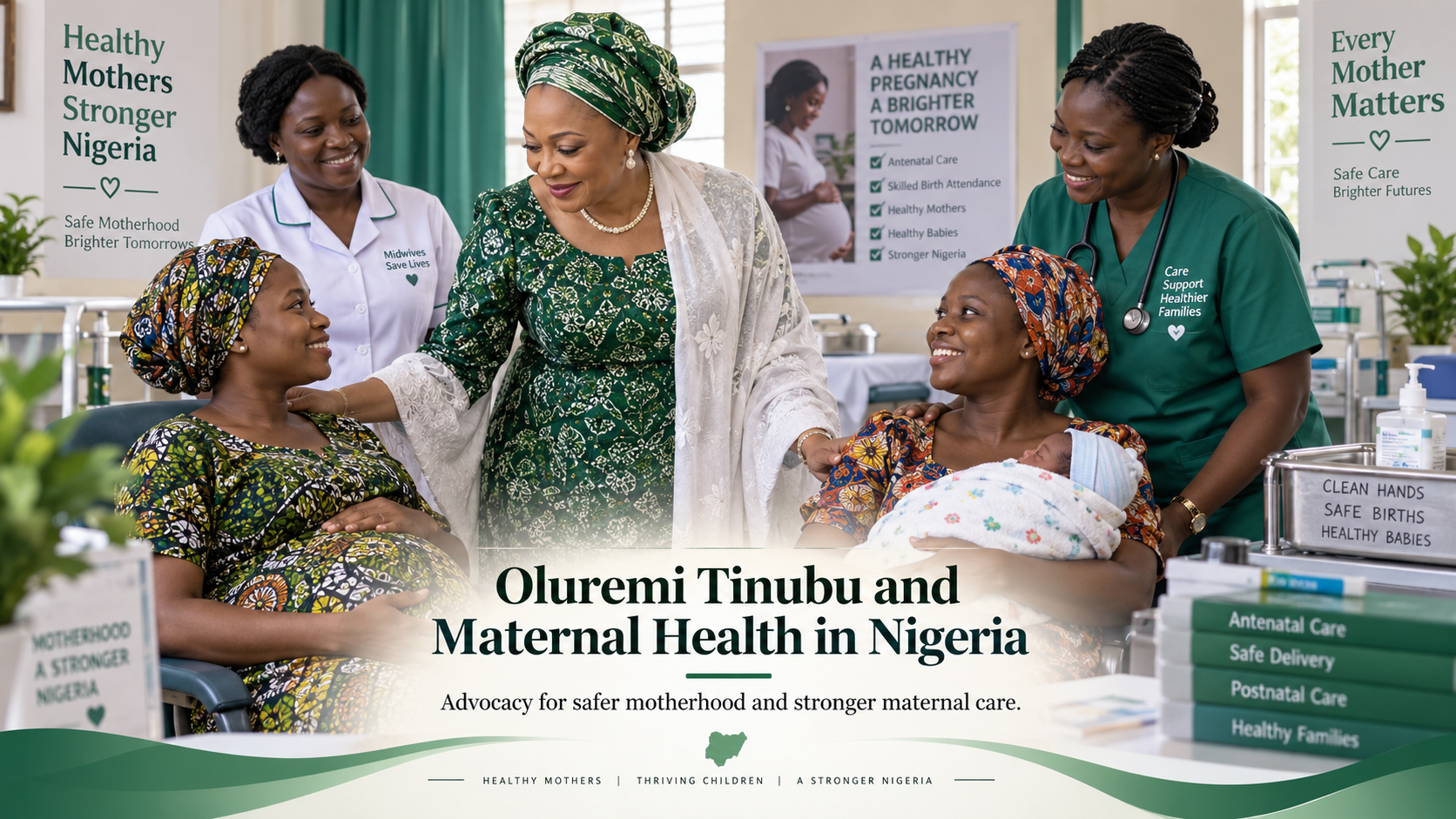
Senator Oluremi Tinubu and Maternal Health in Nigeria: How the First Lady Is Championing Safer Motherhood.
Maternal health remains one of Nigeria’s most urgent public-health challenges, and Nigeria’s First Lady, Senator Oluremi Tinubu, has increasingly used her national platform to draw attention to the health and survival of mothers and their babies.
Through the Renewed Hope Initiative (RHI), public-health campaigns, support for midwives and partnerships with government health institutions, Senator Tinubu has emerged as a prominent advocate for maternal and child health.
But how significant is her role, and what difference can these interventions make in a country where pregnancy and childbirth continue to carry an unacceptably high risk for many women?
Nigeria’s Maternal Health Challenge Remains Severe
The scale of the problem makes sustained action essential.
The latest internationally comparable estimates published by the World Health Organization, UNICEF, UNFPA, World Bank Group and UNDESA estimated Nigeria’s maternal mortality ratio at 993 deaths per 100,000 live births in 2023, with approximately 75,000 maternal deaths during that year. The estimated lifetime risk of maternal death for a Nigerian woman was about 1 in 25.
To put this into perspective, the Sustainable Development Goal target is fewer than 70 maternal deaths per 100,000 live births by 2030.
Nigeria therefore still has an enormous distance to travel.
Globally, most maternal deaths are preventable. The WHO stresses that access to skilled health professionals before, during and after childbirth can save the lives of mothers and newborns.
Against this background, the attention Senator Tinubu has directed toward maternal and child health deserves examination.
Supporting the Midwives Who Stand Beside Nigerian Mothers
One of the most visible components of Senator Tinubu’s maternal-health interventions has been support for midwives and frontline health workers.
Through the Renewed Hope Initiative, thousands of professional kits have been distributed to midwives in different geopolitical zones.
In March 2025, 10,000 professional kits were distributed to midwives in the South-South, as part of an initiative supporting the Federal Government’s programme to retrain 120,000 frontline healthcare workers. The government stated that the initiative was intended to support efforts to reduce maternal and under-five mortality.
Another 10,000 kits were presented to midwives in the South-East, with the Federal Ministry of Health describing the initiative as part of wider efforts to improve maternal and child healthcare.
This may appear to be a simple intervention, but the symbolism is important.
Midwives frequently serve as the closest professional link between pregnant women and the health system, particularly at the primary-healthcare level.
However, professional kits alone cannot solve Nigeria’s maternal-health crisis. Midwives also need appropriate training, safe working conditions, essential medicines, reliable electricity, adequate equipment, blood supplies, referral systems, transportation and sufficient staffing.
The real value of supporting midwives will therefore depend on whether such interventions are accompanied by sustained investment in the health facilities in which they work.
The ‘Free to Shine’ Campaign and Mother-to-Child Transmission
Another important aspect of Senator Tinubu’s health advocacy is the Free to Shine Campaign.
The initiative, associated with the Organisation of African First Ladies for Development, has been used in Nigeria to mobilise communities around the prevention and treatment of diseases affecting mothers and children.
The Federal Ministry of Health has specifically acknowledged Senator Tinubu’s supportive role in raising awareness and mobilising traditional leaders, communities and the media around maternal and child health, particularly efforts to prevent the transmission of HIV, syphilis and hepatitis from mothers to their babies.
The First Lady has also participated in regional launches of the programme.
During the South-East campaign, she emphasised preventing new infections, particularly mother-to-child transmission, while improving treatment and care for affected mothers and children.
This is a significant area of maternal health.
When pregnant women receive appropriate screening, medication, treatment and follow-up, the risk of transmitting certain infections to their babies can be substantially reduced.
The wider goal should therefore be to ensure that every pregnant Nigerian woman, regardless of income or location, can access early antenatal care and the necessary screening services.
Using the First Lady’s Platform for Health Advocacy
Senator Tinubu’s influence does not arise from running hospitals or administering Nigeria’s health system.
Rather, one of her most important assets is visibility.
The position of First Lady gives her an opportunity to draw political and public attention to issues that may otherwise struggle for sustained national attention.
The Federal Ministry of Health has described her as a strong advocate for areas including maternal health, immunisation, cervical-cancer prevention, tuberculosis elimination and nutrition.
In October 2025, she also formally launched a large integrated national vaccination campaign targeting more than 100 million Nigerian children.
During the launch, she drew attention to the connection between maternal and child health, including the serious consequences that rubella infection during pregnancy can have for an unborn child.
Such advocacy matters because maternal health does not begin in the labour room.
A woman’s nutrition, vaccination status, access to reproductive healthcare, prevention and treatment of infections, antenatal attendance and underlying health conditions can all influence pregnancy outcomes.
Maternal Health Must Go Beyond Pregnancy
Another valuable aspect of a broader maternal-health approach is recognising that a woman’s social and economic circumstances affect her health.
Poverty can influence whether a pregnant woman can afford transportation to a clinic, pay for medicines, obtain nutritious food or seek emergency care.
The Renewed Hope Initiative has therefore combined health advocacy with programmes targeting women’s economic empowerment, agriculture, education and social welfare.
This broader approach reflects an important public-health reality: a healthier mother often begins with a healthier and more economically secure woman.
But empowerment programmes should complement—not replace—accessible professional healthcare.
No woman experiencing obstructed labour, severe bleeding, eclampsia, sepsis or another obstetric emergency can be saved by economic empowerment alone. She needs rapid access to competent medical care.
Emergency Obstetric Care Is Critical
One encouraging development is the wider national focus on emergency obstetric services.
By October 2025, the Federal Ministry of Health reported that more than 15,000 women had benefited from the Free Emergency Obstetric Care Initiative, while hundreds of thousands had been enrolled through the Mothers and Babies Implementation Programme.
These are federal government programmes rather than programmes personally administered by Senator Tinubu, and that distinction is important.
However, the First Lady’s advocacy can complement these programmes by encouraging women to use available health services, supporting frontline workers and helping to make maternal health a visible national priority.
Her Role Should Be Understood Correctly
There is an important distinction to make when assessing Senator Oluremi Tinubu’s contribution.
Nigeria’s First Lady does not constitutionally administer the Federal Ministry of Health, employ doctors or midwives, manage hospitals, or determine national clinical policy.
Those responsibilities belong to statutory government institutions, including the Federal Ministry of Health and Social Welfare, state ministries of health, the National Primary Health Care Development Agency and other health authorities.
Her role is better described as one of advocacy, mobilisation, partnership, complementary intervention and public-health leadership through the Renewed Hope Initiative.
Recognising this distinction actually makes it easier to evaluate her contribution fairly.
What Nigeria Still Needs to Do
Despite increased attention to maternal health, distributing kits and launching campaigns cannot by themselves end maternal mortality.
Nigeria needs functioning healthcare systems capable of responding when pregnancy becomes dangerous.
That means expanding access to:
- skilled doctors, nurses and midwives;
- adequately equipped primary healthcare centres;
- reliable emergency obstetric and newborn care;
- affordable or free antenatal and delivery services for vulnerable women;
- blood banks and safe blood-transfusion services;
- emergency caesarean sections;
- ambulances and effective referral systems;
- family-planning and reproductive-health services;
- screening and treatment for hypertension, infections and anaemia during pregnancy;
- adequate nutrition;
- health insurance; and
- effective maternal-death surveillance to identify why women die and prevent similar deaths.
Nigeria must also address disparities between urban and rural communities.
A pregnant woman in a remote village should not have to travel several hours before reaching a facility capable of managing severe bleeding, obstructed labour or eclampsia.
From Advocacy to Measurable Results
Senator Oluremi Tinubu deserves recognition for using the platform of the First Lady to keep women’s and children’s health in the national conversation.
Her work through the Renewed Hope Initiative has brought attention to midwives, maternal healthcare, immunisation, disease prevention, nutrition and the prevention of mother-to-child transmission of infections.
Her advocacy also complements wider federal efforts to improve the healthcare workforce and strengthen primary healthcare.
For example, in April 2026, the Federal Government reported that enrolment capacity for nurses and midwives had expanded from about 28,000 in May 2023 to 110,000 in the 2024/2025 academic year.
That expansion is encouraging, but Nigeria’s maternal mortality statistics demonstrate that much more remains to be done.
Ultimately, maternal-health progress should not be measured primarily by the number of programmes launched, ceremonies held or materials distributed.
It should be measured by something much more meaningful:
How many Nigerian women entered pregnancy and returned home safely with their babies?
Every preventable maternal death leaves behind more than a statistic. It can leave children without mothers, spouses without partners and families permanently changed.
Senator Oluremi Tinubu’s advocacy can help keep maternal health high on Nigeria’s national agenda. But achieving lasting change will require sustained investment, accountability, competent healthcare delivery and collaboration among federal and state governments, healthcare professionals, communities, development partners and civil society.
The goal should be simple but uncompromising:
Pregnancy should never become a death sentence for a Nigerian woman.
References
- World Health Organization, UNICEF, UNFPA, World Bank Group and UNDESA — Trends in Maternal Mortality 2000–2023, published April 2025.
- World Health Organization — Maternal Mortality Fact Sheet, April 2025.
- Federal Ministry of Information and National Orientation, Nigeria — report on the distribution of 10,000 professional kits to South-South midwives, March 2025.
- Federal Ministry of Health and Social Welfare, Nigeria — report on the distribution of professional kits to South-East midwives and support for frontline health workers.
- Federal Ministry of Health and Social Welfare, Nigeria — Expanded Prevention of Mother-to-Child Transmission Technical Working Group and recognition of the First Lady’s Free to Shine advocacy.
- Federal Ministry of Health and Social Welfare, Nigeria — Free to Shine campaign in the South-East.
- Federal Ministry of Health and Social Welfare, Nigeria — Integrated national health and vaccination campaign and maternal-health programmes, October 2025.
- Federal Ministry of Health and Social Welfare, Nigeria — expansion of nursing and midwifery education, April 2026.










Comments