

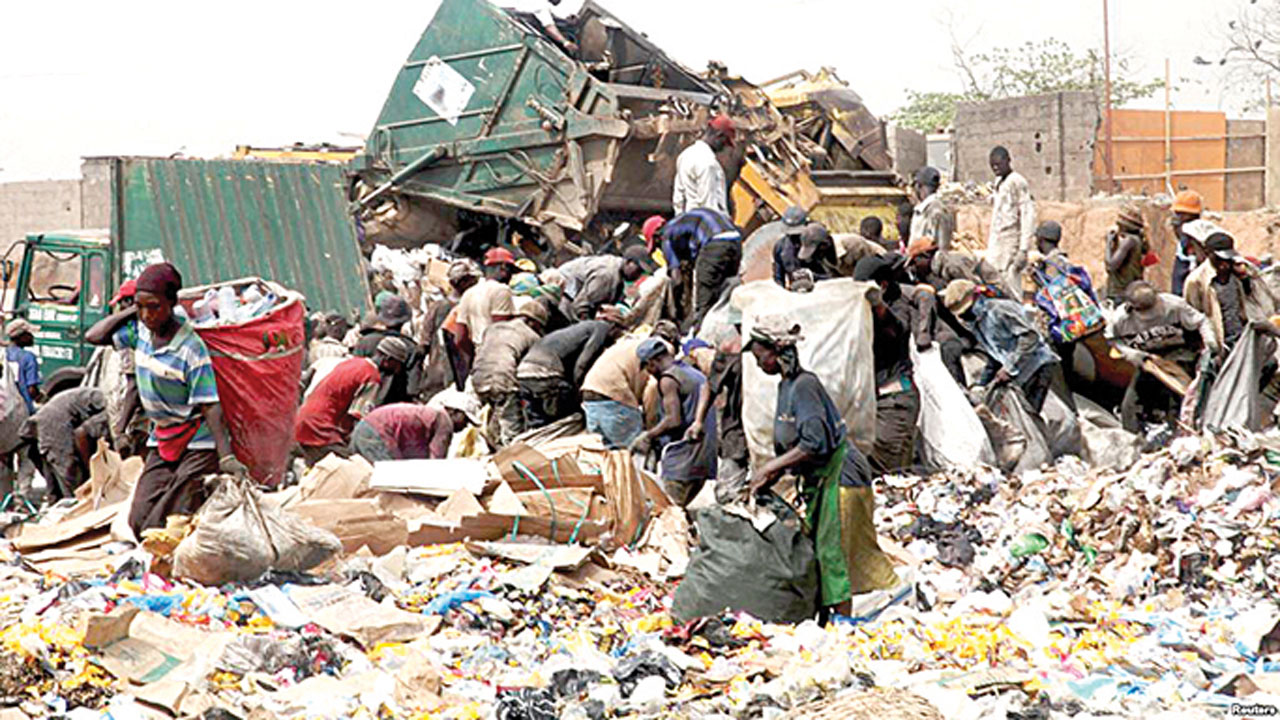
Olusosun Dumpsite: 5 Serious Health Risks Lagos Residents Face as Sanwo-Olu Declares Waste Emergency.
Picture: Courtesy The Guardian .
The condition of the Olusosun dumpsite in Ojota, Lagos State, is not merely an environmental or sanitation problem. It is also a significant public health concern for waste workers, scavengers, motorists, traders and residents living around one of Lagos State's busiest waste disposal facilities.
The issue again came into focus on September 9, 2026, when Lagos State Governor Babajide Sanwo-Olu, accompanied by Deputy Governor Dr. Obafemi Hamzat and other senior officials, inspected the Olusosun dumpsite amid growing concern over delays in refuse collection and mounting waste across parts of Lagos.
During the visit, Sanwo-Olu described the situation as serious enough to warrant what he called a “small state of emergency” on waste management, while announcing measures intended to improve refuse collection, disposal and waste-processing capacity across the state.
Why Olusosun Matters to Public Health
Olusosun is located in a heavily populated and highly travelled part of Lagos. What was once on the outskirts of the metropolis has effectively been surrounded by urban development.
Scientific studies conducted around the site over the years have raised concerns about air pollution, groundwater contamination and exposure to biological contaminants.
The health implications mean that tackling the problems at Olusosun should go beyond making Lagos look cleaner. Waste management should increasingly be viewed as an important component of disease prevention and environmental health protection.
1. Air Pollution and Respiratory Disease
One of the biggest concerns around large open dumpsites is poor air quality.
Decomposing waste can release gases and airborne particles, while movement of trucks, waste sorting and occasional burning can further increase people's exposure to pollutants.
A 2024 study that examined air pollution around Olusosun and Solous dumpsites reported an average PM2.5 concentration of approximately 94.29 micrograms per cubic metre over a 24-hour period at Olusosun.
That level was substantially above the World Health Organization's 24-hour air-quality guideline of 15 micrograms per cubic metre cited by the researchers. The study also reported elevated nitrogen dioxide and sulphur dioxide concentrations around the site.
PM2.5 is particularly concerning because the particles are small enough to penetrate deep into the lungs. Long-term or repeated exposure to fine particulate pollution is associated with increased risks of respiratory and cardiovascular disease.
This means that people who spend significant amounts of time close to an inadequately managed dumpsite may potentially face greater health risks than those who are only briefly exposed.
2. Workers and Scavengers Face Particular Risks
The people most directly exposed are those who actually work on or around the dumpsite.
A study published in the journal Waste Management examined exposure to bioaerosols at the Olusosun open dumpsite.
Bioaerosols can contain bacteria, fungi and other biological material suspended in the air.
Researchers found that Olusosun was a significant source of bioaerosols and that exposure during activities such as scavenging was substantially higher than ambient background levels. The researchers also found that a large proportion of some fungal particles, including Aspergillus fumigatus, were small enough to enter deep into the respiratory system.
Chronic cough and phlegm were among the respiratory symptoms reported among people working at the site.
This highlights the need for proper occupational-health protection, including appropriate personal protective equipment, hygiene facilities, medical surveillance and safer waste-handling systems.
3. Groundwater Contamination
Another less visible danger associated with dumpsites is leachate.
Leachate is contaminated liquid formed when rainwater and moisture pass through accumulated waste, picking up chemicals and other pollutants before potentially entering surrounding soil and groundwater.
A study published in the Journal of Environmental Management examined wells and boreholes around Olusosun and found that 35 percent of the sampled groundwater was considered unsuitable for consumption based on the researchers' water-quality assessment.
The study concluded that landfill leachate was contributing to groundwater pollution and called for appropriate remediation measures.
A later 2023 study also identified groundwater-quality concerns around the Olusosun area, with heavy metals among the important constraints affecting the suitability of groundwater for drinking purposes.
For communities around major dumpsites, this is particularly important because contaminated groundwater may not look or smell obviously polluted.
4. Flies, Rodents and Disease-Carrying Pests
Large accumulations of exposed organic waste provide breeding and feeding grounds for flies, cockroaches, rats and other pests.
Where refuse remains uncollected for long periods, the risk becomes broader than the dumpsite itself because accumulated waste can appear along roads, markets, neighbourhoods and drainage channels.
Poorly managed waste can therefore contribute indirectly to conditions favourable for gastrointestinal infections and other communicable diseases.
It can also worsen flooding when plastic and other solid waste obstruct drainage systems.
5. Smoke and Open Burning
Another serious concern associated with poorly controlled waste sites is burning.
Waste fires can release a complex mixture of smoke, particulate matter and toxic substances depending on what materials are burning.
Burning plastics and mixed municipal waste is particularly problematic because smoke may contain substances harmful to the lungs and cardiovascular system.
The safest approach is therefore not simply to burn accumulated refuse but to move progressively toward controlled disposal, recycling, material recovery, composting and properly engineered waste-to-energy systems where appropriate.
Sanwo-Olu's September 9 Visit
Governor Sanwo-Olu's visit came amid complaints about slow waste collection and visible refuse accumulation in several parts of Lagos.
During his inspection of Olusosun, the governor acknowledged the pressure on the waste-management system and said the government would take immediate as well as longer-term action.
Among the measures announced were plans to increase disposal capacity, deploy additional equipment, reopen or expand waste-receiving locations and strengthen the operations of the Lagos Waste Management Authority.
Reports also indicate that the state has ordered 160 new waste compactor trucks to strengthen refuse evacuation across Lagos.
Sanwo-Olu said the government was also developing transfer-loading infrastructure at Olusosun and Solous 3, which would allow waste to be compacted before being transported to material-recovery facilities where useful materials could be separated and processed.
New Transfer Loading Station
The latest intervention did not begin with the governor's September visit.
Earlier in 2026, the Lagos State Government announced plans for a large Transfer Loading Station at Olusosun, intended to handle roughly 2,500 metric tonnes of waste per day and transfer waste for further processing.
The project forms part of the state's broader attempt to shift from simply dumping refuse toward a more integrated waste-management and waste-to-resource model.
In July, LAWMA also commissioned rehabilitated internal access roads and additional disposal platforms at Olusosun after heavy rainfall affected truck movement and contributed to delays in waste evacuation.
Officials said improved access would allow more trucks to discharge simultaneously and reduce turnaround times.
Government Action Must Go Beyond Clearing Waste
The governor's intervention is welcome, but the health implications of Olusosun require a sustainable approach.
Lagos needs more than an emergency cleanup.
The long-term strategy should include:
- continuous air-quality monitoring around major dumpsites;
- periodic testing of boreholes and groundwater in surrounding communities;
- strict prevention of uncontrolled waste burning;
- improved protective equipment and health surveillance for waste workers and scavengers;
- accelerated recycling, composting and material-recovery programmes;
- proper engineering and containment of landfill leachate;
- greater separation of hazardous, medical, electronic and domestic waste;
- reliable household waste collection before refuse accumulates on streets;
- stronger enforcement against indiscriminate dumping;
- public education on responsible waste disposal.
Waste Management Is Healthcare
It is easy to look at a mountain of refuse and think primarily about its smell or appearance.
But poor waste management is ultimately a health issue.
The air people breathe, the water they drink, the pests that enter their communities and the substances workers encounter every day can all be affected by the way waste is managed.
Governor Babajide Sanwo-Olu's September 9 visit to Olusosun therefore comes at an important time.
The declaration of an emergency response should translate into measurable improvements—not only cleaner streets, but also safer air, protected groundwater, healthier working conditions and reduced environmental exposure for Lagos residents.
For a megacity such as Lagos, the goal cannot simply be to move refuse from the streets to Olusosun.
The ultimate goal must be to reduce, separate, recover, recycle and safely process waste while protecting human health.
A cleaner Lagos should also be a healthier Lagos.
References
- Environmental Challenges (2024). Modeling air pollution around major dumpsites in Lagos State using geospatial methods with solutions.
- Journal of Environmental Management (2016). Evaluations of groundwater contamination by leachates around Olusosun open dumpsite in Lagos metropolis, southwest Nigeria.
- Waste Management (2019). Exposure to bioaerosols at open dumpsites: A case study of Olusosun open dumpsite, Lagos, Nigeria.
- Geography and Sustainability (2023). Groundwater quality in the vicinity of a dumpsite in Lagos metropolis, Nigeria.
- Premium Times, September 9, 2026. Sanwo-Olu declares ‘small state of emergency’ on Lagos waste crisis.
- The Guardian Nigeria, September 9, 2026. Reports on Sanwo-Olu's inspection of Olusosun and planned restructuring of LAWMA.
- Vanguard, September 9, 2026. Filth: Sanwo-Olu declares state of emergency on waste management.
- Channels Television, June 28 and July 28, 2026. Reports on Olusosun's transfer-loading station and infrastructure improvements.









Comments