

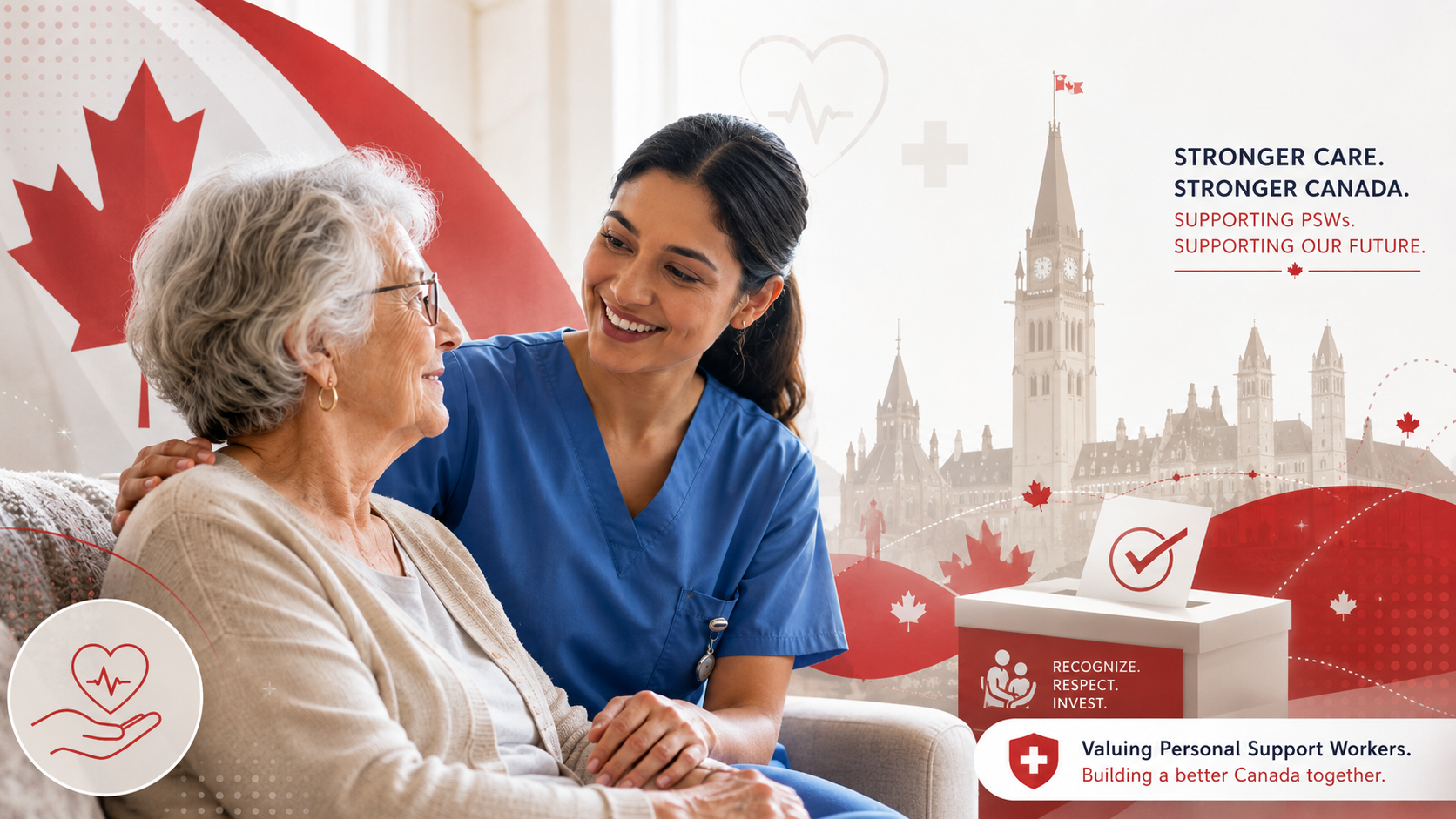
Why Canada’s Political Parties Are Paying More Attention to Personal Support Workers Ahead of Future Elections.
Personal Support Workers are becoming increasingly important in Canada’s political conversation.
For years, PSWs have worked quietly on the front lines of home care, long-term care, hospitals, retirement homes and community health services—helping seniors, people with disabilities and medically vulnerable Canadians with some of the most basic and essential activities of daily living.
But the political significance of this workforce is changing.
As Canada’s population ages, governments struggle with healthcare staffing, and more seniors express a desire to remain at home rather than move into institutions, the question of how Canada treats its Personal Support Workers is becoming difficult for political parties to ignore.
That may help explain why political organizations are increasingly interested in engaging healthcare workers and encouraging them to participate in political parties, advocacy and policy discussions.
The message is becoming clear:
PSWs are no longer simply healthcare workers at the edge of the system. They are becoming an increasingly important political constituency.
Canada Still Needs Personal Support Workers
The demand for frontline healthcare workers remains substantial.
Statistics Canada reported that Personal Support Workers, nurses and related occupations continue to account for a major share of vacancies in Canada's healthcare sector.
In 2024, the job-vacancy rate for PSWs was 6.7 per cent, compared with only 2.6 per cent in 2016. Nurses and PSWs together also accounted for almost 70 per cent of health-related job vacancies.
The situation has improved somewhat.
Statistics Canada reported that vacancies in healthcare occupations declined to about 62,700 during the first quarter of 2026.
However, there were still approximately 13,500 vacancies for nurse aides, orderlies and patient-service associates, while home-support workers and related occupations accounted for another 3,645 vacancies.
The numbers demonstrate why governments cannot easily solve healthcare problems without addressing the workers who provide direct personal care.
Politicians Are Beginning to Put PSWs Directly Into Policy
One of the clearest indications of the growing political importance of PSWs is the creation of policies specifically naming them.
The federal government has introduced a refundable Personal Support Workers Tax Credit.
Under the measure, eligible PSWs can receive a refundable tax credit equal to 5 per cent of eligible employment earnings, up to a maximum of $1,100 annually.
The credit applies for the 2026 through 2030 tax years.
Eligible workplaces include hospitals, nursing-care facilities, residential-care facilities, community-care facilities for seniors, home-healthcare establishments and similar regulated healthcare settings.
The first benefit related to the 2026 tax year would generally be received when eligible workers file their 2026 income-tax returns in 2027.
This is politically significant.
For years, healthcare policy debates frequently focused primarily on doctors, nurses, hospitals and hospital funding.
PSWs are increasingly being mentioned explicitly.
Ontario Is Also Spending More on Home and Community Care
Ontario provides another example.
The province's 2026 Budget announced an additional $1.1 billion over three years for home and community care, following another $1.1-billion investment announced previously.
The money supports services delivered by workers including nurses, therapists and Personal Support Workers.
Ontario also says it is continuing funding intended to ensure long-term-care residents receive an average of four hours of direct care each day from nurses and PSWs.
Some eligible PSWs and direct-support workers in provincially funded social-service settings also continue to receive a permanent $3-per-hour compensation enhancement.
Taken together, these policies show that governments understand something increasingly obvious:
Canada cannot improve seniors' care without improving the workforce that provides that care.
Opposition Parties Are Competing for Healthcare Workers Too
It is not only governments currently in power that are discussing PSWs.
During the 2025 federal election campaign, the Liberal platform proposed providing eligible Personal Support Workers with up to $1,100 annually through a refundable healthcare-worker tax credit.
The federal NDP went further in its campaign proposals, promising a $5,000 tax credit for nurses and Personal Support Workers, alongside policies aimed at healthcare-worker recruitment, staffing and working conditions.
The competing proposals illustrate an important political development.
Political parties increasingly recognize healthcare workers—including PSWs—as workers whose concerns can influence elections.
Why Political Parties Want Healthcare Workers Involved
There is nothing unusual about political parties recruiting people from particular professions.
Political parties routinely try to attract teachers, business owners, healthcare workers, tradespeople, students, immigrants, seniors and members of other communities.
People who work directly inside systems can provide perspectives politicians may not receive from senior administrators.
A PSW understands issues such as:
- inadequate travel time between home-care clients;
- unpaid or insufficiently compensated travel;
- unpredictable schedules;
- short visits that may not reflect a client's actual needs;
- physical demands and workplace injuries;
- staffing shortages;
- cancelled shifts;
- limited benefits for some part-time workers;
- wage differences between hospitals, long-term care, retirement homes and home care;
- violence or harassment from clients or family members;
- emotional exhaustion and burnout;
- limited career-progression opportunities.
These are not theoretical policy issues for frontline workers.
They are experienced during everyday shifts.
Having PSWs participate in political parties, professional associations, consultations, unions and community organizations can therefore give policymakers a more realistic understanding of frontline care.
But PSWs Should Not Give Political Support Blindly
Political attention can benefit workers, but it should also be approached carefully.
Being invited to join a political party does not automatically mean that the party will deliver policies benefiting PSWs.
Workers should examine specific proposals.
Rather than simply asking:
“Which party says it supports PSWs?”
A better question may be:
“What exactly will this party change for PSWs?”
For example:
Will wages increase?
Will travel between clients be properly compensated?
Will PSWs receive better health and retirement benefits?
Will guaranteed hours become more common?
Will home-care workers receive adequate time with clients?
Will there be stronger protections against workplace violence?
Will training and certification become more standardized?
Will experienced PSWs have clearer pathways to become practical nurses, registered nurses or other healthcare professionals?
Will internationally educated healthcare professionals be able to use their previous qualifications more efficiently?
These are measurable questions.
PSWs Could Become an Important Voting Bloc
Canada has hundreds of thousands of workers performing PSW, nursing-assistant, health-care-aide, caregiver and home-support roles.
Their influence extends much further than the workers themselves.
Every PSW belongs to a family.
They interact with seniors.
They speak with patients.
They communicate with family caregivers.
They work alongside nurses and other healthcare professionals.
That creates a much larger community of Canadians who understand the pressures facing frontline care.
Healthcare workers therefore represent not merely an employment group but potentially an increasingly influential electoral constituency.
Political parties understand this.
An Aging Canada Makes the Issue Even Bigger
This debate will only become more important as Canada grows older.
An aging population means increasing demand for:
home care,
long-term care,
dementia support,
mobility assistance,
palliative care,
medication assistance,
personal hygiene support,
meal preparation,
companionship,
and help with everyday activities.
Technology may improve healthcare delivery.
Hospitals may become more efficient.
Artificial intelligence may assist clinicians.
But someone will still have to help an elderly person get out of bed.
Someone will still assist with bathing.
Someone will still help a person living with dementia eat safely.
Someone will still observe changes in a client's condition.
Very often, that person will be a Personal Support Worker.
Recognition Must Go Beyond Election Campaigns
During the COVID-19 pandemic, politicians frequently described frontline healthcare workers as heroes.
That recognition was appreciated.
But applause cannot substitute for sustainable workforce policy.
The next phase must involve addressing compensation, working conditions, retention, training and career development.
Recent federal and provincial policies suggest that governments have started responding.
But PSWs should continue asking whether those measures are enough.
A temporary tax credit can help.
A wage enhancement can help.
Additional home-care funding can help.
But Canada's larger challenge is creating a system where Personal Support Workers see frontline care as a sustainable long-term career rather than employment they eventually need to leave because of low compensation, physical exhaustion or unstable schedules.
PSWs Should Participate in the Conversation
There is nothing inherently wrong with healthcare workers joining political parties.
Democracy works better when people affected by government decisions participate in making those decisions.
But involvement does not necessarily mean unquestioning loyalty.
A PSW can belong to a political party and still challenge its policies.
A healthcare worker can meet politicians and still demand accountability.
And PSWs do not necessarily need party membership to influence public policy.
They can participate through unions, professional organizations, advocacy groups, community meetings, consultations, petitions and elections.
What matters is that their voices are heard.
The Bigger Question
The growing political interest in Personal Support Workers should ultimately be viewed as an opportunity.
For too long, many of the people providing Canada's most intimate and essential forms of healthcare have received less public attention than the importance of their work deserves.
That is gradually changing.
The question for PSWs should therefore not simply be:
“Which political party should we join?”
Perhaps the more important question is:
“Which policies will genuinely improve the lives of Personal Support Workers—and which political leaders are prepared to implement them?”
Political parties may increasingly seek the support of PSWs.
PSWs, in return, should use that growing political attention to demand something meaningful:
Better wages. Better working conditions. Greater professional recognition. Stronger career pathways. And ultimately, better care for the Canadians who depend on them.
That would transform political attention into genuine progress.
BabaCares — Health, Wellness & Social Issues









Comments