

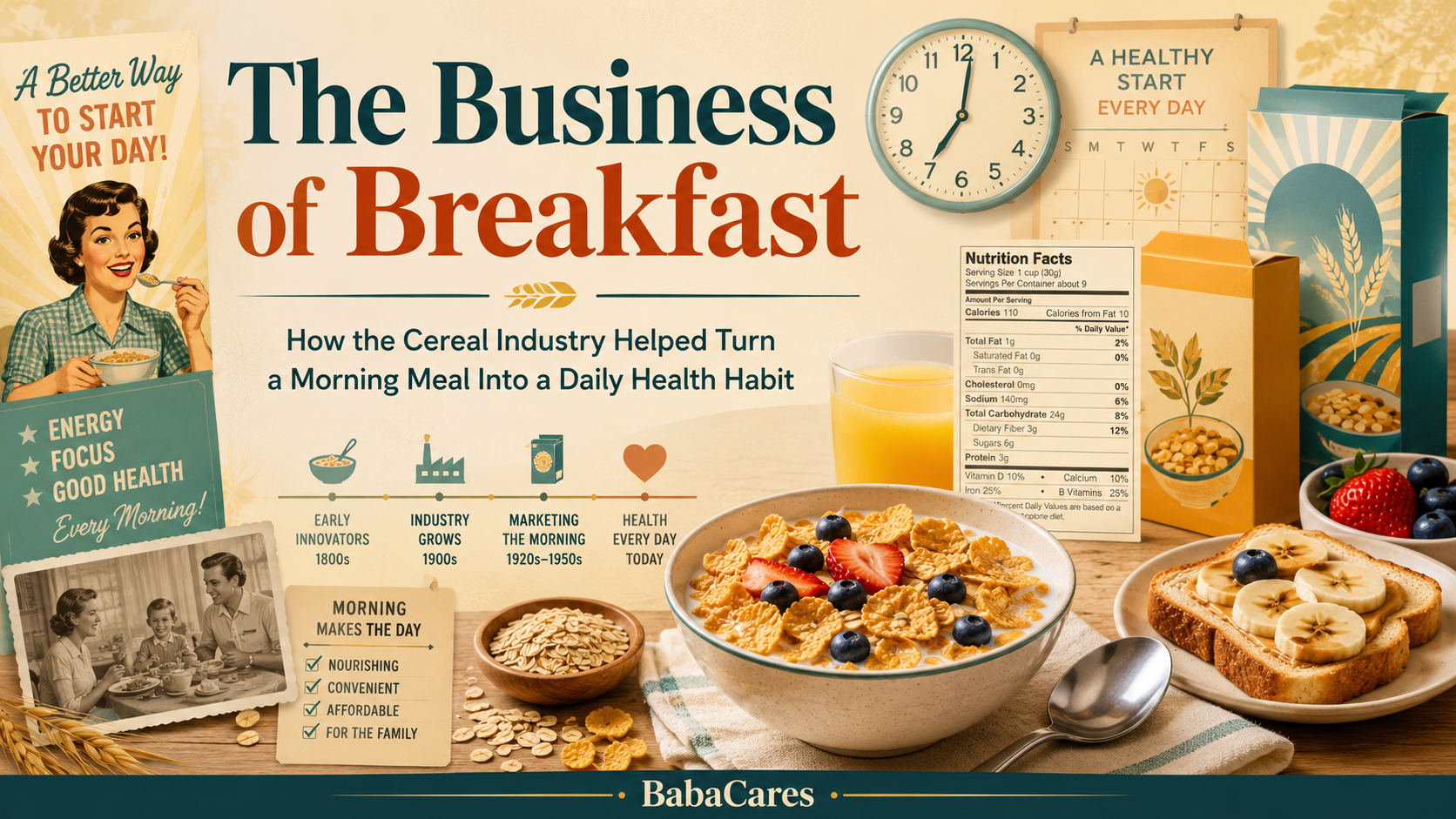
The Business of Breakfast: How the Cereal Industry Helped Turn a Morning Meal Into a Daily Health Habit.
For generations, many of us have heard the same message:
“Breakfast is the most important meal of the day.”
It sounds like timeless health advice.
But how much of that belief came from nutrition science—and how much came from marketing?
The answer is more complicated than many people realize.
Breakfast itself is ancient. People have eaten morning meals for centuries. The cereal industry did not invent breakfast.
What cereal manufacturers did extraordinarily well, however, was help transform breakfast into a highly marketed daily ritual—one increasingly associated with health, productivity, responsibility, childhood development and a successful start to the day.
And at the centre of that transformation was the breakfast cereal.
How Modern Breakfast Cereal Began
Modern ready-to-eat cereal emerged in the United States toward the end of the nineteenth century.
One of its most important origins was Battle Creek, Michigan, where physician John Harvey Kellogg operated the Battle Creek Sanitarium.
Kellogg advocated a relatively plain, grain-based diet and developed cereal products as alternatives to the heavy breakfasts common at the time.
His brother, Will Keith Kellogg, saw the commercial possibilities.
Corn flakes eventually became a mass-market product, while competitors such as C.W. Post also entered the rapidly expanding cereal business.
As cities grew and working life became faster, boxed cereal had an enormous advantage:
It was convenient.
No frying.
No lengthy preparation.
Pour it into a bowl, add milk, and breakfast was ready.
By the early twentieth century, cereal had become part of a changing American breakfast culture.
Did the Cereal Industry Invent “Breakfast Is the Most Important Meal of the Day”?
Not exactly.
The popular internet claim that a cereal company simply invented the phrase in a single advertising campaign is too simplistic.
Historical evidence shows variations of the phrase “breakfast is the most important meal of the day” were already being used before the famous cereal campaigns of the 1940s.
For example, an advertisement for Shredded Wheat used the phrase in 1922.
So cereal companies did not create the idea from nothing.
What they did was amplify it enormously.
As cereal manufacturers competed for consumers, breakfast became a natural marketing battleground.
If companies could convince families that breakfast was essential, then a product designed specifically for breakfast gained enormous commercial value.
Over decades, the association between cereal, breakfast and health became deeply embedded in consumer culture.
Selling More Than Cereal
Cereal companies were not simply selling flakes of grain.
They were selling an idea:
A good day starts with breakfast.
Advertising increasingly linked breakfast with:
- energy;
- concentration;
- school performance;
- workplace productivity;
- good parenting;
- nutrition; and
- healthy living.
Kellogg itself has described its historic philosophy as emphasizing diet and the importance of breakfast, while the company began placing nutrition information and messages on cereal packages decades ago.
This was highly effective branding.
Breakfast gradually became more than a meal.
For many families, skipping breakfast came to feel almost irresponsible.
Then Sugar Entered the Bowl
Early cereals were often relatively plain.
That changed as manufacturers discovered that sweeter cereals were particularly attractive to children.
Pre-sweetened cereals expanded dramatically during the twentieth century, alongside television advertising.
Bright boxes, cartoon characters, mascots, prizes and catchy slogans turned breakfast into entertainment.
Characters such as Tony the Tiger helped cereal brands become deeply embedded in childhood culture.
The formula was powerful:
Children wanted the cereal.
Children influenced parents.
Parents bought the cereal.
Advertising increasingly portrayed cereal as part of an enjoyable—and often supposedly healthy—morning routine.
But some products marketed to children contained substantial amounts of sugar.
That contradiction remains one of the most important public-health questions surrounding breakfast cereals.
What Research Shows About Children's Cereals
Canadian researchers examined 262 breakfast cereals sold in major supermarkets in Ottawa and Gatineau.
They found that cereals targeted toward children were:
- higher in sugar;
- higher in sodium;
- lower in fibre;
- lower in protein; and
- about three times more likely to be classified as less healthy than cereals not targeted toward children.
Sugar was the second ingredient in 75% of the child-targeted cereals studied.
The researchers concluded that stronger restrictions on marketing unhealthy foods to children were needed.
Another study examining cereal advertising found that 87% of cereal advertisements viewed by children promoted high-sugar cereals.
Researchers also found that high-sugar cereal advertising frequently combined health-related messages with entertainment and fantasy-oriented claims.
This reflects a broader problem.
The World Health Organization says food advertising influences children's food preferences, purchasing requests and eating behaviour, with much of the marketing aimed at children promoting products high in sugars, fats or salt.
The “Complete Breakfast” Strategy
Many people will remember cereal commercials ending with a carefully arranged table containing:
- a bowl of cereal;
- milk;
- orange juice;
- toast;
- and perhaps fruit.
The cereal would be described as “part of a complete breakfast.”
That phrase was clever.
The entire meal created a healthy-looking environment around the cereal.
Nutritionally, however, the fruits, milk and other foods in the picture were often contributing much of the nutritional diversity.
Yet cereal remained the branded product at the centre of the advertisement.
Over time, these images helped reinforce the idea that packaged breakfast cereal belonged naturally in a healthy household.
Was Breakfast “Enforced” on Society?
Not enforced in the legal sense.
Nobody passed a law requiring everyone to eat corn flakes at 7:30 every morning.
But there was a kind of cultural enforcement.
Advertising, schools, health messaging, television, family routines and workplace culture all helped normalize the idea that a respectable morning should include breakfast.
Cereal manufacturers were major beneficiaries of this cultural expectation.
There is even evidence of companies deliberately trying to expand cereal breakfast habits among populations whose traditional breakfast foods were different.
For example, in 2012 Kellogg Canada launched a campaign aimed specifically at Chinese Canadians promoting the nutritional benefits and convenience of a cereal breakfast.
This demonstrates how food culture can be influenced by commercial messaging.
But Is Breakfast Really the Most Important Meal?
This is where modern nutrition science becomes interesting.
Breakfast can certainly be nutritious.
A meal containing foods such as:
- oats;
- eggs;
- whole grains;
- vegetables;
- fruit;
- yoghurt;
- nuts;
- seeds;
- beans; or
- other minimally processed foods
can provide protein, fibre, vitamins, minerals and useful energy.
But the scientific evidence does not support the simplistic idea that every adult must eat breakfast to remain healthy or lose weight.
A systematic review and meta-analysis published in The BMJ examined randomized trials comparing adults who ate breakfast with those who skipped it.
The researchers found no convincing evidence that eating breakfast itself promoted weight loss.
In the included studies, people assigned to eat breakfast actually consumed more total daily calories on average, although the researchers cautioned that the trials were generally short and of limited quality.
Their conclusion was not that breakfast is unhealthy.
Rather, it was that telling everyone to eat breakfast specifically for weight loss is not supported by strong evidence.
Breakfast Is Not One Food
Another problem with calling breakfast universally healthy is that breakfast can mean almost anything.
Compare:
Breakfast A:
Oatmeal, berries, nuts and plain yoghurt.
With:
Breakfast B:
A bowl of highly sweetened cereal, sweetened juice and a pastry.
Both are technically breakfast.
Their nutritional profiles are very different.
So the better question is not simply:
“Did you eat breakfast?”
It is:
“What did you eat?”
The Real Health Lesson
The cereal industry's history teaches us something larger about nutrition.
Foods are not marketed only through taste.
They are marketed through ideas.
Energy.
Happiness.
Family.
Success.
Health.
Convenience.
Childhood memories.
When these ideas are repeated often enough, commercial messages can begin to feel like nutritional facts.
That does not mean cereal is automatically unhealthy.
Many cereals can provide whole grains, fibre, vitamins and minerals.
But consumers should read labels rather than relying on front-of-package health messages.
Consider:
- added sugar;
- fibre;
- protein;
- sodium;
- serving size;
- ingredients; and
- how processed the product is.
Children Remain Particularly Vulnerable
Food marketing to children continues well beyond television.
Children now encounter advertising through:
- YouTube;
- social media;
- gaming;
- influencers;
- websites;
- product packaging;
- sponsorships; and
- digital entertainment.
Health Canada reports that sugary cereals remain among the food categories commonly advertised to Canadian children and teenagers.
WHO continues to encourage stronger policies limiting children's exposure to marketing for foods high in sugar, salt and unhealthy fats.
The cereal story therefore remains relevant even in the age of TikTok and Instagram.
The advertising medium has changed.
The psychology has not.
So Should You Eat Breakfast?
If you enjoy breakfast and it helps you feel energetic, focused and satisfied, there is no reason to stop.
Choose nutritious foods whenever possible.
If you are not hungry first thing in the morning, however, the evidence does not support panicking simply because someone once told you that missing breakfast automatically damages your health.
Individual needs differ.
Children, older adults, people taking certain medications and individuals living with conditions such as diabetes may have specific nutritional requirements and should follow appropriate professional guidance.
The broader diet matters more than one slogan.
The BabaCares Takeaway
The cereal industry did not invent breakfast.
Nor did it single-handedly invent the belief that breakfast matters.
But cereal manufacturers played an enormous role in commercializing, popularizing and reinforcing the modern breakfast culture.
They successfully connected breakfast with health, convenience, family life and productivity—and then positioned cereal at the centre of that morning ritual.
That is one of the great marketing achievements of the modern food industry.
The lesson for consumers today is simple:
Do not allow advertising alone to define what “healthy” means.
Breakfast can be excellent.
Cereal can be nutritious.
Skipping breakfast may also be perfectly reasonable for some adults.
What matters most is the overall quality of your diet, your health needs and the foods you choose—not a slogan printed on a cereal box.
BabaCares — promoting informed conversations about health, healthy ageing and wellbeing.
References
- History. Cereal: The Accidental Invention That Changed American Breakfast. Updated August 2025.
- Potvin Kent M, Cameron C, Philippe S. The Healthfulness and Prominence of Sugar in Child-Targeted Breakfast Cereals in Canada. Health Promotion and Chronic Disease Prevention in Canada. 2017.
- Harris JL et al. Sugar as Part of a Balanced Breakfast? What Cereal Advertisements Teach Children About Healthy Eating. Journal of Health Communication. 2013.
- World Health Organization. Protecting Children From the Harmful Effects of Food and Drink Marketing.
- World Health Organization. Reducing the Impact of Marketing of Foods and Non-Alcoholic Beverages on Children.
- Sievert K et al. Effect of Breakfast on Weight and Energy Intake: Systematic Review and Meta-analysis of Randomised Controlled Trials. BMJ. 2019;364.
- Health Canada. Food and Beverage Advertising to Children and Teens in Canada.
- Kellogg Canada. From the Congee Bowl to the Cereal Bowl. 2012.
- Kellogg's. Food and Nutritional Heritage.











Comments