

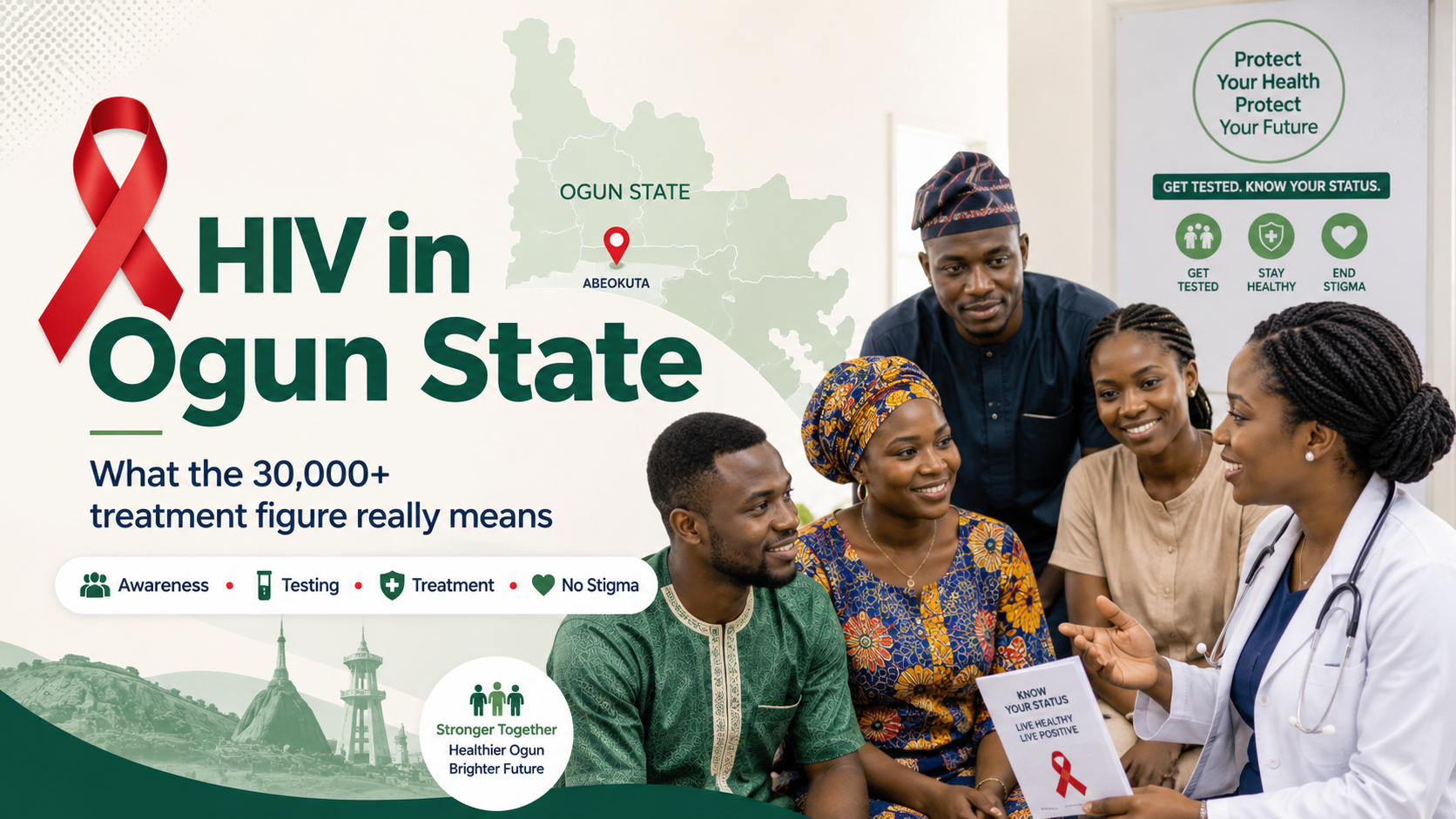
Is HIV Increasing in Abeokuta? The Truth About 30,000 People Receiving HIV Treatment in Ogun State.
Reports about HIV in Abeokuta and other parts of Ogun State have recently generated concern, with some people claiming that HIV is “trending” in the state capital and that more than 30,000 people are currently in hospitals receiving treatment.
The actual situation deserves careful explanation.
More than 30,000 people living with HIV in Ogun State are currently receiving free antiretroviral therapy, counselling and support services, according to information released by the Ogun State Government.
This does not mean that 30,000 people are hospitalized in Abeokuta.
It also does not necessarily mean that Ogun State has suddenly recorded 30,000 new HIV infections.
Rather, the figure represents people already diagnosed with HIV who are accessing treatment through health facilities across the state.
The announcement was made by Ogun State Governor Dapo Abiodun in Abeokuta on June 18, 2026, during the commissioning of the Pharma-Grade Warehouse of the Ogun State Drugs and Health Commodities Management Agency.
Why the 30,000 Figure Matters
According to the state government, more than 30,000 Ogun State residents living with HIV are receiving free:
- antiretroviral therapy
- HIV counselling
- medical monitoring
- treatment support services
These services are being delivered through health facilities across Ogun State's 20 local government areas.
The figure therefore tells us two important things.
First, HIV remains an important public health issue in Ogun State.
Second, thousands of people who have been diagnosed are successfully being connected to treatment.
That second point is extremely important because HIV today is very different from the disease that created widespread fear several decades ago.
HIV Is Treatable
There is presently no widely available cure for HIV, but modern antiretroviral therapy can control the virus extremely effectively.
When treatment is taken consistently, antiretroviral medicines reduce the amount of HIV in the blood, known as the viral load.
With effective treatment, many people living with HIV can live long, healthy and productive lives.
Treatment can also reduce the amount of virus to an undetectable level.
When someone living with HIV maintains an undetectable viral load through effective treatment, they do not sexually transmit HIV to their partners.
This principle is commonly described as:
U = U — Undetectable = Untransmittable.
This is one reason why encouraging people to test, begin treatment early and remain on medication is so important.
Is HIV Really Increasing in Abeokuta?
At the moment, the available reports do not establish that Abeokuta itself is experiencing a sudden HIV outbreak.
The widely reported 30,000-plus figure applies to Ogun State as a whole, rather than Abeokuta alone.
The announcement happened in Abeokuta because the governor was speaking at a state government health event there.
It would therefore be misleading to interpret the figure as saying that 30,000 people in Abeokuta have recently contracted HIV.
Nevertheless, the number should remind residents that HIV has not disappeared.
Prevention, testing and treatment remain essential.
What Previous Ogun State Figures Show
The 30,000 figure is also not entirely new.
In November 2024, Ogun State Commissioner for Health, Dr Tomi Coker, reported that approximately 30,350 people were receiving HIV treatment in the state.
At the state's 2025 World AIDS Day activities, officials again reported that more than 30,000 people were receiving free antiretroviral therapy.
The state also reported that approximately 96% of people living with HIV knew their status, while efforts were continuing to increase treatment coverage and achieve global HIV-control targets.
This suggests that the latest announcement is largely about the number of people currently accessing care rather than evidence of 30,000 newly infected residents.
Ogun State's HIV Prevalence
The Nigeria HIV/AIDS Indicator and Impact Survey reported an HIV prevalence of approximately 1.6% among adults aged 15–64 in Ogun State.
That survey placed Ogun among the states with the higher estimated prevalence in Nigeria's South-West geopolitical zone at the time.
However, prevalence should not be confused with new infections.
Prevalence refers broadly to how many people in a population are living with a condition, while incidence refers to new infections occurring over a particular period.
Therefore, seeing thousands of people on treatment does not automatically mean HIV infections are suddenly increasing.
Why Everyone Should Know Their HIV Status
One of the greatest challenges with HIV is that someone can live with the virus for years without obvious symptoms.
You cannot determine whether someone has HIV by:
- appearance
- body size
- occupation
- social status
- education
- marital status
The only reliable way to know is through an HIV test.
Knowing your status allows treatment to begin early when necessary and helps prevent further transmission.
Testing should always be confidential, voluntary and accompanied by appropriate counselling and connection to treatment services.
How HIV Is Transmitted
HIV can be transmitted through certain body fluids, particularly through:
- unprotected sexual intercourse with a person who has transmissible HIV
- sharing contaminated needles or syringes
- exposure to contaminated blood
- transmission from mother to child during pregnancy, childbirth or breastfeeding when effective preventive treatment is not provided
HIV is not transmitted through ordinary social contact.
You cannot contract HIV from:
- shaking hands
- hugging
- sharing food
- sitting beside someone
- using the same toilet
- coughing or sneezing
- casual workplace contact
Understanding these facts is critical to reducing stigma against people living with HIV.
Prevention Still Matters
Although treatment has transformed HIV from what was once frequently a fatal disease into a manageable chronic condition for many people, prevention remains essential.
People can reduce their risk by:
- knowing their HIV status
- practicing safer sex
- using condoms correctly and consistently where appropriate
- avoiding sharing needles and sharp instruments
- ensuring blood used for transfusion is properly screened
- accessing HIV prevention services when at increased risk
- obtaining appropriate medical care during pregnancy to prevent mother-to-child transmission
Nigeria has also continued expanding access to newer HIV prevention strategies for people at increased risk.
We Must Avoid Stigmatising People Living With HIV
The disclosure that more than 30,000 Ogun residents are receiving treatment should not become an excuse to stigmatise people.
In fact, people receiving treatment are doing exactly what public health professionals want them to do.
They have been tested.
They know their status.
They are connected to healthcare.
They are receiving medication.
And many who maintain successful treatment can achieve viral suppression and live normal, productive lives.
Stigma does the opposite.
It discourages people from getting tested and can cause individuals to hide their status or avoid treatment.
The conversation should therefore be based on education rather than fear.
A Message to Residents of Abeokuta and Ogun State
If the recent discussions about HIV have caused concern, the appropriate response is not panic.
It is awareness.
It is also an opportunity to ask ourselves important questions:
Do I know my HIV status?
When did I last test?
Do I understand how HIV is transmitted?
Am I protecting myself and others?
Am I contributing to stigma against people living with HIV?
The fact that more than 30,000 people are receiving treatment demonstrates both the continuing presence of HIV and the progress being made in connecting people with life-saving healthcare.
The message should therefore be clear:
Get informed. Get tested. Protect yourself. And never stigmatise someone because they are living with HIV.
HIV is still a serious public health concern, but with early diagnosis, effective treatment and responsible prevention, people living with the virus can live long and healthy lives.
References
- News Agency of Nigeria. 30,000 Ogun Residents Receive Free HIV Treatment — Gov. Abiodun. June 18, 2026.
- The Guardian Nigeria. 30,000 Residents on Free HIV Care in Ogun, Says Abiodun. June 19, 2026.
- Punch Newspapers. 96% of People Living With HIV/AIDS in Ogun Know Their Status — Commissioner. November 25, 2025.
- Punch Newspapers. 30,350 Receiving HIV/AIDS Treatment in Ogun — Commissioner. November 25, 2024.
- National Agency for the Control of AIDS. Nigeria HIV/AIDS Indicator and Impact Survey — South-West Zone Fact Sheet.
- World Health Organization. HIV and AIDS: Questions and Answers.
- World Health Organization. HIV — Overview, Prevention, Diagnosis and Treatment.
BabaCares — promoting informed conversations about health, healthy ageing and wellbeing.







Comments