

“DON’T TRY IT — OLD AGE IS NOT A GOOD IDEA”: A Caregiver’s Reflection on Ageing, Health, Dignity and Preparation
By Babajide Moronfolu
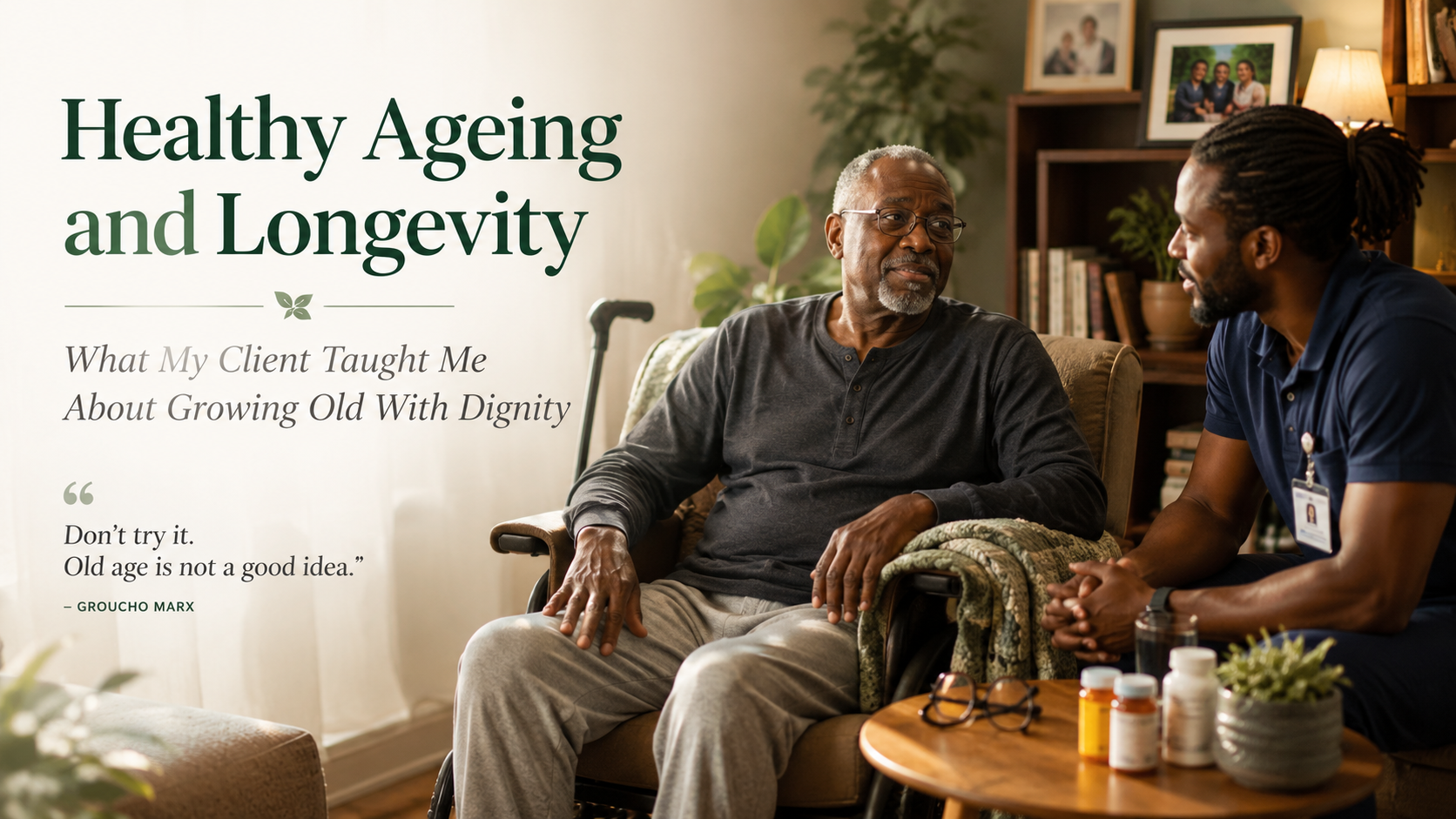
Every now and then, one of my clients says something that makes me laugh, but also leaves me thinking deeply long after the moment has passed.
He looks at me and says:
“Don’t try it. Old age is not a good idea.”
He says it with humour, but behind those words is the experience of someone who has lived through serious health challenges.
My client is an older adult living with the effects of a spinal injury and stroke. As a result, some of the activities many younger and healthier people perform without thinking can become difficult, exhausting or impossible without assistance.
Getting out of bed.
Walking from one room to another.
Taking a bath.
Putting on clothes.
Preparing food.
Going outside.
Reaching for something.
Turning comfortably in bed.
Standing up from a chair.
These are ordinary activities when the body is strong and functioning well.
But when illness, injury or ageing begins to affect mobility and independence, ordinary activities can suddenly become major achievements.
So whenever he tells me, “Don’t try it,” I smile.
Of course, none of us can truly follow that advice.
If we are fortunate enough to live long, ageing is inevitable.
But I believe there is a deeper message hidden in his words:
Do not wait until old age arrives before you begin preparing for it.
We Pray for Long Life, But Do We Prepare for It?
In many cultures, especially within African communities, long life is one of our greatest prayers.
We say:
“May you live long.”
“Long life and prosperity.”
“May you live to see your children’s children.”
These are beautiful prayers.
But perhaps we should add something more.
May we live long in good health.
May we retain our mobility.
May our minds remain active.
May we continue making decisions for ourselves.
May we remain connected to people who love and value us.
May we have enough financial resources to meet our needs.
May we continue to have purpose.
And if a time comes when we need assistance, may we receive that help with dignity.
There is an important difference between living long and living well for a long time.
Longevity is not simply about adding years to life.
It is also about adding life, meaning, dignity and function to those years.
Healthy Ageing Is More Than Being Free From Disease
Healthy ageing does not mean that an older person must have no medical conditions.
Many people live with hypertension, arthritis, diabetes, heart disease, mobility limitations and other chronic conditions while still enjoying meaningful and fulfilling lives.
Healthy ageing is also about maintaining the ability to do the things that matter.
Can you move?
Can you communicate?
Can you participate in family and community life?
Can you make decisions?
Can you maintain meaningful relationships?
Can you continue doing something that gives you purpose?
These questions become increasingly important as we grow older.
The goal should therefore not be to fear ageing.
The goal should be to age as well as possible while preparing realistically for the changes that may come with time.
Independence Is a Gift We Rarely Appreciate
One of the greatest lessons caregiving has taught me is how precious independence really is.
Most of us do not think about independence while we still have it.
You wake up in the morning and get out of bed.
You go to the bathroom.
You take your shower.
You choose what clothes to wear.
You prepare your food.
You walk outside.
You drive your car.
You go shopping.
You visit friends.
You decide when you want to sleep.
You turn over in bed when you become uncomfortable.
You put on your own shoes.
These things appear normal because we can do them.
But imagine suddenly needing another person to assist you with some of these activities.
That experience can be emotionally difficult.
Someone who was once completely independent may begin to rely on another person for bathing, dressing, mobility, meal preparation or medication reminders.
This is why functional independence should be regarded as one of the great blessings of life.
We should protect it for as long as possible.
Old Age Is Not a Disease
It is also important to make something very clear.
Old age itself is not a disease.
There are people in their seventies, eighties and nineties who remain physically active, mentally alert, socially engaged and deeply involved in their communities.
Likewise, there are younger people living with serious disability and chronic illness.
Ageing affects people differently.
Genetics plays a role.
Lifestyle plays a role.
Environment matters.
Income matters.
Healthcare access matters.
Social support matters.
Accidents happen.
Illnesses occur.
Some conditions develop even when a person has lived carefully.
Therefore, conversations about healthy ageing should never become opportunities to blame people for becoming ill.
Rather, we should encourage people to protect the health and abilities they have today while building compassionate communities for those who eventually need support.
Preparing for Old Age Must Be Holistic
Healthy ageing cannot be reduced to taking vitamins, going to the gym or eating vegetables.
Those things may be useful, but ageing well is much broader.
We need to think about the whole person.
That means caring for the:
- body,
- mind,
- emotional life,
- social relationships,
- finances,
- living environment,
- spirituality,
- and sense of purpose.
This holistic approach is one of the major themes I have explored in my own books on health, longevity and ageing.
In Ageless Living: Unlock the Secrets to Staying Young as You Grow, I emphasize the importance of maintaining vitality as we age by caring for the body, mind, habits, relationships and overall lifestyle.
In Do Not Grow Old Prematurely: Timeless Principles for Body, Mind, and Lifelong Vitality, I explore the idea that while chronological ageing cannot be stopped, some of the ways we experience ageing may be influenced by the choices we make throughout life.
The Yoruba-language book, MÁ KÚ L’ÉWE: Àṣírí Ìtọ́jú Ara, Ọkàn àti Ẹ̀mí Gígùn, carries a similar message from a culturally relevant perspective: longevity should involve caring for the body, mind and spirit rather than merely counting the number of years lived.
My experiences as a caregiver continue to reinforce these principles.
1. Take Care of the Body Before Crisis Comes
Many people begin thinking seriously about their health only after something goes wrong.
A heart attack occurs.
A stroke happens.
Blood pressure becomes dangerously high.
Diabetes develops complications.
Mobility begins to decline.
But prevention and early management matter.
Know your blood pressure.
Know your blood sugar.
Know your cholesterol.
Attend appropriate medical check-ups.
Take prescribed medications properly.
Avoid smoking.
Limit harmful alcohol consumption.
Eat nutritious foods.
Get adequate sleep.
Maintain a healthy body weight where possible.
And keep moving.
The body we depend upon at 70 or 80 is influenced by how we treat it during the decades before then.
Of course, healthy living cannot guarantee that illness will never happen.
But it can improve our chances of maintaining strength and function for longer.
2. Protect Your Mobility
Mobility is one of the foundations of independence.
When mobility decreases, many other parts of life can begin to change.
A person may become less physically active.
Muscles can weaken.
Confidence may decline.
Fear of falling may increase.
Social outings may reduce.
Eventually, someone's world may shrink from an entire community to a neighbourhood, then perhaps to a house or even a single room.
That is why strength, balance and flexibility matter.
Walking regularly, doing appropriate exercises and maintaining muscle strength can contribute greatly to independence later in life.
Fall prevention also becomes increasingly important.
Good lighting, safe footwear, removing tripping hazards, appropriate mobility aids and making the home safer can prevent serious injuries.
3. Protect Your Brain
We often talk about protecting the heart, but the brain deserves equal attention.
Keep learning.
Read books.
Write.
Have meaningful conversations.
Solve problems.
Learn new skills.
Use technology.
Play mentally stimulating games.
Learn another language if you can.
Stay curious.
Do not allow retirement from employment to become retirement from thinking.
A person can stop working professionally and still remain intellectually alive.
Mental stimulation, social interaction, adequate sleep, physical activity and good cardiovascular health are all important parts of protecting brain health as we age.
4. Do Not Retire From People
Loneliness is one of the less visible challenges of ageing.
As people grow older, many things can reduce their social circles.
Friends may die.
Spouses may pass away.
Children become busy with their own families.
Mobility may decline.
Driving may stop.
Retirement removes workplace interaction.
People may gradually become isolated.
Someone who once interacted with dozens of people each week may eventually spend long periods alone.
That is why relationships must be nurtured long before old age.
Call people.
Visit people.
Forgive where possible.
Join community groups.
Volunteer.
Participate in religious or cultural activities if they are meaningful to you.
Maintain friendships.
Build relationships across generations.
Sometimes one of the greatest gifts an older person can receive is simply having someone who genuinely wants to sit down, listen and talk.
5. Prepare Financially for Ageing
Many people plan financially for retirement without thinking enough about the possible cost of care.
Ageing can bring expenses that were never anticipated.
Medication.
Transportation.
Mobility equipment.
Home modifications.
Personal support.
Home care.
Assistive devices.
Long-term care.
Dental needs.
Vision care.
Hearing aids.
Depending on the country and healthcare system, some services may be publicly funded while others may require personal or family resources.
Therefore, retirement planning should ask more than:
“How much money will I need when I stop working?”
It should also ask:
“If I eventually need help with everyday activities, how will that care be provided?”
Families should have these conversations early.
Planning before a crisis gives people more options.
6. Make Your Home Suitable for the Older Version of Yourself
Sometimes disability is made worse by an environment that was never designed for changing physical abilities.
A house filled with stairs may become difficult after a stroke.
A bathtub may become dangerous when balance declines.
Poor lighting increases fall risks.
Narrow spaces may make it difficult to use a walker or wheelchair.
Therefore, we should ask ourselves:
Can this home accommodate me if my mobility changes?
Could grab bars be installed in the bathroom?
Can essential rooms be accessed without climbing stairs?
Is the environment safe?
Could a walker or wheelchair move through the space?
Are healthcare facilities and transportation reasonably accessible?
A home should ideally grow older with its occupants.
7. Mental and Emotional Health Must Not Be Ignored
Physical decline can affect emotional wellbeing.
Imagine being someone who once worked, travelled, drove, raised children and made important decisions.
Then one day, you need another person to help you take a bath.
That transition can be painful.
There may be frustration.
Embarrassment.
Anger.
Sadness.
Fear.
Grief.
Loneliness.
Depression.
Sometimes what families describe as “stubbornness” may actually be an older person's attempt to hold on to independence.
Sometimes refusing help may be an attempt to preserve control.
Sometimes anger may be grief in disguise.
We must learn to listen beyond behaviour.
There is often a story underneath it.
8. Dignity Must Remain at the Centre of Care
This is perhaps one of the most important lessons caregiving has taught me.
A person may need help bathing and still deserve privacy.
A person may need help walking and still deserve choice.
A person may speak slowly after a stroke and still have something important to say.
A person may need help eating and still deserve to choose what he or she wants to eat.
Physical dependence should never erase personhood.
We must avoid treating older adults like children simply because their bodies have become weaker.
Ask before doing things.
Explain what you are doing.
Give choices whenever possible.
Respect routines.
Encourage independence.
Listen to stories.
Be patient.
Sometimes excellent caregiving does not mean doing everything for a person.
It means helping that person continue doing as much as possible for themselves.
9. Purpose Does Not Have an Expiry Date
One of the greatest dangers of ageing is beginning to believe that life no longer has meaning.
Human beings need purpose at every stage of life.
For one person, purpose may come from grandchildren.
For another, faith.
For another, gardening.
Writing.
Mentoring.
Teaching.
Cooking.
Community service.
Business.
Music.
Travelling.
Volunteering.
Sharing wisdom.
Supporting younger people.
Older adults should never be treated as if they are simply waiting for life to end.
They are reservoirs of experience, memory, culture, knowledge and wisdom.
A society that ignores its older citizens loses an enormous amount of human capital.
10. Spiritual Wellbeing Also Matters
For many people, ageing raises deeper questions.
What has my life meant?
What legacy am I leaving?
What do I believe?
What gives me hope?
How do I understand suffering?
How do I face mortality?
Spiritual wellbeing may come through faith, prayer, meditation, reflection, community, gratitude or a personal philosophy of life.
For many older adults, spiritual connection becomes an important source of strength.
Healthy ageing therefore involves more than keeping the body alive.
It also involves nurturing the inner person.
Perhaps My Client Is Right — But Only Partly
Whenever my client tells me:
“Don’t try it. Old age is not a good idea,”
I understand him.
His experience has earned him the right to speak honestly about the frustrations that can accompany physical decline.
He knows what it feels like when the body no longer responds the way it once did.
He understands dependence from personal experience.
Yet I would respectfully disagree with one part of his conclusion.
Growing old is not necessarily the problem.
Growing old can actually be a privilege.
The challenge is that longer life can sometimes come with illness, disability, loneliness, dependence and loss.
Therefore, our goal should not be to fear old age.
Our goal should be to prepare for it.
To protect our health where possible.
To strengthen our relationships.
To plan financially.
To create safer living environments.
To preserve purpose.
To remain mentally engaged.
And to build communities that respect older adults even when they become dependent.
What Are You Doing for the Older Version of Yourself?
Whatever your age today, ask yourself a few important questions.
What am I doing for the person I may become at 70, 80 or 90?
Am I protecting my heart?
Am I keeping my body active?
Am I maintaining muscle strength?
Am I exercising my brain?
Am I nurturing relationships?
Am I saving for the future?
Am I preparing for possible care needs?
Am I building purpose beyond my occupation?
Am I creating a home and lifestyle that can accommodate changing physical abilities?
And perhaps most importantly:
Am I treating older people today the way I would want to be treated someday?
Because one day, if life grants us enough years, we may become the person sitting in that chair.
We may become the person walking slowly.
Someone may need to wait patiently while we finish a sentence.
Someone may have to help us put on our shoes.
Someone may have to prepare our meals.
Someone may have to assist us into the shower.
Someone may have to remind us about medication.
That possibility should not simply frighten us.
It should make us wiser.
It should make us more prepared.
And above all, it should make us more compassionate.
My client may continue smiling and telling me:
“Don’t try it. Old age is not a good idea.”
Perhaps my response should be:
We cannot avoid ageing if we are fortunate enough to live long. But we can prepare ourselves to age with better health, stronger relationships, financial preparedness, purpose, dignity and hope.
We may not be able to guarantee good health forever.
We cannot prevent every stroke.
We cannot prevent every accident.
We cannot control every disease.
We cannot stop time.
But there is something we can insist upon:
When good health can no longer be guaranteed, dignity should never be negotiable.
References and Further Reading
Moronfolu, Babajide. Ageless Living: Unlock the Secrets to Staying Young as You Grow.
A practical exploration of longevity, lifestyle, physical wellbeing, mental wellness and maintaining vitality throughout the ageing process.
Moronfolu, Babajide. Do Not Grow Old Prematurely: Timeless Principles for Body, Mind, and Lifelong Vitality.
Explores practical principles for maintaining physical health, mental wellbeing, healthy habits and purposeful living throughout life.
Moronfolu, Babajide. MÁ KÚ L’ÉWE: Àṣírí Ìtọ́jú Ara, Ọkàn àti Ẹ̀mí Gígùn.
A Yoruba-language exploration of caring for the body, mind and spirit while pursuing longevity, vitality and meaningful ageing.
World Health Organization. Healthy Ageing and Functional Ability.
WHO resources on maintaining the abilities that enable wellbeing and meaningful participation during later life.
World Health Organization. Decade of Healthy Ageing 2021–2030.
International guidance promoting environments, healthcare systems and communities that support older adults and preserve functional ability.
Centers for Disease Control and Prevention. Physical Activity for Older Adults.
Guidance concerning aerobic activity, muscle strengthening, balance and maintaining physical function during later life.
Centers for Disease Control and Prevention. Resources on older-adult fall prevention, healthy ageing and social connectedness.






Comments